



Bitcoin, the flagship cryptocurrency, is once again at a critical juncture, presenting prospective investors with a familiar dilemma: to buy or not to buy. At the time of writing, Bitcoin is trading around the $61.8k mark, a level that recently flirted with the significant long-term support of $60,000. This period of price consolidation and minor dips has ignited a debate among potential buyers, many of whom have been anticipating a more substantial bearish move to strategically enter the market. The core of this hesitation lies in a pervasive psychological barrier, a fear of buying too early and missing out on further price declines, a phenomenon that has repeatedly shaped entry points in the volatile digital asset landscape.
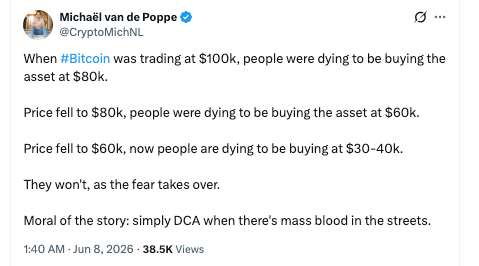
The current sentiment among many retail investors mirrors observations from past market cycles. A prominent crypto analyst, Michael Van de Poppe, highlighted this recurring pattern in a recent social media post. His commentary echoed sentiments heard approximately a year ago when Bitcoin was trading significantly higher, even surpassing the $100,000 resistance level. During that bull run, many who had missed the earlier gains expressed a strong desire to acquire Bitcoin should it pull back to around $80,000. Now, with prices considerably lower, the enthusiasm to buy remains subdued, as many continue to hold out for an even steeper drop, potentially to the $50,000 level or below. However, the inherent unpredictability of the market means there is no guarantee that such a significant decline will materialize, creating a state of indecision.
The Cycle of Missed Opportunities
This behavioral pattern is not unique to the current market conditions; it has been a recurring theme throughout Bitcoin’s history. In 2018, a period characterized by a substantial bear market, many investors who had vowed to purchase Bitcoin below the $10,000 mark found themselves hesitant even when the price plummeted to as low as $3,200. Similarly, during the 2022 bear market, a phase of widespread capitulation and significant price depreciation, strong long-term buying opportunities emerged. Yet, retail investor participation often waned during these "blood in the streets" moments.
In contrast, institutional investors and more seasoned market participants have frequently employed strategies like Dollar Cost Averaging (DCA). This disciplined approach involves investing a fixed amount of money at regular intervals, regardless of the asset’s price. DCA serves as a powerful tool to mitigate the impact of volatility. By consistently investing, investors can acquire more units of an asset when prices are low and fewer units when prices are high, effectively lowering their average cost basis over time. This strategy transforms market volatility from a potential threat into an advantage, enabling the accumulation of assets at more favorable average prices.
The rationale behind DCA’s efficacy in volatile markets like cryptocurrency is straightforward: pinpointing the exact bottom of a price decline is virtually impossible. Current price ranges for Bitcoin, fluctuating between $30,000 and $60,000, exemplify this uncertainty. As the market continues to experience price shifts, the perceived ideal entry point perpetually moves, contributing to investor confusion and paralysis. Therefore, maintaining investor discipline and adhering to a well-defined strategy are paramount to capitalizing on the potential benefits offered during bear markets.
Market Dynamics and Investor Psychology
The current price action of Bitcoin, hovering around $61.8k after a recent test of the $60k support, is a microcosm of broader market psychology in the cryptocurrency space. The $60,000 level has historically served as a significant psychological and technical barrier, and its recent vulnerability has amplified investor concerns. This particular price point has been a focal point for several reasons:

- Historical Significance: Bitcoin experienced significant price appreciation leading up to and during 2021, with the $60,000 mark acting as a crucial psychological threshold. Breaching and holding above this level was seen as a sign of strong bullish momentum. Conversely, falling below it can trigger fears of a deeper correction.
- Technical Indicator: For many technical analysts, $60,000 represents a key support or resistance level depending on market trends. Its retest and potential break can signal shifts in market sentiment and direction.
- Retail Investor Entry Points: Many retail investors, particularly those who entered the market during the 2021 bull run, may have set their target buy-in points around or below this level, anticipating a healthy pullback.
The "fear of missing out" (FOMO) and the "fear of buying the top" are potent psychological forces that constantly battle within investors. When prices are rapidly ascending, FOMO can drive premature entries. Conversely, during periods of decline, the fear of buying at a temporarily higher price, only to see it fall further, leads to the "never-buy-dip" mentality. This often results in investors waiting for what they perceive as the absolute lowest point, a target that is constantly redefined by market fluctuations.
The Role of Market Cycles and Data
Understanding Bitcoin’s historical market cycles is crucial to contextualizing the current situation. Bitcoin has historically followed a four-year cycle, often correlated with its halving events. The halving, which reduces the reward for mining new Bitcoin blocks, has historically preceded periods of significant price appreciation.
- 2012 Halving: Led to a bull run in 2013.
- 2016 Halving: Preceded the major bull run of 2017.
- 2020 Halving: Was followed by the massive bull run of 2021.
- 2024 Halving: Occurred in April 2024.
Following the 2024 halving, the market experienced a period of anticipation and some price appreciation, reaching new all-time highs. However, the subsequent consolidation and dips are not unusual in the aftermath of such significant events. The period after a halving can be characterized by volatility as the market digests the supply shock and speculative interest ebbs and flows.
Data from on-chain analytics firms can provide further insight into investor behavior. For instance, metrics such as the Net Unrealized Profit/Loss (NUPL) can indicate whether the market is in a state of euphoria or fear. During periods of high NUPL, investors are holding significant unrealized profits, often leading to profit-taking. Conversely, low NUPL, especially when it dips into negative territory, suggests that many investors are holding at a loss, which can signal a potential bottoming phase where capitulation is occurring. While specific current NUPL data would require real-time access, historical trends suggest that dips often coincide with periods of lower NUPL, presenting opportunities for those willing to buy during times of market stress.
Institutional Adoption and Regulatory Landscape
While retail psychology plays a significant role, the actions of institutional investors are also a critical factor shaping Bitcoin’s trajectory. The approval of spot Bitcoin Exchange-Traded Funds (ETFs) in the United States in January 2024 marked a watershed moment for institutional adoption. These ETFs have provided a regulated and accessible avenue for traditional investors to gain exposure to Bitcoin.
The inflows and outflows of these ETFs can serve as a proxy for institutional sentiment. Significant inflows into Bitcoin ETFs indicate sustained institutional interest and can provide a floor to price declines. Conversely, outflows can signal a shift in institutional sentiment or profit-taking. The ongoing performance of these ETFs and the broader regulatory environment surrounding digital assets continue to influence market dynamics.
The regulatory landscape, both in the US and globally, remains a key consideration. While the SEC’s approval of spot Bitcoin ETFs was a positive development, the broader regulatory framework for cryptocurrencies is still evolving. Uncertainty or adverse regulatory developments can introduce volatility and impact investor confidence. However, a clear and supportive regulatory environment could further bolster institutional adoption and long-term market stability.
The Psychology of "Never Buy Dip"
The "never-buy-dip" phenomenon is deeply rooted in the human tendency to avoid perceived immediate losses. In a market as volatile as cryptocurrency, where prices can swing dramatically, the fear of buying at a perceived peak, only to witness a sharp decline, is a powerful deterrent. This fear can be amplified by:
- Media Hype and Negative News: Sensationalized headlines about market crashes or regulatory crackdowns can heighten investor anxiety.
- Social Media Echo Chambers: Online communities can reinforce existing biases, with individuals seeking validation for their fears or convictions.
- Past Traumatic Experiences: Investors who have previously bought at a market top and experienced significant losses may become overly cautious.
The irony of the "never-buy-dip" strategy is that it often leads investors to miss out on the very opportunities that historically generate the most significant returns. The deepest troughs in the market, characterized by widespread fear and capitulation, have historically been the most opportune moments to accumulate assets at a discount. By waiting for an absolute, guaranteed bottom, investors often find themselves on the sidelines as the market begins its ascent.
Strategies for Navigating Volatility
For investors looking to overcome the psychological barriers and navigate the inherent volatility of the crypto market, several strategies can be employed:
- Dollar Cost Averaging (DCA): As previously discussed, this is a time-tested method for mitigating risk and accumulating assets over time. It removes the emotional burden of trying to time the market perfectly.
- Setting Clear Investment Goals and Risk Tolerance: Understanding one’s financial objectives and how much risk one is willing to take is crucial. This helps in making rational decisions rather than being driven by fear or greed.
- Diversification: While the article focuses on Bitcoin, a well-diversified portfolio across different asset classes can help manage overall risk. Within the crypto space, diversification across various reputable digital assets can also be considered.
- Informed Decision-Making: Staying informed about market trends, technological developments, and regulatory news from reliable sources is essential. However, it’s also important to filter out noise and avoid succumbing to FUD (Fear, Uncertainty, Doubt).
- Focusing on Long-Term Potential: Cryptocurrency, particularly Bitcoin, is still a relatively nascent asset class with significant long-term growth potential. Adopting a long-term investment horizon can help investors weather short-term volatility.
The Road Ahead
The current price action of Bitcoin around $61.8k, with its recent challenges to the $60,000 support, represents a critical juncture. The persistent "never-buy-dip" mentality among a segment of potential investors underscores the enduring power of fear and indecision in financial markets. While the allure of catching the absolute bottom is strong, historical data and market psychology suggest that disciplined, strategic accumulation, such as through DCA, is often a more effective approach to capitalizing on opportunities within volatile asset classes.
As the market continues to mature, with increasing institutional involvement and evolving regulatory frameworks, the dynamics of price discovery and investor behavior will undoubtedly continue to evolve. However, the fundamental human emotions that drive trading decisions—fear and greed—are likely to remain constant. For those looking to participate in the cryptocurrency market, understanding these psychological drivers and employing strategies that mitigate their impact will be key to navigating the inevitable cycles of opportunity and challenge. The question for many remains not if they should invest, but when and how, a decision that is continuously reshaped by the shifting sands of fear and market anticipation.














