The global cryptocurrency market is currently experiencing a significant liquidity drought, with trading volumes for major cryptocurrencies and altcoins plummeting to their lowest points in approximately two years. This sharp decline signifies a notable cooling in market participation, as traders increasingly adopt a cautious stance and retreat from active engagement. The prevailing macroeconomic uncertainty, coupled with escalating geopolitical tensions and the residual effects of recent market liquidations, are cited as primary drivers behind this widespread reluctance to engage with the market. Despite the bearish sentiment suggested by these low volumes, historical market cycles indicate that periods of extreme apathy have often served as precursors to some of the most robust recoveries in the cryptocurrency sector. Simultaneously, while speculative interest has diminished, metrics related to long-term adoption of blockchain technology remain resilient. Network data reveals a consistent rise in the total number of non-empty addresses across leading digital assets, suggesting a foundational growth in user adoption that transcends short-term market fluctuations. Ethereum, in particular, continues to demonstrate strength in user adoption, now boasting a record 195 million holders, despite recent price underperformance.
Macroeconomic Headwinds and Geopolitical Tensions Dampen Crypto Enthusiasm
The current downturn in cryptocurrency trading volumes is not an isolated event but rather a reflection of broader global economic anxieties. The United Kingdom’s recent confirmation of a deep recession, marked by a significant contraction in its Gross Domestic Product (GDP), serves as a potent symbol of the economic challenges confronting major global economies. This recessionary environment, characterized by reduced consumer spending, business investment, and overall economic activity, invariably impacts speculative asset classes like cryptocurrencies. Investors tend to shift towards safer assets during times of economic uncertainty, leading to a withdrawal of capital from riskier markets.
The ongoing geopolitical tensions, while not directly tied to the cryptocurrency market’s mechanics, contribute to a general climate of risk aversion. Such global instability can disrupt supply chains, influence energy prices, and create unpredictable shifts in financial markets, all of which can indirectly affect investor sentiment towards digital assets.
Furthermore, the lingering impact of recent liquidation events within the crypto space has instilled a sense of caution. Large-scale liquidations, often triggered by significant price drops or margin calls, can create cascading effects, leading to further price declines and eroding investor confidence. This has contributed to a more risk-averse trading environment, where traders are less inclined to deploy capital in high-volatility markets.
Santiment Data Reveals Two-Year Lows in Trading Volumes
On-chain analytics firm Santiment has provided crucial data illustrating the extent of the liquidity drought. Their analysis of the "trading volume" metric, which aggregates the total volume of tokens traded across centralized exchanges, shows a consistent downward trend since the sector’s peak in mid-2025. This sustained decline in trading activity is a significant indicator of reduced market participation.
Historically, high trading volumes are often associated with periods of intense market activity, price discovery, and speculative fervor. Conversely, a prolonged period of low trading volumes, as observed by Santiment, suggests that fewer participants are actively trading, and the overall market momentum has weakened. This can make it more challenging for prices to move significantly, as there is less capital to absorb buy or sell orders.
The data from Santiment underscores the current state of the cryptocurrency market, highlighting a period of subdued interest and cautious capital deployment. This situation is not unique to cryptocurrencies, as many traditional financial markets also experience periods of lower liquidity during times of economic uncertainty.
Historical Parallels: Apathy as a Precursor to Recovery
While the current low trading volumes paint a picture of market stagnation, seasoned market observers are drawing parallels with historical cryptocurrency cycles. A recurring pattern observed in past bull and bear markets is that periods of extreme investor apathy and low trading volumes have often preceded significant market recoveries.
During these "crypto winters," when interest wanes and media coverage declines, a core group of developers and long-term investors often continue to build and accumulate assets. This period of consolidation allows for the maturation of underlying technologies and the development of new use cases. As macroeconomic conditions improve or as new narratives gain traction, the market can experience a rapid resurgence, fueled by a renewed interest and a backlog of capital waiting to be deployed.

The current apathy could, therefore, be interpreted not solely as a sign of weakness but as a potential indicator of an impending phase of accumulation and development, which could pave the way for the next bull cycle. This perspective suggests that while short-term price action may be subdued, the underlying potential for growth remains.
Long-Term Adoption Metrics Show Resilience
Despite the prevailing bearish sentiment and reduced trading volumes, crucial metrics related to the long-term adoption of blockchain technology continue to exhibit strength. The steady increase in the total number of non-empty addresses across major cryptocurrencies signifies a growing user base that is actively holding and utilizing these digital assets. This indicates that the fundamental demand for blockchain technology and its applications is not diminishing, even if speculative trading activity has cooled.
Ethereum, the second-largest cryptocurrency by market capitalization, stands out in this regard. While its price has faced challenges, the network continues to see remarkable growth in its holder base. With a record 195 million holders, Ethereum demonstrates a robust and expanding ecosystem of users and developers. This widespread adoption is crucial for the long-term viability and success of any blockchain network, as it signifies a tangible utility and a community actively participating in its growth.
The resilience of these adoption metrics provides a counterpoint to the narrative of a dying market. It suggests that the underlying technology and its potential are still recognized and embraced by a significant number of individuals and institutions, even amidst prevailing market corrections.
Bitcoin and Ethereum Face Immediate Headwinds Despite Long-Term Potential
The current pricing of major cryptocurrencies reflects the investor nervousness prevalent in the current economic climate. Bitcoin, the market leader, is currently trading around $63,492, a price point that signifies a delicate balance between speculative fear and institutional ambition.
Bitcoin’s Current Price Dynamics:
- Speculative Fear: Concerns about the broader economic outlook, potential regulatory crackdowns, and the inherent volatility of Bitcoin contribute to speculative fear among some investors. This fear can lead to selling pressure, especially during periods of market uncertainty.
- Institutional Ambition: On the other hand, the increasing institutional adoption of Bitcoin, particularly through the approval of U.S. spot Bitcoin Exchange-Traded Funds (ETFs), provides a strong long-term bullish narrative. These ETFs offer a regulated avenue for institutional capital to enter the market, potentially driving significant demand.
- U.S. ARMA Act Potential: The potential passage of the U.S. ARMA Act, which could establish a sovereign Bitcoin reserve, represents a significant long-term bullish catalyst. Such legislation would signal a degree of government acceptance and could further legitimize Bitcoin as a store of value.
- Immediate Headwinds: Despite the long-term positive outlook, Bitcoin faces immediate challenges. Sustained outflows from U.S. spot Bitcoin ETFs have indicated a recent cooling of institutional interest, creating selling pressure. Additionally, existential concerns about the future vulnerabilities of Bitcoin’s cryptography to quantum computing, though a long-term threat, can influence sentiment and price action.
Ethereum’s Current Price Dynamics:
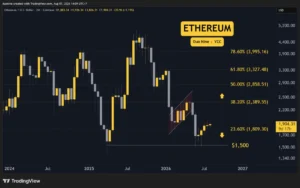
Ethereum is currently trading around $1,662.47, facing its own set of challenges.
- Ambitious Roadmap: Ethereum’s development team has laid out an ambitious roadmap for future upgrades, including further scaling solutions and enhanced functionalities. The successful execution of this roadmap is crucial for its long-term competitiveness and adoption.
- Regulatory Headwinds: The regulatory landscape surrounding Ethereum remains somewhat uncertain. The classification of Ether as a security by some regulatory bodies could create compliance challenges and deter institutional investment.
- Raoul Pal’s Optimism: Despite these challenges, prominent figures like Raoul Pal, founder of Global Macro Investor, remain optimistic. Pal characterizes the current market action as a typical "mid-cycle correction," drawing parallels to the patterns observed in 2020. He suggests that the liquidity cycle is still largely in play, positioning crypto favorably to benefit from potential rotations within the broader tech sector.
Broader Impact and Future Implications
The current market correction and liquidity drought have significant implications for the broader cryptocurrency ecosystem and its integration into the global financial system.
- Consolidation and Innovation: Periods of low market activity often lead to consolidation within the industry. Projects with weaker fundamentals or unsustainable business models may struggle to survive, while those with strong technology and clear use cases are likely to emerge stronger. This can foster an environment where genuine innovation is prioritized.
- Institutional Re-evaluation: While institutional interest has been a significant driver of recent market growth, current market conditions may prompt a more thorough re-evaluation of risk and reward. Institutions may become more selective in their investments, focusing on assets with demonstrable utility and robust underlying technology.
- Regulatory Clarity: The ongoing market fluctuations, coupled with the increasing integration of digital assets into mainstream finance, are likely to accelerate the push for regulatory clarity. Governments worldwide are grappling with how to regulate cryptocurrencies, and the current market environment may incentivize faster decision-making to protect investors and foster market stability.
- Technological Advancement: The resilience of adoption metrics, particularly for established networks like Ethereum, suggests that the underlying demand for blockchain technology remains strong. This period of correction could provide an opportunity for developers to focus on building and refining their products without the pressure of an overheated speculative market. The focus is likely to shift from short-term price gains to long-term value creation and real-world application.
In conclusion, the current cryptocurrency market is navigating a complex landscape characterized by macroeconomic headwinds, geopolitical uncertainty, and a notable liquidity drought. While trading volumes have receded to two-year lows, historical patterns suggest that such periods of apathy can be fertile ground for future recoveries. The resilience of long-term adoption metrics, particularly for Ethereum, offers a glimmer of optimism, indicating that the fundamental growth of the blockchain ecosystem continues. As Bitcoin and Ethereum face immediate challenges, the market awaits further developments, with many looking to historical precedents and the continued evolution of the underlying technology for signs of the next significant market upswing.