Bitcoin (BTC) has experienced a significant downturn, extending a period of heightened volatility and a shift towards a risk-off sentiment in the broader cryptocurrency market. Over the past seven days, the leading digital asset has shed approximately 6% of its value, resulting in an estimated $100 billion erosion of its total market capitalization. Prices have retreated from recent highs around the $78,000 mark to hover in the low $70,000s. This decline is attributed to a confluence of factors, including a slowdown in institutional accumulation, increased profit-taking, and a colossal off-exchange transaction involving a substantial Bitcoin Exchange Traded Fund (ETF) holding, which has amplified concerns about market risk aversion.
A Week of Volatility and Shifting Investor Behavior
The recent price action for Bitcoin paints a picture of a market grappling with shifting investor dynamics. After a period of sustained upward momentum, the cryptocurrency has entered a corrective phase, marked by increased selling pressure. Analysts at CryptoQuant have pointed to a noticeable deceleration in institutional inflows as a primary catalyst for this pullback. This suggests that the relentless buying spree from large financial entities, which had previously buoyed the market, may be moderating.
Compounding this, a wave of profit-taking has begun to surface. Notably, a significant sale of $2.5 million worth of Bitcoin was executed on May 30 by a previously dormant entity that had held its position for three years. This re-emergence of profit-taking, coupled with the slowdown in new institutional accumulation, has weakened the traditional "dip-buying" support that characterized earlier market phases. Consequently, the market has become more sensitive to sell-offs, leading to amplified short-term volatility.
The $1.26 Billion Transaction: A Catalyst for Concern
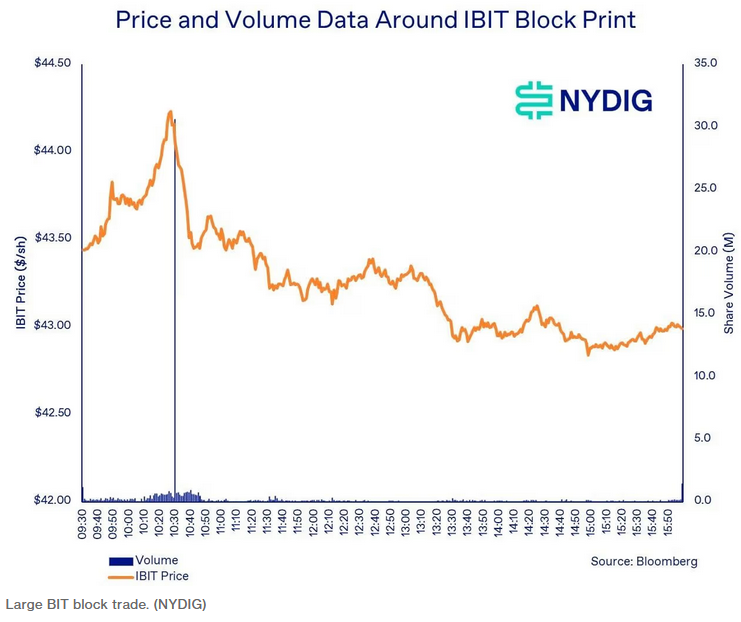
The sentiment in the cryptocurrency market took a further negative turn following reports of an exceptionally large institutional Bitcoin transaction. On May 26, a single counterparty executed the sale of 29.21 million shares of the iShares Bitcoin Trust (IBIT) in an off-exchange block trade. The transaction, valued at approximately $1.26 billion, occurred at a price of $43.16 per share. This information, detailed in research by NYDIG, has become a focal point for discussions surrounding the recent market weakness.

According to NYDIG’s analysis, the seller accepted a discount of $1.01 per share, representing a 2.3% reduction from the prevailing market price of $44.17. This effectively meant the seller paid an "urgency premium" of roughly $29.5 million to secure immediate liquidity for such a substantial block of shares. The structure and pricing of this trade strongly suggest a hurried exit rather than a meticulously planned unwinding of a hedged or arbitrage position.
Unpacking the Urgency: What the $1.26 Billion Trade Reveals
NYDIG’s research highlighted several key indicators pointing to the urgency of this massive transaction. The sheer scale of the block trade, the absence of corresponding activity in the CME Bitcoin futures market, and the significant discount accepted all collectively suggest that the seller’s paramount objective was speed. This implies that the investor prioritized liquidating their position rapidly over achieving the optimal market price.
The report further contextualized the trade by noting its occurrence during a period of market weakness. Spot Bitcoin ETFs had already been experiencing several consecutive days of outflows leading up to and on May 26, indicating a broader trend of capital withdrawal from these investment vehicles. This confluence of factors – large-scale selling pressure from an urgent seller and existing outflows from ETFs – contributed to the prevailing risk-off sentiment.
Analyst NicCrypto echoed this interpretation, observing that the trade’s architecture was indicative of an immediate need to exit rather than a gradual, strategic repositioning. "This wasn’t a strategy… It was a large investor who wanted out quickly and was willing to pay for the privilege," NicCrypto stated, emphasizing the decisive nature of the sale.
Divided Interpretations: Rotation vs. Outright Bearishness
Despite the strong indicators of urgency, the interpretation of this massive transaction remains a subject of debate within the cryptocurrency community. While some analysts view it as a clear signal of bearish sentiment and significant capital flight from Bitcoin, others propose alternative explanations.

A dissenting perspective suggests that such large block trades do not necessarily signify outright bearish positioning or a wholesale exit from the market. Instead, it is argued that these transactions can represent internal transfers between institutional counterparties or a strategic rotation of assets.
Analyst "Cryptothedoggy" posited that the transaction was not a simple exit into the open market but rather a privately matched trade between large institutional players. In this view, the Bitcoin exposure did not disappear from the financial system but was instead transferred almost instantaneously to another institutional buyer. This interpretation implies that the trade reflects a rotation of holdings rather than a net liquidation pressure on the market.
Implications for the Bitcoin Market
If the interpretation of a strategic rotation holds weight, it suggests that the perceived sell-off might be a manifestation of structural repositioning within the Bitcoin ETF ecosystem. In this scenario, one large holder exits a position, while another large institutional buyer takes it on at scale. This could lead to a reshuffling of ownership among major players without necessarily indicating a fundamental shift in overall market sentiment or a reduction in the total amount of Bitcoin held by institutions.
However, the immediate impact on market sentiment cannot be disregarded. The sheer size of the transaction, regardless of its ultimate purpose, has undoubtedly contributed to increased caution and volatility. The market’s reaction underscores the sensitivity of Bitcoin prices to significant institutional movements, especially in the current environment of heightened risk aversion.
The ongoing outflows from spot Bitcoin ETFs, as reported by various data aggregators, further complicate the narrative. While the $1.26 billion trade could be a component of this broader trend, its specific characteristics—the urgency and discount—warrant close attention. It raises questions about the underlying reasons for such a swift divestment.
Bitcoin’s Current Standing and Future Outlook
At the time of reporting, Bitcoin was trading at approximately $71,493, reflecting a 2.91% decline over the preceding 24-hour period. This price point represents a significant pullback from its all-time highs, highlighting the challenges the cryptocurrency has faced in maintaining upward momentum.
The coming weeks will be crucial in determining the market’s trajectory. Investors will be closely watching for further institutional activity, ETF flows, and any additional large-scale transactions that could signal shifts in sentiment. The debate between outright liquidation and strategic rotation will likely continue, with the market’s subsequent price action serving as the ultimate arbiter.
The events of the past week underscore the dynamic and often opaque nature of institutional involvement in the cryptocurrency market. While the $1.26 billion transaction has undoubtedly fueled bearish sentiment, a deeper understanding of the motivations behind such trades, whether driven by urgent liquidity needs or strategic asset reallocation, will be essential for a comprehensive assessment of Bitcoin’s short-to-medium term prospects. The resilience of Bitcoin in the face of such significant market events will be a key indicator of its maturity and its capacity to absorb large-scale institutional flows.