Launched in February 2025 by the Ethereum Foundation in collaboration with Hyperlane and Bootnode, the Open Intents Framework (OIF) is rapidly emerging as a foundational infrastructure layer for the development and execution of cross-chain intents. With an impressive coalition of over 30 teams, including prominent industry players such as Arbitrum, Optimism, Polygon, ZKsync, and Starknet, the OIF is intentionally charting a course as a neutral, open standard rather than a proprietary solution. This collaborative approach aims to foster a more interconnected and efficient blockchain ecosystem, addressing the long-standing challenges of interoperability that have hindered broader adoption of decentralized technologies.
The genesis of the Open Intents Framework can be traced back to a growing recognition within the blockchain community of the limitations imposed by siloed blockchain networks. While individual blockchains like Ethereum, Solana, and others have achieved significant milestones in their respective domains, the ability for assets and data to move seamlessly between these networks has remained a persistent hurdle. Early attempts at cross-chain communication often relied on centralized bridges or bespoke solutions, which introduced single points of failure and security vulnerabilities. The OIF represents a paradigm shift, proposing a decentralized and permissionless framework that empowers developers to build interoperable applications without being beholden to any single entity.
The Mechanics of Cross-Chain Intent Fulfillment
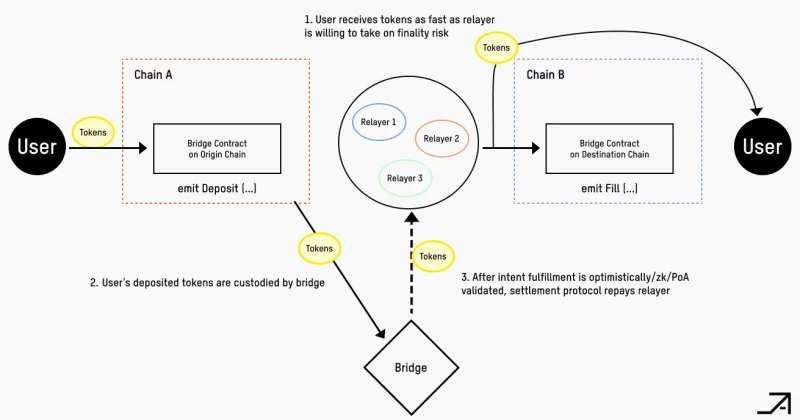
At its core, the Open Intents Framework provides a comprehensive toolkit that enables cross-chain intents to function effectively across a multitude of blockchain networks. This toolkit comprises a suite of essential components: smart contracts that define the rules of engagement, open-source solvers that compete to execute requests, aggregators that streamline the process, and a Software Development Kit (SDK) designed for seamless integration by developers. Crucially, the OIF’s architecture is built on a foundation of permissionless access, meaning developers can leverage these tools without requiring explicit approval from any central authority.
The framework’s operational architecture is underpinned by three primary contract types: InputSettler, OutputSettler, and Oracle contracts. The InputSettler acts as the entry point for an intent, receiving and validating the initial request. The OutputSettler then handles the execution of the intent on the destination chain, ensuring that the desired outcome is achieved. Oracle contracts, a vital component in any decentralized system interacting with external data, are integrated to provide reliable information necessary for the fulfillment of complex intents. These core contracts are interconnected and orchestrated by the interoperability SDK, which simplifies the developer experience and abstracts away much of the underlying complexity.
The OIF’s design is deeply rooted in the ERC-7683 standard, a crucial innovation that standardizes the structure and format of cross-chain intents. This standardization is pivotal for ensuring that different networks and applications can interpret and process intent requests uniformly. When a user submits an intent—for instance, a desire to swap a specific token on one blockchain for another token on a different chain—the OIF triggers a competitive marketplace of "solvers." These solvers are independent entities that race to fulfill the user’s request with optimal efficiency, aiming to secure the best execution price and minimize transaction costs. This competitive dynamic incentivizes solvers to operate with speed and precision, ultimately benefiting the end-user.
Early deployments of the OIF are already live and operational on several prominent testnets, including Ethereum Sepolia and Optimism Sepolia. Under ideal network conditions and with active solver participation, the completion time for solver-fulfilled orders typically ranges from a swift 10 to 60 seconds. This demonstrates the practical viability and potential speed of the framework, even in its nascent stages. The ability to execute cross-chain transactions within this timeframe represents a significant improvement over many existing solutions, which can often take considerably longer due to network congestion or less efficient routing mechanisms.
Coinbase’s Strategic Integration and the Permissionless Ethos
A significant endorsement for the Open Intents Framework arrived in September 2025, when Coinbase Payments, the dedicated payments arm of the global cryptocurrency exchange Coinbase, officially became a core contributor. This strategic involvement signals a strong commitment from a major industry player to the standardization of cross-chain asset transfers through the OIF. Coinbase’s expertise in handling large-scale financial transactions and its extensive user base are expected to accelerate the adoption and refine the capabilities of the framework. Their participation suggests a belief that the OIF’s open and decentralized approach is the most robust and scalable path forward for interoperability.
A defining characteristic of the OIF’s design is its deliberate modularity and permissionless nature. This means that any development team, regardless of size or affiliation, can deploy and extend the framework’s smart contracts without needing to seek approval from a central governing body. This open approach directly contrasts with many proprietary solutions that can create vendor lock-in and limit innovation. The absence of a governance token further reinforces this ethos, ensuring that the framework’s direction is not dictated by the financial interests of token holders but rather by the collective needs of the ecosystem. Furthermore, the OIF eschews protocol fee extraction, meaning that the framework itself does not generate revenue, further solidifying its role as neutral infrastructure.
The implications of this permissionless and tokenless design are profound. For developers, it removes the complexities and potential volatilities associated with navigating intricate tokenomics, staking requirements, or fee structures that can be subject to unpredictable governance decisions. This allows them to focus purely on building innovative applications that leverage cross-chain capabilities.
The Strategic Significance of a Tokenless Framework
The decision to operate without a dedicated token is a deliberate and strategic choice that underpins the OIF’s positioning as a neutral, public utility for the blockchain space. In the often-speculative world of cryptocurrency, the introduction of a token can bring with it a host of complexities, including price volatility, the need for robust tokenomics design, and the potential for governance disputes. By forgoing a token, the OIF aims to eliminate these distractions and establish itself as a reliable and stable infrastructure layer.
While the absence of a token means there is no direct financial incentive mechanism to bootstrap a network of solvers and participants in the traditional sense, the OIF leverages a different, yet equally powerful, economic model: competitive dynamics. Solvers are incentivized to participate and provide their services by the prospect of earning fees from successfully fulfilling intents. This competition drives efficiency and innovation, as solvers strive to offer the best execution prices and fastest fulfillment times to attract users. This model aligns with the principles of open markets, where competition fosters better outcomes for all participants.
The current landscape of blockchain interoperability is fragmented and often inefficient. While solutions like Cosmos’ Inter-Blockchain Communication (IBC) protocol and Polkadot’s parachain model offer robust interoperability within their respective ecosystems, the OIF aims to bridge the gap between these diverse ecosystems and Ethereum-centric networks. The ERC-7683 standard, upon which the OIF is built, is gaining traction as a potential universal language for cross-chain intents, promising to simplify developer workflows and enhance user experiences across the entire blockchain spectrum.
The development of the OIF is an ongoing process, with production-ready contracts already deployed across various testnets and mainnets. Continuous security audits are being conducted to ensure the robustness and integrity of the framework. Furthermore, the development of additional solver implementations is a key focus for the remainder of the year, aimed at expanding the network of participants and increasing the resilience of the OIF ecosystem. This commitment to ongoing development and security underscores the seriousness with which the Ethereum Foundation and its collaborators are approaching the challenge of cross-chain interoperability.
Broader Impact and Future Implications
The Open Intents Framework has the potential to significantly reshape the blockchain landscape. By providing a standardized, permissionless, and efficient mechanism for cross-chain interactions, the OIF can unlock a new wave of innovation in decentralized applications (dApps). Developers will be empowered to build applications that seamlessly span multiple blockchains, offering users a more fluid and integrated experience. This could lead to the development of more sophisticated DeFi protocols, novel NFT marketplaces that operate across different networks, and even entirely new categories of dApps that were previously impractical due to interoperability limitations.
For end-users, the OIF promises a more streamlined and intuitive experience. The ability to execute cross-chain transactions with speed and reliability, without the need to navigate complex bridging protocols or understand intricate network dynamics, will lower the barrier to entry for mainstream adoption of blockchain technology. Imagine a user being able to participate in a yield farming opportunity on one chain, swap assets on another, and claim an NFT on a third, all through a single, cohesive interface, without ever explicitly managing multiple wallet connections or bridge transactions.
The involvement of major players like Coinbase adds a layer of institutional validation and practical implementation expertise. As Coinbase Payments works to standardize cross-chain asset transfers through OIF, it signals a broader trend towards integrating decentralized interoperability solutions into mainstream financial infrastructure. This collaboration is likely to drive the adoption of the OIF by other financial institutions and enterprises looking to leverage blockchain technology for cross-border transactions and asset management.
The "no token" approach, while unconventional in the crypto space, is a strategic move that emphasizes the OIF’s role as a public good. This positions it as a foundational layer, akin to the internet’s underlying protocols, that facilitates communication and exchange without being driven by speculative financial interests. This neutrality is crucial for fostering trust and encouraging widespread adoption by a diverse range of participants, from individual developers to large enterprises.
As the OIF continues to mature and gain broader adoption, it is poised to become a cornerstone of the future decentralized web. Its success will hinge on the continued collaboration of its growing community of developers and the ongoing refinement of its technical capabilities. The framework represents a significant step forward in solving one of the most persistent challenges in the blockchain industry, paving the way for a more interconnected, efficient, and user-friendly decentralized future. The ambition is clear: to build the invisible plumbing that allows the diverse blockchain ecosystem to function as a cohesive whole.