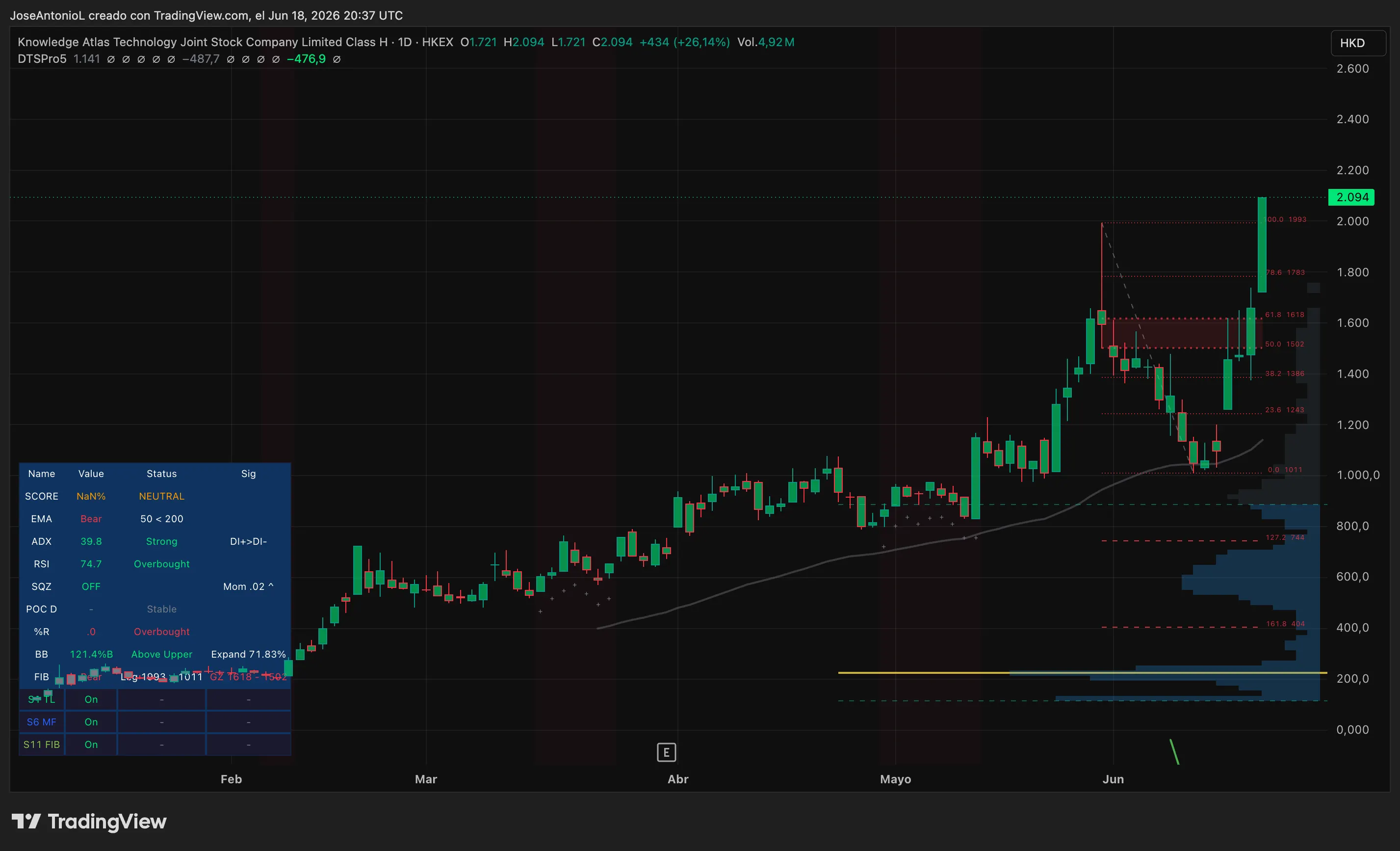
On June 16, Z.ai, a Beijing-based artificial intelligence research laboratory, officially released GLM-5.2, its latest large language model, promising a new benchmark in top-tier performance that surpasses its already advanced predecessor, GLM-5.1. This significant technological leap has been met with considerable market enthusiasm, driving Z.ai’s stock up by an impressive 90% over the past week, sending it to an unprecedented all-time high. The surge in valuation for Z.ai comes amidst a complex global landscape, where the company’s status on the U.S. Entity List since January 2025, coupled with recent regulatory actions impacting competitors, appears to be paradoxically bolstering its position in the rapidly evolving AI sector.
Technical Prowess Unveiled: GLM-5.2 Sets New Benchmarks
The technical specifications and benchmark results for GLM-5.2 provide substantial backing for the hype surrounding its release. At its core, GLM-5.2 is a 744-billion-parameter Mixture-of-Experts (MoE) model, a sophisticated architecture that allows it to efficiently handle a vast range of tasks. One of its most striking features is a genuine 1 million-token context window, a five-fold increase from the 200,000-token limit of GLM-5.1. This monumental expansion in context window capacity represents a significant operational shift for developers, enabling workflows that were previously cumbersome or impossible. For instance, tasks requiring whole-repository navigation, multi-file refactoring, or long agentic pipelines can now be executed through single-call operations, streamlining development processes and enhancing efficiency.
To validate its performance claims, GLM-5.2 was subjected to rigorous industry benchmarks. On FrontierSWE, a critical benchmark designed to evaluate an AI agent’s ability to complete open-ended technical projects over extended periods—encompassing systems optimization, large-scale code construction, and applied machine learning research, scored by dominance rate—GLM-5.2 achieved a remarkable score of 74.4. This places it in direct competition with leading models like Claude Opus 4.8, which scored 75.1, and comfortably ahead of GPT-5.5, which registered 72.6.
Further demonstrating its capabilities, GLM-5.2 excelled on SWE-bench Pro, a benchmark that assesses an AI’s autonomous problem-solving skills for real-world GitHub issues, measured by pass rate. Here, GLM-5.2 achieved a score of 62.1, outperforming GPT-5.5’s 58.6 and significantly widening the margin over its predecessor, GLM-5.1, which scored 58.4. These results underscore GLM-5.2’s superior ability to resolve complex coding challenges, a critical feature for developers and enterprises seeking highly capable AI assistants.
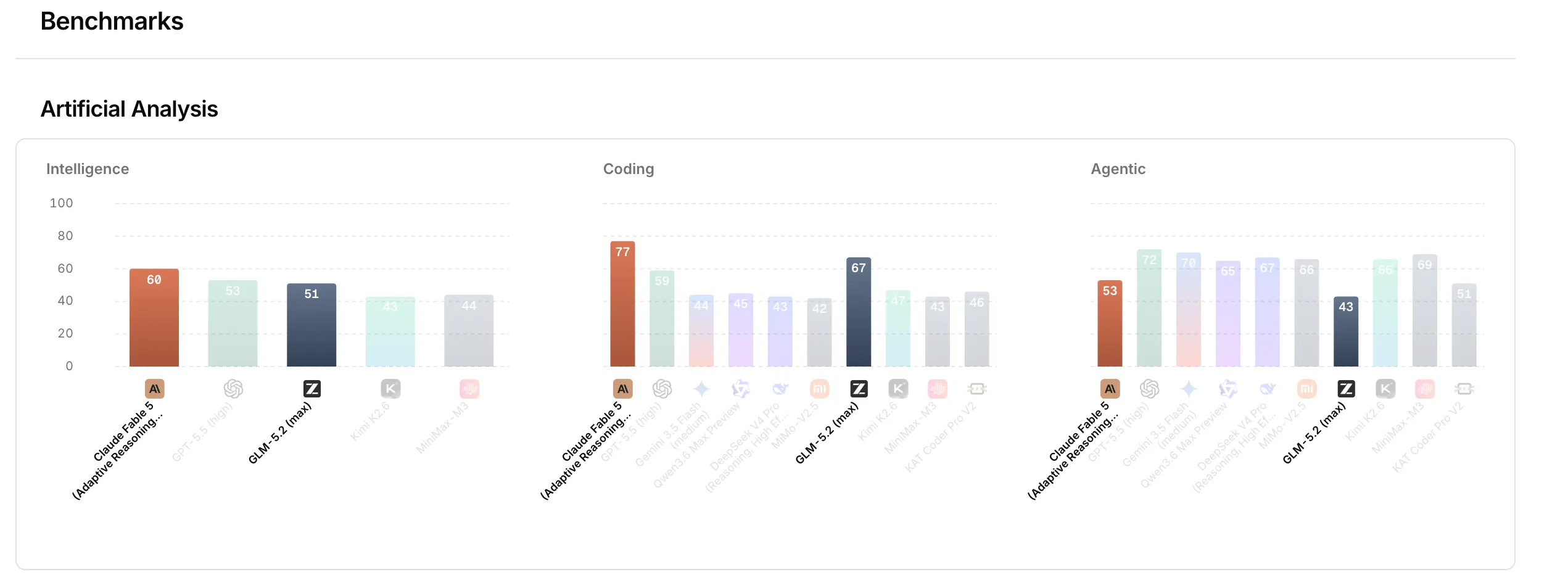
The aggregate performance of GLM-5.2 has earned it the distinction of being the best open-source model to date in the Artificial Analysis Intelligence Index. This comprehensive index synthesizes results from nine different scores to provide a holistic assessment of an AI model’s general quality. Independent benchmarks conducted by OpenRouter further corroborate these findings, placing GLM-5.2 in the same performance category as the now-banned Claude Fable 5, a clear indication of its competitive standing against even the most advanced proprietary models.
A Geopolitical Chessboard: Z.ai’s Rise Amidst U.S.-China Tech Rivalry
Z.ai’s journey to this prominent position has been anything but conventional. The Beijing-based lab has been on the U.S. Entity List since January 2025, a designation typically reserved for entities deemed to pose a national security risk or to be involved in activities contrary to U.S. foreign policy interests. This listing restricts Z.ai’s access to certain U.S. technologies, including critical semiconductor components and software. Historically, such sanctions aim to impede the technological progress of targeted companies. However, in Z.ai’s case, the Entity List designation appears to have catalyzed a strategic pivot towards self-sufficiency and indigenous innovation, ultimately strengthening its market appeal.

The timing of GLM-5.2’s release and its subsequent market performance is particularly noteworthy, coinciding with what the article describes as "growing concerns over America’s approach to AI." This sentiment has been amplified by the recent ban on Anthropic Fable, a competing AI model. While the specifics of the "ban" are not detailed in the original context, such actions in the highly competitive and sensitive AI space can stem from a variety of factors: national security concerns over data handling or model capabilities, intellectual property disputes, or regulatory non-compliance. Regardless of the exact reasons, the perceived restriction on a prominent American-developed AI model likely created a vacuum or a perceived opportunity for alternatives, especially for those seeking robust, globally accessible solutions. For many international users and developers, the unpredictability of access to U.S.-controlled AI technologies might make an independent, high-performing model like GLM-5.2, developed outside the direct purview of U.S. sanctions, an increasingly attractive option.
This dynamic illustrates the complex interplay between technological advancement, economic policy, and international relations. Far from crippling Z.ai, the U.S. sanctions appear to have inadvertently fostered an environment where the company’s commitment to independent development, particularly in hardware, has become a strategic advantage. The stock market’s reaction, with Z.ai’s shares skyrocketing, clearly reflects investor confidence in the company’s ability to not only circumvent these restrictions but to thrive by offering competitive, sanction-resistant AI solutions.
The Huawei Advantage: Bypassing Western Sanctions with Domestic Hardware
Perhaps one of the most intriguing aspects of GLM-5.2’s development is the hardware infrastructure upon which it was trained. Unlike many global AI powerhouses that heavily rely on Nvidia’s dominant GPU technology, GLM-5.2 was entirely trained on Huawei Ascend chips. This strategic choice signifies a deliberate and successful effort by Z.ai to establish a completely independent AI development pipeline, free from reliance on American semiconductor technology. This move is not entirely new for Z.ai; as reported earlier in the year, the lab had already been training image generation models on Huawei’s Ascend Atlas servers without a single American chip. GLM-5.2 pushes this indigenous infrastructure further, demonstrating that cutting-edge, large-scale AI models can indeed be developed and trained using domestically produced hardware.
The implications of this hardware independence are profound. It showcases China’s burgeoning capability to develop a full-stack AI ecosystem, from foundational chips to advanced large language models, mitigating the impact of potential future technology embargoes. This self-reliance reduces vulnerability to geopolitical pressures and ensures continuity of research and development, providing a stable platform for innovation.
The cost-effectiveness of this approach is also a significant factor. Emad Mostaque, founder of Stability AI, estimated the total training costs for GLM-5.2 to be approximately $25 million, with about 80% of that allocated to post-training processes. This figure, if accurate, would position GLM-5.2 as an "extremely cheap" model compared to its peers, which often incur hundreds of millions, if not billions, of dollars in training expenses. The ability to achieve top-tier performance at a fraction of the cost, particularly by leveraging non-Nvidia hardware, could disrupt the current economic models of AI development and make advanced AI more accessible to a broader range of developers and organizations globally. This cost advantage, combined with its performance, makes GLM-5.2 a compelling alternative in the global AI market.
Economic Impact and Market Dynamics: A New Challenger Emerges
The financial performance of Z.ai following the GLM-5.2 launch underscores a significant shift in market perception. The 90% stock surge indicates strong investor belief in the company’s strategic resilience and technological prowess. This meteoric rise can be attributed to several converging factors: the undeniable technical superiority demonstrated by GLM-5.2, Z.ai’s successful navigation of U.S. sanctions through domestic hardware innovation, and the broader market’s increasing apprehension about the stability and accessibility of U.S.-centric AI technologies. The "ban on Anthropic Fable" serves as a stark reminder of regulatory risks, making Z.ai’s open-source, MIT-licensed model developed on independent infrastructure a safer bet for many.
Beyond stock performance, GLM-5.2 presents a highly competitive offering in terms of API pricing. For developers, API access runs at $1.40 per million input tokens and $4.40 per million output tokens. This is significantly more affordable than competitors like Claude Opus 4.8, which charges $5 per million input tokens and $25 per million output tokens. This aggressive pricing strategy, combined with its advanced capabilities, positions GLM-5.2 as a highly attractive option for developers and enterprises looking to integrate powerful AI into their applications without incurring exorbitant costs. The availability of a "Coding Plan" starting at around $18 a month, directly integrated with popular agentic environments such as Claude Code, Cline, and Kilo Code, further enhances its accessibility and appeal to the developer community. This cost-efficiency is particularly impactful for multi-shot generation workflows and agentic pipelines where output diversity is prioritized over raw computational power, making the economics of open-source pricing levels hard to dispute.
Empowering Developers: Features and Accessibility
GLM-5.2’s genuine 1 million-token context window is a game-changer for developers. This expanded memory allows the model to process and understand vastly larger amounts of information in a single interaction. For complex programming tasks, this means that entire code repositories can be analyzed, multiple files refactored, and intricate agentic pipelines managed within a single conversational thread, drastically simplifying development workflows. Developers can move beyond the tedious process of "chunking" large codebases or complex data into smaller, manageable segments for AI processing, leading to more coherent and effective AI-assisted development.
In a move that further democratizes access to advanced AI, Z.ai has also made local deployment technically feasible. Unsloth AI, a prominent figure in AI optimization, has already pushed 2-bit GGUF quantizations of GLM-5.2. These quantizations compress the massive model from its original 1.51 terabytes down to a more manageable 238 gigabytes, while remarkably retaining approximately 82% of its original accuracy. This level of compression, though still substantial, brings the model within the realm of high-end consumer or prosumer hardware.
However, developers should manage their expectations regarding local deployment. Running the quantized GLM-5.2 still demands a formidable 256GB of unified memory or a matching RAM/VRAM combination. This translates to hardware requirements such as a fully specced M4 Ultra Mac Studio or a workstation equipped with a mid-range GPU alongside 256GB of system RAM, especially when utilizing mixture-of-experts offloading. While this hardware configuration represents a significant investment, it fundamentally shifts the paradigm from purely cloud-based, subscription-dependent AI access to a potentially on-premise, fully controlled solution. For individuals and organizations prioritizing data privacy, low latency, or independence from cloud providers, this local deployment capability, despite its cost, offers a compelling alternative. It allows for advanced AI capabilities to be run within a user’s own infrastructure, providing greater control and flexibility.
Real-World Application: Creative Generative Capabilities
To assess GLM-5.2’s practical capabilities, a real-world test was conducted, tasking the model with building a game that combined typing mechanics with a shooter genre. While the resulting user interface might not have been the most aesthetically polished compared to outputs from other models, the overall gaming experience generated by GLM-5.2 proved to be exceptionally varied. The model demonstrated an impressive ability to create diverse scenarios across multiple waves, introduce shifting enemy types, and integrate bosses appearing later in the game run.
This variance in game states is a crucial indicator of GLM-5.2’s generative creativity and its capacity to produce non-repetitive, engaging content in a zero-shot setup. It generated a broader array of game states than any other model tested for the same task, highlighting its potential in creative applications where output diversity is paramount. For developers in gaming, content creation, or simulation, this capability suggests that GLM-5.2 can serve as a powerful tool for generating dynamic and unpredictable content, reducing the need for extensive manual design and iteration. The generated game is even available for public testing on Itch.io, allowing others to experience its unique generative capabilities firsthand.
This characteristic points to GLM-5.2’s most significant economic advantage for certain use cases. For multi-shot generation workflows and agentic pipelines where the originality and breadth of output are more valuable than mere aesthetic polish, GLM-5.2’s performance combined with its open-source pricing structure makes it an incredibly strong contender. However, it is also important to acknowledge that a gap still exists between GLM-5.2 and the "closed frontier" models for the hardest, most sustained tasks. On SWE-Marathon, for instance, GLM-5.2 scored 13.0 against Claude Opus 4.8’s 26.0, indicating that while Z.ai has made immense strides, there remains a discernible performance difference in certain highly specialized areas.
The Open-Source Frontier: Democratizing Advanced AI
Z.ai’s decision to release GLM-5.2 under an MIT license is a pivotal move. The MIT license is one of the most permissive free software licenses, essentially allowing users to freely use, modify, and distribute the software for any purpose, commercial or otherwise, with minimal restrictions. This choice directly addresses the concern that "no government directive can flip the access switch." In a world increasingly wary of technological control and potential restrictions, an MIT-licensed model offers unparalleled freedom and assurance to developers and researchers globally. It establishes GLM-5.2 as a truly open-source asset, promoting collaboration, innovation, and broad adoption without fear of future geopolitical interference or sudden changes in access terms.
The open-source weights for GLM-5.2 are live on HuggingFace, the leading platform for AI model sharing, under the MIT license. Additionally, the quantized weights, optimized for more accessible local deployment, are also available on HuggingFace. This widespread availability ensures that a vast community of developers and researchers can access, experiment with, and build upon GLM-5.2. For existing GLM Coding Plan subscribers, switching to the new model is straightforward, requiring only the model string GLM-5.2. Furthermore, Z.ai offers free testing of GLM-5.2 on its own platform, z.AI, albeit with some usage constraints, further lowering the barrier to entry for interested parties. This commitment to openness positions Z.ai not just as a technology provider but as a significant contributor to the global open-source AI movement, fostering an ecosystem of shared innovation.
Looking Ahead: Challenges and Opportunities
The launch of GLM-5.2 marks a significant milestone for Z.ai and for the broader AI landscape. It demonstrates that geopolitical sanctions, while intended to constrain, can inadvertently spur innovation and foster self-reliance. Z.ai’s ability to develop a top-performing, cost-effective AI model using indigenous hardware, all while navigating an Entity List designation, positions it as a formidable and increasingly independent player in the global AI race.
The model’s superior context window, impressive benchmark scores, and aggressive pricing strategy are set to appeal strongly to developers and enterprises worldwide, particularly those in regions sensitive to U.S. technological influence or simply seeking more affordable, high-performance alternatives. The commitment to an MIT license further cements its appeal as a reliable, future-proof option.
However, challenges remain. While GLM-5.2 excels in many areas, the performance gap to "closed frontier" models in certain highly specialized and sustained tasks, as highlighted by the SWE-Marathon scores, indicates that there is still room for improvement. The high hardware requirements for local deployment, even with quantization, also mean that true widespread accessibility for individual users might still be some time away for the full model.
Nevertheless, Z.ai’s GLM-5.2 stands as a testament to the power of independent technological development and the complex, often unpredictable, dynamics of the global AI market. Its success not only validates Z.ai’s strategic choices but also offers a compelling vision for a more diverse and competitive AI future, less reliant on a single technological hegemony. The ripple effects of this launch are likely to be felt across the industry, influencing future research, investment, and geopolitical strategies in artificial intelligence for years to come.