The digital asset market is currently navigating a period of intense structural transition, as recent data reveals that altcoins are enduring their most significant stretch of spot-market selling pressure in nearly five years. According to comprehensive market analysis provided by CryptoQuant, the cumulative buy/sell volume difference for the broader altcoin market has reached a staggering negative $209 billion. This metric, which tracks the net flow of capital within spot exchanges, suggests a prolonged and deep-seated divestment from non-Bitcoin assets, marking a level of exhaustion not witnessed since the pre-bull market conditions of 2020. This trend underscores a shifting paradigm in investor behavior, where the speculative appetite that once fueled explosive "altseasons" has been replaced by a defensive posture characterized by capital rotation into more established assets or a complete exit to fiat and stablecoins.
The significance of spot-market data cannot be overstated in the context of crypto-asset valuation. Unlike the derivatives market, which is often driven by leverage, liquidations, and short-term hedging, spot flows represent "organic" demand and supply. When the cumulative buy/sell volume difference tilts heavily toward the sell side, it indicates that holders are physically offloading their tokens rather than merely trading fluctuations in price. The current $209 billion deficit reflects a market where every attempt at a price recovery is met with significant "overhead supply"—a scenario where investors who purchased at higher prices use minor bounces as opportunities to exit their positions with minimal further losses.
A Historical Comparison: Tracing the Path from 2020 to 2025
To understand the gravity of the current sell pressure, one must look back to the market conditions of 2020. During that era, the cryptocurrency industry was emerging from a multi-year "crypto winter" following the 2017 initial coin offering (ICO) bubble. In early 2020, altcoins faced similar skepticism as investors consolidated their holdings into Bitcoin ahead of the third halving event. However, the current environment is fundamentally different in scale and complexity. In 2020, the total market capitalization of all cryptocurrencies was a fraction of what it is today, and the infrastructure for institutional participation was largely non-existent.
The chronology of the current slump can be traced back to the collapse of the Terra-Luna ecosystem in mid-2022, followed by the bankruptcy of the FTX exchange. These events decimated retail confidence and led to a "flight to quality." While Bitcoin managed to decouple and rally throughout 2023 and 2024, bolstered by the approval of spot ETFs in the United States, the altcoin market failed to maintain the same momentum. The data from CryptoQuant suggests that the "altcoin summer" many anticipated for 2024 never truly materialized in a broad sense. Instead, the market saw a fragmented performance where only a tiny percentage of tokens—largely meme-based or highly specific AI-themed assets—outperformed the market, while the vast majority of "utility" tokens entered a period of slow, grinding depreciation.
The Mechanics of Sell Pressure: Why Altcoins are Struggling
Several macroeconomic and internal factors have converged to create this $209 billion sell-off. One of the primary drivers is the "BlackRock Effect" or the institutionalization of Bitcoin. The introduction of spot Bitcoin ETFs has provided a regulated, easy-to-access vehicle for institutional capital. This capital, however, is strictly mandated to hold Bitcoin. Previously, a rise in Bitcoin’s price would lead to "wealth effect" selling, where investors would take BTC profits and rotate them into high-risk altcoins to chase 10x or 100x returns. In the current cycle, that rotation has slowed significantly. Institutional investors are staying within the Bitcoin wrapper, and retail investors, who traditionally drive altcoin rallies, have remained sidelined by broader economic pressures such as inflation and high interest rates.
Furthermore, the altcoin market itself is suffering from extreme liquidity fragmentation. In 2020, there were significantly fewer active projects vying for investor attention. Today, the market is saturated with thousands of tokens, many of which are backed by venture capital firms with aggressive unlock schedules. As these tokens reach their "vesting" dates, early investors and team members often sell their holdings to realize gains, creating a constant stream of sell pressure that the current retail demand cannot absorb. This "dilution" of the market means that even if the same amount of capital enters the altcoin space as it did in previous years, it is spread so thin across so many projects that individual token prices struggle to rise.
The Role of Ethereum and the "Safe Haven" Shift
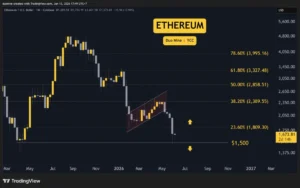
Ethereum, traditionally the leader of the altcoin market, has also faced a unique set of challenges that contribute to the overall sell-pressure data. While Ethereum remains the dominant platform for decentralized finance (DeFi) and tokenization, its price performance relative to Bitcoin has been lackluster for much of the past eighteen months. The transition to a Proof-of-Stake consensus mechanism and the subsequent "Dencun" upgrade have successfully lowered transaction fees on Layer-2 networks, but they have also reduced the "burn rate" of ETH, impacting its deflationary narrative.

As Ethereum struggles to keep pace with Bitcoin’s dominance, many investors have reclassified ETH not as a high-growth altcoin, but as a "mature" asset. This leaves mid-cap and small-cap altcoins without their traditional "north star." Without a strong Ethereum rally to lead the way, speculative capital has become increasingly transient, moving rapidly in and out of tokens rather than building long-term positions. This transience is reflected in the CryptoQuant data as a lack of sustained accumulation.
Contrarian Perspectives: Is the Bottom in Sight?
From a contrarian standpoint, extreme sell pressure is often a prerequisite for a market bottom. In technical analysis, the concept of "capitulation" describes a period where the final group of "weak hands" or exhausted holders finally sells their assets, leaving only "diamond hands" or long-term believers in the market. When the net selling volume reaches extremes—such as the $209 billion mark—it suggests that the market is becoming "oversold" on a fundamental level.
Market analysts often point to the "Altcoin Season Index," which measures whether the top 50 altcoins are outperforming Bitcoin over a 90-day period. Currently, this index remains in the lower-to-mid range, indicating that we are far from the "euphoria" phase that typically precedes a market crash. For a contrarian investor, the fact that altcoins are deeply out of favor is a potential signal of opportunity. If the selling pressure has truly exhausted the available supply of sellers, even a modest increase in new buy orders could trigger a sharp upward correction.
Institutional and Regulatory Responses
While there has been no official "statement" from a centralized body—given the decentralized nature of the market—the actions of major financial institutions provide a window into the professional sentiment. Firms like Fidelity and Grayscale continue to expand their altcoin trust offerings (including Solana, Chainlink, and Near Protocol), suggesting that while the spot market is currently dominated by sellers, the institutional pipeline is still being built.
Regulators, particularly in the United States, have also played a role in the prolonged sell pressure. The SEC’s ongoing "regulation by enforcement" approach has labeled many prominent altcoins as unregistered securities. This has forced several US-based exchanges to delist certain assets and has discouraged institutional custodians from offering them to clients. The legal uncertainty creates a "risk premium" on altcoins; investors demand a much lower price to compensate for the possibility of future regulatory action. Until there is a clear legislative framework for digital assets, this regulatory overhang is expected to persist, contributing to the defensive posture of market participants.
Broader Implications and the Outlook for 2025
The implications of this $209 billion sell-pressure stretch are twofold. In the short term, it suggests that any "altseason" will likely be selective rather than universal. The days when "a rising tide lifts all boats" in the crypto space may be over. Instead, we are likely entering an era of "asset picking," where projects with real-world revenue, active user bases, and sustainable tokenomics decouple from the broader sea of stagnant tokens.
Looking toward the remainder of 2025, the altcoin market’s recovery depends on a shift in global liquidity. If central banks move toward a more "dovish" monetary policy and lower interest rates, the resulting increase in global M2 money supply historically flows into high-risk assets. Additionally, as Bitcoin approaches new all-time highs and its dominance eventually peaks, the "rotation" into altcoins could finally begin in earnest.
However, the CryptoQuant data serves as a sobering reminder that the market is currently in a state of stress. The $209 billion in net selling is a high hurdle to overcome. For a true reversal to be confirmed, analysts will be looking for a sustained shift from net selling to net accumulation in spot volumes, accompanied by a broadening of market participation beyond just Bitcoin and a handful of meme coins. Until that shift occurs, the altcoin market remains a "show-me" story, where buyers are demanding deep discounts and tangible proof of value before stepping back into the fray. The current data does not necessarily predict a further crash, but it does confirm that the road to recovery for altcoins will be a steep climb against a heavy wind of existing sell orders.