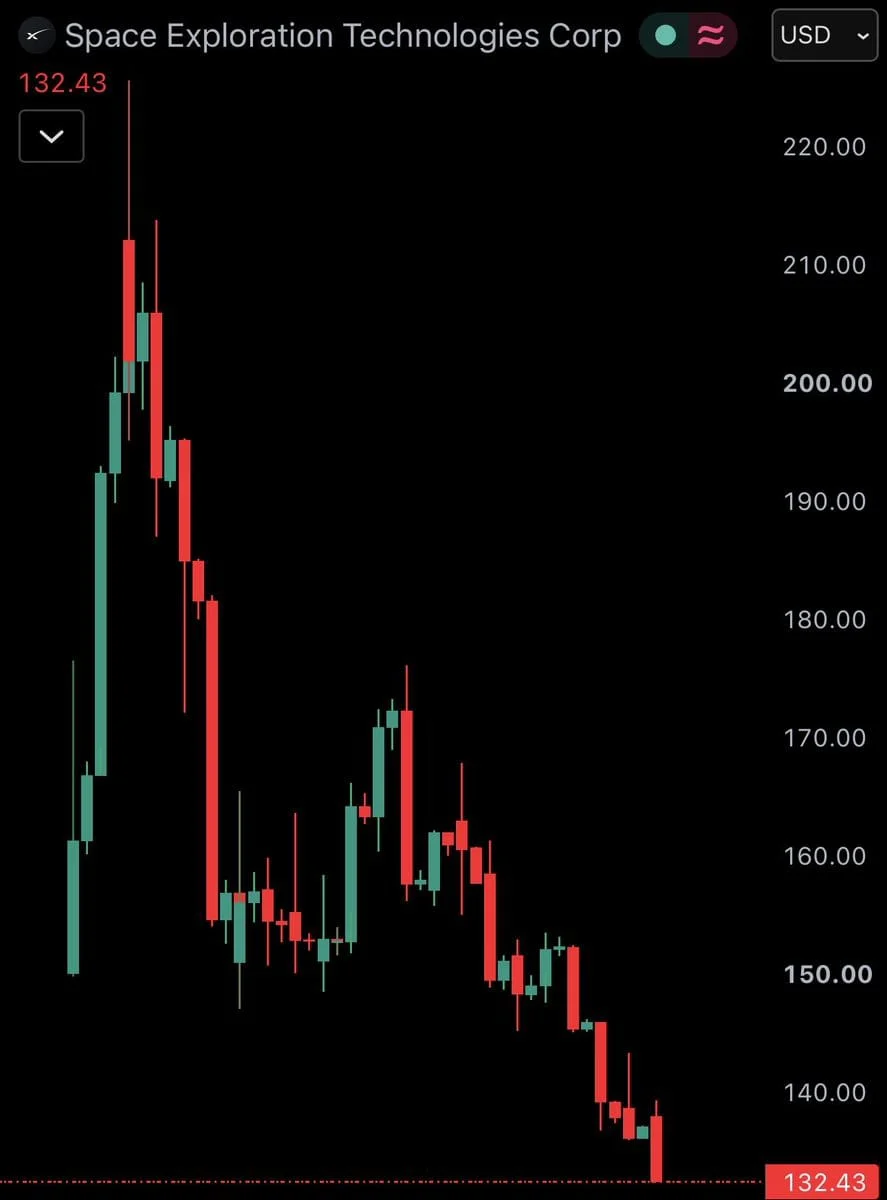
SpaceX, a titan of private enterprise with a valuation that has at times approached that of the world’s largest public companies, has recently exhibited stock price movements more akin to a small-cap meme stock than a multi-trillion-dollar entity. This paradoxical behavior, characterized by sharp swings and significant value erosion, has puzzled many market observers, yet its underlying mechanics reveal a logical, albeit unusual, interplay of market forces centered on its exceptionally limited share float. The recent decline, which saw its notional share price fall below its $135 IPO reference point and erase an estimated $1.25 trillion from its peak market capitalization, underscores a critical re-evaluation of the company’s intrinsic value versus its narrative-driven premium.
The Unprecedented Scale of SpaceX and Its Private Market Dynamics
SpaceX stands as a testament to audacious innovation and entrepreneurial vision, spearheading advancements in reusable rocket technology, satellite internet constellations, and human spaceflight. Founded by Elon Musk in 2002, the company’s mission to make humanity multi-planetary has attracted immense capital and talent, propelling it to an estimated valuation that, at its zenith, neared an unprecedented $3 trillion in private markets. This makes it one of the most valuable private companies globally, a distinction typically reserved for tech giants on the cusp of or already public.
However, unlike its publicly traded counterparts, SpaceX shares are not freely available on major stock exchanges. Instead, trading occurs predominantly in secondary private markets, often through specialized platforms or direct placements for accredited investors. This fundamental characteristic is the lynchpin of its peculiar stock behavior. The company’s primary revenue streams are diverse and rapidly expanding, encompassing launch services for government and commercial clients, the burgeoning Starlink satellite internet service, and ambitious projects like the Starship program aimed at deep-space exploration. Projections for SpaceX’s revenue in 2025, for instance, are estimated around $18 billion, a substantial figure that, while impressive for a private entity, still pales in comparison to the $200 billion forecasted for a mature public company like Meta over the same period. This revenue disparity, juxtaposed with a valuation approaching that of the world’s largest public firms, highlights the speculative premium embedded in SpaceX’s private market price.
The "Float Trap": A Deep Dive into Illiquidity
The core issue driving SpaceX’s pronounced volatility is what market analysts term the "float trap." In essence, a vast majority of SpaceX’s total outstanding shares remain tightly held by insiders, early-stage venture capital investors, institutional backers, and its founder, Elon Musk. Only a minuscule fraction of the company’s total equity is genuinely available for trading in the secondary private markets. This limited "free float" means that even relatively modest buying or selling pressure can disproportionately impact the share price, triggering dramatic fluctuations.
Consider a company with a market capitalization of $1.7 trillion (as recently implied for SpaceX). If it were publicly traded with a typical free float of, say, 70-80%, billions of dollars would need to move in and out of the stock to induce significant price changes. However, when the available float is perhaps less than 5-10% (a common characteristic for highly valued private companies pre-IPO), a capital inflow or outflow of merely tens or hundreds of millions of dollars can send the stock soaring or plummeting by double-digit percentages. This structural illiquidity creates an environment where a company valued like an institutional juggernaut behaves, on a day-to-day basis, with the erraticism of a far smaller, more speculative, and less mature enterprise. The market is attempting to price a multi-trillion-dollar valuation with the trading mechanics of a much smaller, thinly traded asset, leading to the observed disconnect.

A Chronology of Valuation and Market Perception
SpaceX’s valuation trajectory has been one of exponential growth, fueled by a series of successful funding rounds and major technological milestones.
- Early 2000s: Initial seed funding rounds, largely from Elon Musk himself and early investors, established the foundational capital.
- Mid-2000s to Early 2010s: Strategic investments from venture capital firms and government contracts (e.g., NASA’s Commercial Orbital Transportation Services program) began to validate the company’s vision and technological prowess. Valuation remained in the hundreds of millions.
- 2012: First successful commercial resupply mission to the ISS, a major turning point, boosting confidence in its operational capabilities.
- Mid-2010s: Development of reusable rocket technology (Falcon 9 landings) captured global attention and significantly increased perceived value, demonstrating cost-saving potential. Valuation began climbing into the low billions.
- Late 2010s: Initiation of the Starlink constellation project, promising a global broadband internet service, opened up a massive new revenue stream and market opportunity. This period saw valuations soar into the tens of billions.
- Early 2020s: Rapid deployment of Starlink satellites, successful crewed missions to the ISS, and ambitious Starship development pushed valuations into the hundreds of billions. Private market trades reflected increasing investor appetite.
- 2021-2022: The peak of the "Musk premium" and a broader tech bull market saw SpaceX’s valuation reportedly reach highs approaching $3 trillion in some secondary market transactions. This was driven by aggressive growth projections for Starlink and the long-term potential of Starship.
- 2023-Present: A shift in market sentiment, rising interest rates, and increased scrutiny on profitability led to a contraction in tech valuations. SpaceX, despite continued operational successes, saw its notional share price decline significantly, dropping below its $135 IPO reference price (a notional benchmark for private market transactions), leading to the erasure of an estimated $1.25 trillion from its peak market capitalization. This period marks the current "float trap" dynamics playing out prominently.
Pre-IPO Hedging: Exacerbating the Downturn
Another significant factor contributing to SpaceX’s dramatic price swings, particularly on the downside, is the phenomenon of pre-IPO hedging. Many early investors, employees, and institutional shareholders in private companies like SpaceX face a dilemma: they hold valuable, illiquid shares that they cannot readily sell to realize gains or manage risk. To mitigate this exposure, especially when an IPO is anticipated but not yet materialized, some engage in hedging strategies.
For SpaceX shareholders, this often involved shorting a basket of publicly traded aerospace or space-related equities. The rationale was simple: if SpaceX’s private market valuation, and by extension the broader space sector, were to decline, the gains from their short positions in public companies would offset potential losses in their illiquid SpaceX holdings. This strategy, while sound for individual investors, had a cascading effect on the thinly traded SpaceX shares. With so few actual SpaceX shares available, any significant hedging activity, even if indirect, created an outsized downward pressure on the perceived or transacted price of SpaceX stock in the private market. The act of hedging against a potential future decline inadvertently contributed to the very decline it sought to mitigate, especially as more participants adopted similar strategies.
The recent break below the $135 IPO reference point suggests that a substantial portion of this hedge pressure may have unwound. Once the initial trigger level for hedging is breached, the immediate incentive to add new short positions or maintain existing ones diminishes. This could potentially pave the way for a more stable, albeit still volatile, trading environment for private space equities moving forward, as the artificial downward pressure from hedging subsides.
The Erosion of the "Musk Premium"
For years, a significant portion of SpaceX’s sky-high valuation was attributed to the "Elon Musk trillionaire narrative." This premium was based on the widespread belief that Musk’s visionary leadership, disruptive innovation, and track record of success (with companies like Tesla and PayPal) inherently justified an elevated valuation, often disconnected from traditional financial metrics like quarterly revenue, debt levels, or execution risk. Investors were willing to pay a premium for the "Musk factor," betting on his ability to defy expectations and revolutionize industries.
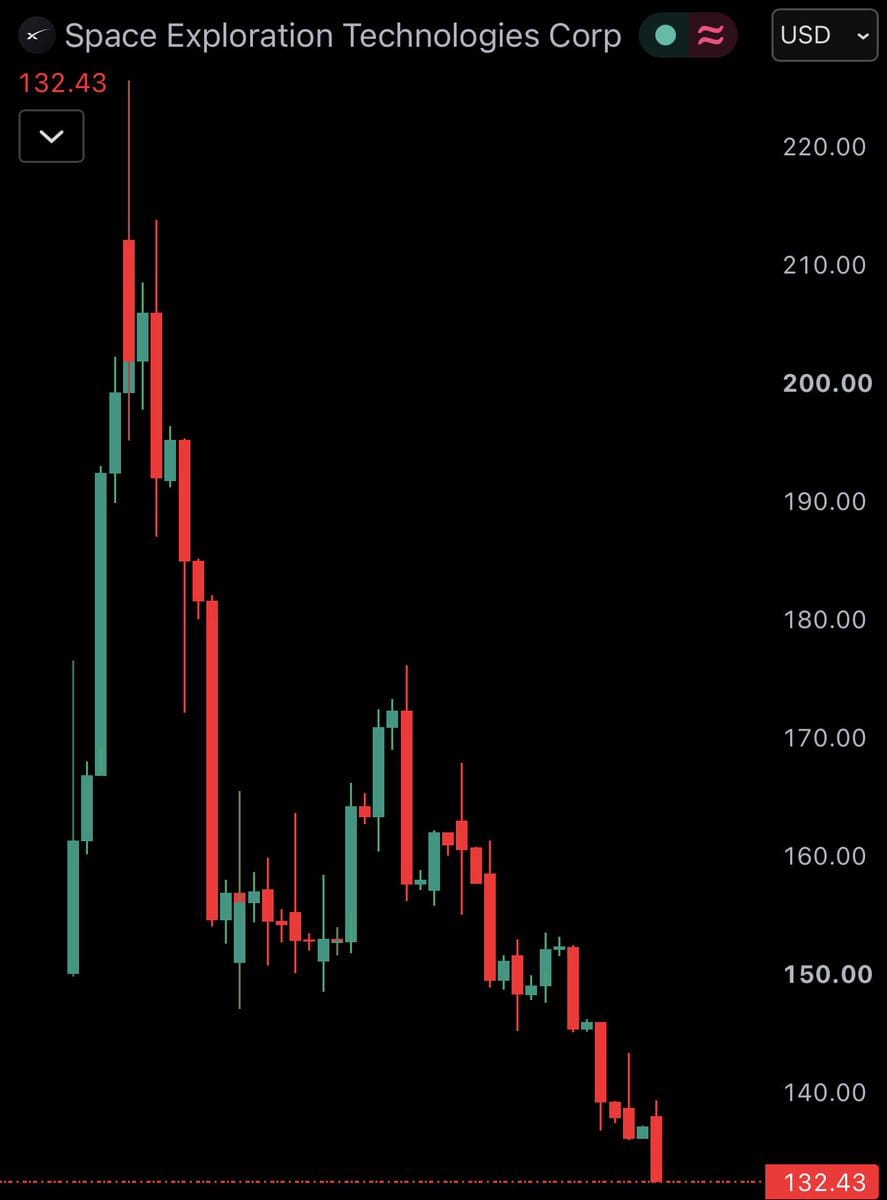
However, the recent market downturn and the sharp correction in SpaceX’s valuation signal a significant erosion of this narrative-driven premium. The market is increasingly demanding tangible evidence of financial performance and sustainable business models, even from the most charismatic leaders. Investors are now asking harder, more fundamental questions:
- What is SpaceX’s actual debt burden, especially with capital-intensive projects like Starship development?
- How does the ambitious launch cadence of Starship truly translate into predictable and scalable revenue streams?
- Is the company’s burgeoning investment in artificial intelligence, a bet Musk frequently signals, truly justified by its strategic relevance to SpaceX’s core mission and its capital allocation requirements?
These are no longer rhetorical questions but critical inquiries that the market is actively pricing in. This shift from an almost mythological valuation based on future potential and leadership charisma to one grounded in financial fundamentals represents a profound re-rating. The "Musk premium" has not entirely vanished, but it has certainly been recalibrated, forcing SpaceX to demonstrate its value through traditional business metrics rather than relying solely on its founder’s visionary aura.
Comparisons to Meme Stocks: Structural Similarities
The comparison of SpaceX’s stock behavior to that of meme stocks, while initially sounding unfair for a company of its stature, reveals crucial structural similarities due to the float trap. Meme stocks, characterized by their immense volatility, often have a relatively small float, high short interest, and are heavily influenced by retail sentiment amplified through social media. While SpaceX is not driven by the same social media frenzy, its low float creates a similar environment where sentiment, rather than fundamentals, dictates price action disproportionately.
In a thinly traded, illiquid market, every piece of news, every analyst note, every large trade, and even shifts in investor sentiment carry an outsized impact. A single negative headline about Starship delays, a large institutional investor unwinding a position, or a skeptical report from a private market analyst can trigger double-digit percentage moves in a single day. This is not necessarily a reflection of SpaceX’s underlying business deteriorating overnight; rather, it is a direct consequence of how little room the limited float leaves for absorbing shocks. There aren’t enough readily available shares to balance supply and demand efficiently, leading to exaggerated price swings that mirror the behavior of much smaller, more speculative, and often retail-driven meme stocks. The mismatch between a multi-trillion-dollar implied valuation and the actual trading mechanics creates this peculiar and volatile dynamic.
Broader Implications for Investors and the Space Sector
For existing and prospective investors, the current trajectory of SpaceX’s private market shares ($SPCX under $135) is not an indicator of technical failure in its rockets or a collapse of its core business. Instead, it signals a maturation of the market’s approach to valuing the company. The era where Elon Musk was treated as an almost mythical figure, whose every venture was guaranteed to transcend traditional economic gravity, is giving way to a more conventional assessment. The market is now compelling Musk and SpaceX to operate like any other large enterprise: balancing books, servicing debt, proving the efficacy of capital allocation (e.g., in AI), and demonstrating sustained profitability and growth based on fundamentals. The "Musk premium" has officially evaporated, marking the beginning of a period where tangible execution and financial discipline will be paramount.
This shift, while a rough ride for those who invested at peak valuations, is arguably a healthier long-term development. A stock trading on its intrinsic fundamentals and proven performance, rather than pure narrative and speculative premium, offers a more sustainable and predictable investment landscape. Whether SpaceX successfully validates its significant AI bets, whether its float eventually loosens up through future funding rounds or an eventual public offering, and whether the market consistently rewards actual operational execution over entrepreneurial mythology – these are the critical narratives that will define SpaceX’s valuation story moving forward. The company’s journey through this period of valuation recalibration will also provide crucial lessons for other high-growth private companies and the evolving dynamics of secondary private markets. The space sector as a whole may also benefit from this more sober valuation approach, potentially fostering a more sustainable investment environment based on tangible progress and commercial viability.