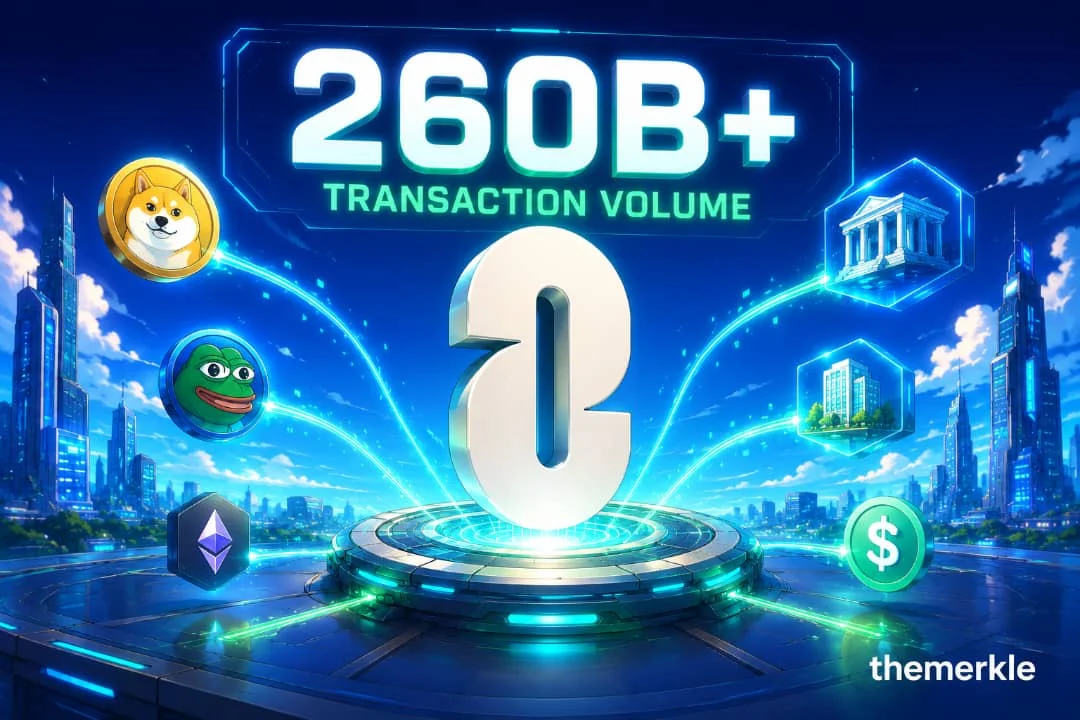
LayerZero, the omnichain interoperability protocol, has now facilitated over $260 billion in transaction volume across more than 830 Omnichain Fungible Tokens (OFTs) deployed on upward of 170 distinct blockchains. This significant milestone underscores LayerZero’s burgeoning influence as a critical piece of infrastructure, silently connecting the increasingly fragmented landscape of decentralized networks. The protocol’s capacity to support a vast spectrum of digital assets, from highly speculative memecoins to institutional-grade tokenized treasuries and government-issued stable tokens, highlights its adaptability and robust architecture, positioning it as a fundamental backbone for the evolving Web3 ecosystem.
The Growing Imperative for Seamless Interoperability
The rapid expansion of the blockchain space over the past decade has led to an explosion of specialized networks, each designed with unique characteristics, consensus mechanisms, and ecosystems. While this proliferation fosters innovation and caters to diverse use cases, it simultaneously creates a significant challenge: fragmentation. Assets and data often remain siloed within their native chains, impeding liquidity, limiting user experiences, and hindering the potential for truly global decentralized applications. Traditional bridging solutions, while addressing some aspects of this problem, have frequently introduced their own complexities, including increased security risks, liquidity fragmentation, and reliance on centralized or multi-signature intermediaries, which have often become targets for malicious actors. Numerous high-profile bridge exploits, resulting in billions of dollars in losses, have underscored the urgent need for more secure, robust, and flexible interoperability solutions. LayerZero emerged into this environment, aiming to provide a novel approach that prioritizes security, configurability, and decentralization, seeking to overcome the inherent limitations of earlier designs.
A Timeline of LayerZero’s Development and Ascent
LayerZero Labs, the core development team behind the protocol, was founded in 2021 by Bryan Pellegrino, Ryan Zarick, and Caleb Banister. From its inception, the vision was to create a general messaging protocol that would allow applications to communicate across any blockchain without relying on a central intermediary. The protocol’s architecture was designed around the concept of "ultra-light nodes," which are more efficient than traditional light nodes and offer a higher degree of security by leveraging external verifiers.
Following its initial conceptualization and whitepaper release, LayerZero quickly garnered significant attention from venture capital firms. In March 2022, LayerZero Labs announced a $135 million Series A+ funding round, co-led by FTX Ventures, Andreessen Horowitz (a16z), and Sequoia Capital, valuing the company at $1 billion. This early backing provided the necessary capital for extensive research, development, and expansion of the team. The mainnet launch followed, steadily integrating with a growing number of prominent Layer 1 and Layer 2 blockchains, including Ethereum, BNB Chain, Polygon, Avalanche, Arbitrum, Optimism, and Fantom. By April 2023, the company had secured another substantial funding round, a Series B led by a16z Crypto, Lightspeed Venture Partners, and Christie’s Ventures, raising an additional $120 million at a valuation of $3 billion. These funding milestones not only injected capital but also signaled strong market confidence in LayerZero’s long-term potential and its innovative approach to omnichain interoperability. The continuous integration of new chains and the steady increase in deployed OFTs and transaction volume have marked its trajectory from a promising startup to a foundational infrastructure provider in the Web3 space.
Diving Deeper into the $260 Billion Milestone
The $260 billion transaction volume figure is not merely a quantitative achievement; it is a qualitative indicator of LayerZero’s deep integration into diverse segments of the digital asset economy. This volume represents the aggregate value of assets and data messages that have traversed various blockchain networks using LayerZero’s infrastructure. The fact that this volume is spread across more than 830 OFTs signifies the protocol’s broad utility. An OFT, or Omnichain Fungible Token, is a token standard that allows assets to exist natively on multiple blockchains while maintaining a unified supply. Unlike traditional wrapped tokens, which rely on a bridge to lock an asset on one chain and mint a synthetic representation on another, OFTs leverage LayerZero’s messaging layer to facilitate direct, native transfers. This design eliminates the need for intermediary wrapped assets, reducing counterparty risk and streamlining the user experience.
The integration with over 170 blockchains further highlights LayerZero’s extensive reach. This includes major EVM-compatible chains, non-EVM chains, and a growing number of Layer 2 scaling solutions. This broad compatibility ensures that builders and users are not restricted to a limited set of networks, fostering a truly interconnected multi-chain environment. The diverse nature of the assets utilizing LayerZero—from speculative tokens to highly regulated financial instruments—underscores the protocol’s flexible security and configurability, which can be adapted to meet the stringent requirements of various use cases.
LayerZero’s Core Technology: A Generalizable Messaging Protocol
At its technological heart, LayerZero is a highly generalizable messaging protocol rather than a fixed bridging solution. This distinction is crucial to understanding its widespread adoption and versatility. Unlike protocols that enforce a specific security model or asset transfer mechanism, LayerZero provides a customizable framework for cross-chain communication. It operates by separating the concerns of transaction validation and message delivery.
When a message is sent from Chain A to Chain B via LayerZero, it involves two primary components: an Oracle and a Relayer. The Oracle is responsible for fetching a block header from Chain A and sending it to Chain B. The Relayer, on the other hand, is responsible for fetching the transaction proof for the specified transaction on Chain A and sending it to Chain B. For a transaction to be considered valid on Chain B, both the Oracle and the Relayer must agree on the validity of the transaction, but they must operate independently. This separation of concerns is a fundamental security primitive. Builders using LayerZero can configure their own security assumptions by choosing which Oracle and Relayer services to use, or even running their own Decentralized Verifier Networks (DVNs). This deep configurability allows applications to tailor their security posture to their specific needs and risk profiles, rather than being forced into a one-size-fits-all model. This architectural flexibility means LayerZero can function as market access for a startup, trust infrastructure for an asset issuer, or compliance plumbing for a regulated financial institution.
How LayerZero Caters to Diverse Builders
The original article correctly identifies that the builders leveraging LayerZero are far from a monolithic group. This diversity is a testament to the protocol’s adaptable nature.
1. Empowering Memecoin Builders for Rapid Market Capture:
For memecoin projects, speed, reach, and liquidity are paramount. The viral nature of memecoins dictates a narrow window for capitalizing on momentum. Being confined to a single blockchain means missing out on potential liquidity, user bases, and trading volume present on other networks. LayerZero directly addresses this by enabling memecoin teams to deploy OFTs. This allows their asset to be listed across multiple chains almost simultaneously, tapping into native user communities and existing liquidity pools without the need to develop bespoke bridge infrastructure or rely on third-party wrapped tokens, which often carry additional security risks and can fragment liquidity. With an OFT, the token moves natively, and its total supply remains unified across every chain it inhabits. For these builders, LayerZero functions primarily as a powerful distribution tool, removing the technical friction of multi-chain expansion and allowing teams to concentrate on community building, cultural resonance, and maintaining momentum—the true drivers of memecoin success.
2. Ensuring Security and Trust for Tokenized Real-World Assets (RWAs):
The real-world asset sector, encompassing tokenized treasuries, real estate funds, commodities, and other tangible assets, presents an entirely different set of challenges. Unlike memecoins, RWAs carry significant legal, financial, and regulatory weight. A misstep in the security model is not merely a technical glitch but can lead to severe regulatory penalties, reputational damage, and financial losses. LayerZero provides RWA issuers with the critical ability to define and embed their own trust assumptions directly into the token’s configuration. This is achieved through mechanisms such as custom Decentralized Verifier Networks (DVNs) and configurable signing thresholds, allowing issuers to dictate the precise validation logic that governs every cross-chain message their token initiates. Crucially, these parameters are inherent to the token and travel with it across every blockchain it touches. The security model is not left behind; it is an intrinsic part of the asset’s identity and functionality, ensuring consistent enforcement of rules regardless of the underlying chain. This capability is indispensable for institutional adoption, as asset managers and custodians demand consistent, enforceable rules across all blockchains where their tokenized products might reside.
3. Enabling Compliance Infrastructure for Financial Institutions:
For regulated financial institutions—banks, asset managers, and custodians—navigating cross-chain interoperability extends beyond technical feasibility; it becomes a fundamental compliance question. Moving assets across disparate blockchains necessitates carrying Know Your Customer (KYC), Anti-Money Laundering (AML) requirements, transaction monitoring obligations, and jurisdictional restrictions into environments that were not inherently designed to accommodate them. Traditional blockchain infrastructure often struggles with this, requiring cumbersome off-chain processes or ad-hoc solutions. LayerZero offers a paradigm shift. Rather than treating compliance as an afterthought, institutions can configure the protocol to enforce compliance logic directly at the messaging layer. This means that every transfer, every cross-chain message, must first pass through the specific policy checks and rule sets that the institution has defined. This could include whitelist checks, geographical restrictions, or sanctioned entity screening, all enforced programmatically. This functionality represents a significant breakthrough for financial institutions entering the on-chain space. It eliminates the perceived trade-off between leveraging blockchain’s efficiency benefits and adhering to stringent regulatory obligations. As the market for tokenized treasuries and institutional digital assets continues its upward trajectory, the ability to seamlessly carry robust, configurable compliance infrastructure across multiple chains will transition from a desirable feature to an absolute baseline requirement.
Broader Impact and Future Implications
LayerZero’s success in facilitating such a massive volume of transactions across a diverse ecosystem of builders and chains has profound implications for the future of Web3.
- Towards a Truly Interconnected Web3: The protocol is a significant step towards realizing the vision of a truly interconnected, composable Web3, where assets and data can flow freely and securely between applications residing on different blockchains. This frictionless movement is essential for unlocking the full potential of decentralized finance (DeFi), gaming, and other emerging applications.
- Enhanced Security Posture for Interoperability: By offering a highly configurable security model, LayerZero addresses one of the most persistent and critical challenges in the interoperability space. The ability for builders to define their own trust assumptions and leverage independent Oracles and Relayers mitigates the single points of failure often associated with traditional bridge designs, thereby reducing systemic risk across the multi-chain landscape.
- Catalyst for Institutional Adoption: The protocol’s tailored solutions for RWAs and financial institutions are pivotal for accelerating institutional engagement with blockchain technology. By providing a secure, compliant, and flexible framework for tokenizing and transferring regulated assets, LayerZero lowers the barriers to entry for traditional finance, potentially unlocking trillions of dollars in value for the on-chain economy. Industry analysts have increasingly pointed to interoperability as a key enabler for institutional adoption, stating that "without robust and secure cross-chain communication, the promise of tokenized securities and digital currencies remains largely unfulfilled for regulated entities."
- Competitive Landscape and Continued Innovation: While LayerZero has established a strong foothold, the interoperability sector remains dynamic and competitive, with other protocols exploring different approaches (e.g., Cosmos’s IBC, Polkadot’s XCMP, various ZK-proof based bridges). LayerZero’s success will likely spur further innovation across the industry, driving continuous improvements in security, scalability, and user experience for cross-chain interactions. The LayerZero team has indicated a commitment to ongoing research and development, particularly in areas like further decentralizing its Oracle and Relayer networks and expanding support for even more diverse blockchain architectures.
- Challenges Ahead: Despite its achievements, the broader interoperability space, including LayerZero, still faces challenges. These include maintaining security against evolving threats, ensuring scalability as transaction volumes grow exponentially, and navigating the complex and often disparate regulatory environments across various jurisdictions. However, LayerZero’s adaptable framework appears well-suited to evolve in response to these challenges.
In conclusion, LayerZero’s achievement of over $260 billion in transaction volume across a vast network of OFTs and blockchains is more than a metric; it is a clear signal that the market has embraced its vision for a deeply configurable and secure omnichain future. By serving the vastly different needs of memecoin creators, RWA issuers, and regulated financial institutions, LayerZero has demonstrated the power of its generalizable messaging protocol, solidifying its position as an indispensable piece of infrastructure for the next phase of Web3 growth. Its ongoing evolution promises to further bridge the gaps between disparate blockchain ecosystems, fostering a more connected and efficient digital asset landscape.