
Foundry, a subsidiary of Digital Currency Group (DCG) and the operator of the world’s most dominant Bitcoin mining pool, has officially announced its strategic expansion into the privacy-preserving cryptocurrency sector with the planned launch of a Zcash (ZEC) mining pool. Set to debut in April 2026, this new venture is specifically designed to cater to the requirements of institutional investors, public corporations, and large-scale enterprise miners who require a higher degree of transparency, compliance, and infrastructure reliability than what is currently available in the Zcash ecosystem. By leveraging the expertise gained from managing Foundry USA—which currently commands the largest share of the global Bitcoin hashrate—the company aims to bridge the gap between sophisticated financial entities and the specialized world of privacy-focused blockchain networks.
The move marks a significant milestone for Zcash, a protocol that has often occupied a niche space within the broader digital asset market. According to Foundry CEO Mike Coyler, the decision to enter the Zcash space was driven by the observation that while ZEC has matured into an asset class capable of attracting institutional interest, the underlying mining infrastructure has struggled to keep pace with the rigorous standards required by regulated entities. The upcoming pool is intended to provide a North American-based, institutional-grade alternative to existing pools, many of which lack the geographic transparency or the robust reporting tools that public companies demand.
The Strategic Importance of Institutional Infrastructure
The entrance of a major player like Foundry into the Zcash mining landscape signals a shift in how privacy-centric assets are perceived by market infrastructure providers. Traditionally, mining pools for "privacy coins" have been decentralized and often operated with minimal oversight, which can pose a challenge for institutional miners who must adhere to strict Anti-Money Laundering (AML) and Know Your Customer (KYC) protocols. Foundry’s initiative represents a "compliant privacy" approach, focusing on the premise that financial privacy and regulatory compliance are not mutually exclusive.
Foundry USA’s dominance in the Bitcoin sector provides a blueprint for this new endeavor. By offering a pool that is based in the United States and operated by a recognized financial entity, Foundry provides a level of counterparty risk mitigation that is attractive to publicly traded mining firms. These firms often face pressure from auditors and shareholders to prove the provenance of their rewards and the security of their operations. An enterprise-grade Zcash pool allows these entities to diversify their mining portfolios beyond Bitcoin without compromising their internal compliance frameworks.
Background and Context: The Evolution of Zcash
Zcash was launched in 2016 by a team of scientists and cryptographers, including Zooko Wilcox, based on the Zerocash protocol. While it shares the same underlying codebase as Bitcoin—including a fixed supply of 21 million tokens and a four-year halving cycle—it distinguishes itself through the use of Zero-Knowledge Succinct Non-Interactive Arguments of Knowledge (zk-SNARKs). This technology allows users to prove they possess the information required to authorize a transaction without revealing the transaction’s amount or the addresses of the sender and receiver.

Despite its technological sophistication, Zcash has faced hurdles regarding its perception in the regulatory landscape. Unlike Bitcoin, where every transaction is visible on a public ledger, Zcash offers "shielded" addresses that provide true anonymity. However, the protocol also supports "transparent" addresses, which function similarly to Bitcoin’s. This dual-nature has allowed Zcash to argue that it can be used for compliant financial activity, as the "view keys" can be shared with authorized third parties for auditing purposes. Foundry’s press release emphasized this point, noting that Zcash demonstrates how cutting-edge privacy technology can coexist with transparent blockchain verification.
Analyzing the Recent Surge in Zcash Hashrate
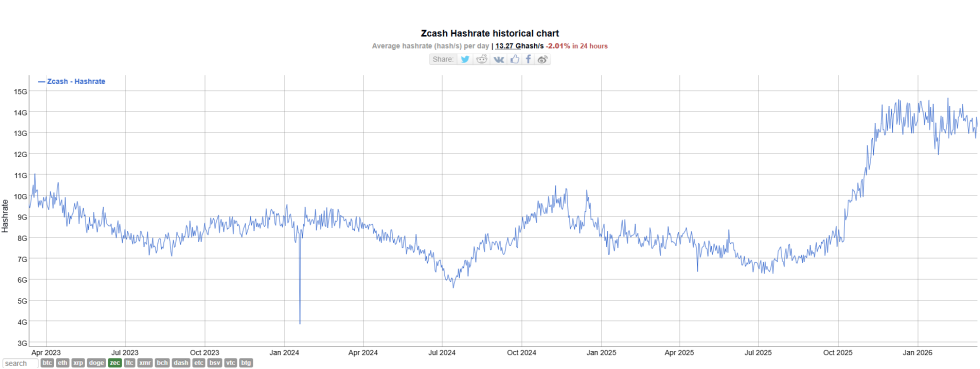
The announcement of Foundry’s expansion comes at a time of renewed vigor for the Zcash network. Data from BitInfoCharts indicates a substantial increase in the network’s computing power over the latter half of 2025 and early 2026. In October 2025, the Zcash hashrate was measured at approximately 8 Gigahashes per second (Ghash/s). By early 2026, this figure had surged to over 13 Ghash/s, representing a nearly 63% increase in network security and miner participation within a few months.
Several factors contribute to this growth in hashrate:
- Hardware Efficiency: The release of more efficient Application-Specific Integrated Circuit (ASIC) miners designed for the Equihash algorithm has allowed miners to generate more hashes per watt of electricity consumed.
- Market Speculation: Anticipation of institutional infrastructure, such as the Foundry pool, often leads to a "front-running" effect where miners increase their capacity in expectation of higher asset prices and greater network utility.
- Network Upgrades: Recent protocol improvements aimed at enhancing the performance of shielded transactions have made the network more attractive to developers and users alike.
This growth in hashrate is a critical metric for Foundry, as it indicates a healthy and competitive mining environment. A higher hashrate makes the network more resistant to 51% attacks, thereby increasing its appeal to institutional custodians who prioritize the security of the underlying ledger.
Chronology of Foundry’s Expansion and Market Positioning
Foundry’s journey to becoming the largest Bitcoin mining pool operator began in 2019 when Digital Currency Group launched the firm to provide institutional-grade services to the North American mining industry. Since then, the company has followed a clear timeline of expansion:
- 2020-2021: Foundry USA rapidly climbed the ranks of Bitcoin mining pools, eventually securing the number one spot by total hashrate. This was largely due to its "Foundry Academy" and its ability to provide financing for mining hardware.
- 2023-2024: The company focused on horizontal integration, offering site services, hardware sales, and advisory roles for large-scale data centers.
- Late 2025: Amidst a period of workforce restructuring aimed at streamlining operations, Foundry identified Zcash as a strategic growth area.
- March 2026: Official announcement of the institutional Zcash pool.
- April 2026: Projected launch date for the Zcash mining operations.
This timeline suggests that Foundry’s move into Zcash is not a reactionary step but a calculated part of a multi-year strategy to dominate the infrastructure layer of high-value PoW (Proof of Work) assets.

Official Responses and Industry Reactions
The reaction from the Zcash community has been overwhelmingly positive. Zooko Wilcox, the founder of Zcash and currently the Chief Product Officer at Shielded Labs, expressed his enthusiasm for the partnership. Shielded Labs, an independent organization based in Switzerland dedicated to supporting the Zcash ecosystem, views the entry of a North American giant as a validation of Zcash’s long-term viability.
"We at Shielded Labs are delighted that Foundry—the largest Bitcoin mining pool, and one based in North America—is launching an enterprise-grade Zcash mining pool," Wilcox stated. He further noted that the presence of such a reputable operator would likely encourage more public companies to explore ZEC mining as a legitimate business line.
Industry analysts suggest that Foundry’s move may also be a response to the shifting landscape of Bitcoin mining. As Bitcoin block rewards continue to decrease with each halving, large-scale miners are increasingly looking for secondary assets to mine using their existing infrastructure or by diversifying into new hardware. Zcash, with its Bitcoin-like tokenomics and proven track record, is a logical choice for firms already comfortable with the PoW model.
Broader Impact and Implications for the Crypto Market
The launch of an institutional Zcash pool by Foundry has several far-reaching implications for the digital asset industry:
1. Legitimation of Privacy Technology:
Foundry’s involvement provides a "stamp of approval" for privacy-preserving technologies. By creating a compliant pathway for institutions to mine ZEC, Foundry is helping to decouple the concept of "privacy" from "illicit activity" in the eyes of regulators and traditional finance.
2. Decentralization of Geographic Hashrate:
Historically, much of the hashrate for privacy coins was concentrated in regions with less regulatory clarity. By establishing a major pool in North America, Foundry contributes to the geographic decentralization of the Zcash network, making it less vulnerable to regional regulatory crackdowns.
3. Competitive Pressure on Existing Pools:
Foundry’s entry will likely force existing Zcash mining pools to upgrade their offerings. To compete with an institutional-grade service, other pools may need to improve their transparency, payout structures, and user interfaces, ultimately benefiting the entire mining community.
4. Potential for ZEC Price Stability:
While mining activity does not always correlate directly with price, the presence of institutional miners often leads to more sophisticated selling strategies. Rather than dumping rewards immediately to cover costs, institutional players may engage in more structured hedging, potentially reducing the extreme volatility often seen in the ZEC markets.
Current Market Performance and Future Outlook
At the time of the announcement, Zcash (ZEC) was trading at approximately $209. Despite a weekly retracement of roughly 11%, the long-term sentiment among proponents remains cautiously optimistic. The price action reflects a broader market correction, but the fundamental growth in network hashrate suggests that miners remain committed to the asset’s future.
As the April 2026 launch date approaches, the industry will be watching closely to see how much of the existing Zcash hashrate migrates to Foundry’s pool. If Foundry can replicate its success with Bitcoin, it could soon become the dominant force in Zcash mining, providing the network with the stability and institutional backing it has sought since its inception a decade ago. This development reinforces the narrative that the future of blockchain technology lies in the intersection of robust privacy and institutional-grade reliability.