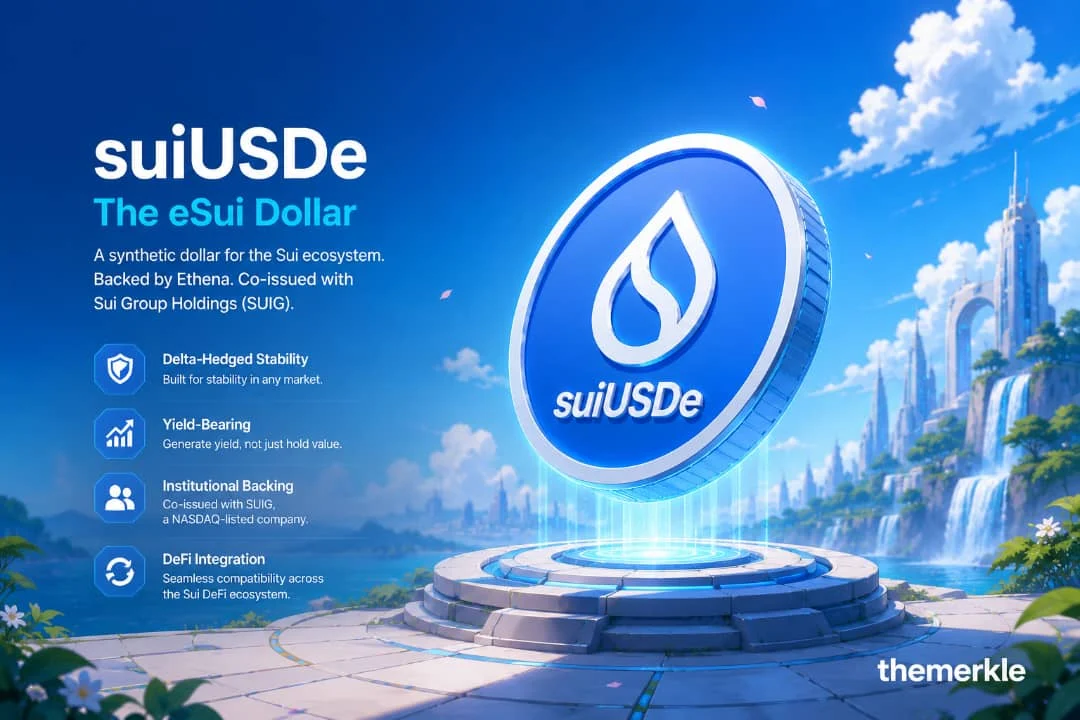
The token, officially known as the eSui Dollar, is the product of a strategic collaboration between Ethena Labs, a prominent decentralized finance (DeFi) protocol, and Sui Group Holdings (NASDAQ: SUIG), a NASDAQ-listed public company. This partnership has already seen suiUSDe integrated into various DeFi protocols across the Sui blockchain ecosystem. Until this development, comprehensive information regarding suiUSDe was fragmented across multiple forum posts, technical documentation, and social media announcements. The introduction of a centralized landing page streamlines access to critical details, providing a singular, authoritative source for understanding the token. While seemingly a minor technical launch, the creation of a dedicated informational hub is crucial for synthetic dollar tokens, whose widespread adoption and stability heavily depend on user comprehension and trust. A well-structured, accessible website serves as a foundational element in establishing a token’s credibility and fostering broader understanding at scale within the complex DeFi landscape.
Unpacking suiUSDe: A New Paradigm in Synthetic Assets
suiUSDe fundamentally redefines the concept of a stablecoin, diverging sharply from the traditional model reliant on direct fiat currency reserves held in bank accounts. Instead, it operates on the innovative mechanism pioneered by Ethena for its flagship USDe token on the Ethereum network. This mechanism involves a sophisticated strategy of collateralization paired with dynamic trading positions designed to offset price swings, a practice known as delta-neutral hedging. Crucially, this system is engineered to generate yield through these trading strategies, rather than merely parking value in static reserves.
The core of Ethena’s model involves holding liquid staking tokens (LSTs) derived from Ethereum (or other supported chains) as collateral, which generate a native staking yield. This yield is then amplified by engaging in perpetual futures contracts on centralized exchanges. By simultaneously holding the underlying asset (e.g., staked ETH) and shorting its equivalent value in perpetual futures, the protocol aims to maintain a delta-neutral position. This means that as the price of the underlying asset fluctuates, the gains or losses from the spot position are theoretically balanced by the inverse movements in the futures position, thereby stabilizing the token’s peg to the U.S. dollar. The yield generated primarily stems from the funding rates of these perpetual futures markets and the inherent staking yield of the collateral. This innovative approach offers a yield-bearing synthetic dollar that aims to be censorship-resistant and scalable, unlike traditional fiat-backed stablecoins which often face centralization risks and regulatory scrutiny over their reserves.
The joint issuance of suiUSDe is particularly noteworthy within the cryptocurrency space. Ethena Labs, a crypto-native protocol, has rigorously tested and proven its synthetic dollar model through various market conditions on Ethereum. Partnering with Sui Group Holdings, a public company subject to NASDAQ listing rules and direct accountability to shareholders, introduces an unprecedented layer of oversight and institutional integration into a DeFi asset. This fusion of a cutting-edge decentralized protocol with a publicly traded entity represents a significant departure from the norm in an industry often characterized by its permissionless and less regulated nature. The model has already demonstrated its viability, with suiUSDe actively integrated into lending markets and liquidity pools across the Sui DeFi ecosystem since its initial launch, suggesting a ready-made utility for the asset rather than a speculative, cold start.
The Strategic Alliance: Ethena and Sui Group Holdings
The collaboration between Ethena Labs and Sui Group Holdings to issue suiUSDe is more than just a technical integration; it is a strategic alliance that brings together distinct strengths from both the decentralized and traditional financial worlds. Ethena’s expertise lies in its innovative financial engineering, having developed a robust synthetic dollar protocol that has achieved significant adoption. Their USDe token, launched earlier this year on Ethereum, quickly ascended to become one of the largest synthetic dollar offerings in crypto, demonstrating the resilience and scalability of its underlying mechanism. This track record of surviving actual market volatility, rather than merely presenting a theoretical framework, was a crucial factor for the Sui ecosystem in seeking to adopt Ethena’s model rather than developing an untested solution from scratch.
Sui, a relatively new Layer 1 blockchain, was not an arbitrary choice for Ethena’s expansion. Developed by Mysten Labs, a team composed of former engineers from Meta’s Diem (formerly Libra) project, Sui is built for speed, scalability, and low transaction costs, utilizing a unique object-centric data model and the Move programming language. Its distinct execution design, which allows for parallel transaction processing, positions it as a strong contender for high-throughput DeFi applications. Prior to suiUSDe, the Sui DeFi ecosystem, despite its technological prowess and growing user base, had a discernible gap: a reliable, yield-bearing dollar asset that could serve as a foundational primitive for its lending, borrowing, and trading protocols. The introduction of suiUSDe directly addresses this critical need, providing a stable, capital-efficient asset that can significantly enhance the liquidity and depth of Sui’s burgeoning DeFi landscape.
For Ethena, each successful deployment on a new blockchain like Sui serves as a powerful validation of its core mechanism’s interoperability and universality. A single successful product on Ethereum demonstrates proof-of-concept; multiple successful deployments across diverse ecosystems elevate Ethena’s model from a niche product to a foundational category within the broader DeFi space. This cross-chain expansion strategy is vital for Ethena’s long-term vision of becoming a global synthetic dollar provider, leveraging the unique strengths of various Layer 1 networks.
Sui Blockchain: A Growing Ecosystem
The Sui blockchain, launched in May 2023, has rapidly gained traction as a high-performance Layer 1 platform. Its architecture, inspired by the lessons learned from the Diem project, is designed to support a new generation of decentralized applications that demand high throughput and low latency. Key features include its object-centric model, which allows for greater parallelism and efficiency in transaction processing, and its use of the Move programming language, which offers enhanced security features for smart contracts.
Since its mainnet launch, Sui has seen steady growth in its Total Value Locked (TVL), attracting developers and users with its promise of scalability and a developer-friendly environment. As of late 2023 and early 2024, Sui’s TVL has grown to over $700 million, indicating a healthy and expanding ecosystem of decentralized applications. Prominent DeFi protocols on Sui include lending platforms like Scallop Lend and Navi Protocol, decentralized exchanges (DEXs) such as Cetus and Turbos Finance, and liquid staking providers like Volo. These platforms offer a diverse range of financial services, from spot trading and liquidity provision to collateralized lending and yield farming.
However, a recurring challenge for many nascent Layer 1 ecosystems, including Sui, has been the absence of a deeply liquid, capital-efficient, and yield-bearing stablecoin. Traditional stablecoins like USDT and USDC are available on Sui but often do not offer native yield and can be subject to the policies of their centralized issuers. The introduction of suiUSDe fills this void by providing a synthetic dollar that not only aims for price stability but also generates yield through its underlying mechanism, making it a more attractive asset for long-term holding and integration into DeFi strategies. This makes suiUSDe a crucial building block for Sui’s continued DeFi growth, enabling more sophisticated financial products and attracting greater capital.
The Genesis of USDe: Ethena’s Track Record
Ethena’s journey began with the launch of USDe on the Ethereum mainnet in early 2024, following extensive development and auditing. The protocol quickly garnered attention for its innovative approach to stablecoin design and its ability to offer a native yield. Within months, USDe’s market capitalization soared, reaching over $3 billion by mid-2024, establishing it as one of the fastest-growing synthetic assets in the crypto space. This rapid ascent was not merely a result of market hype but a testament to the robustness of Ethena’s delta-neutral hedging strategy, which had been rigorously backtested and proven in live market conditions.
The Ethena model addresses several limitations of traditional stablecoins. Fiat-backed stablecoins, while offering stability, are centralized, subject to single points of failure, and often lack transparency regarding their reserves. Algorithmic stablecoins, on the other hand, have historically struggled with maintaining their peg during periods of extreme market stress, leading to spectacular collapses. Ethena’s USDe aims to offer a decentralized, scalable, and censorship-resistant alternative by leveraging liquid staking derivatives and perpetual futures. Its ability to generate yield from both staking rewards and funding rates provides a compelling incentive for users, distinguishing it from non-yield-bearing stablecoins. The success and resilience of USDe on Ethereum provided the necessary validation and confidence for a public entity like Sui Group Holdings to engage in a co-issuance partnership, demonstrating the increasing acceptance of innovative DeFi solutions by more traditional financial players.
Bridging TradFi and DeFi: Sui Group Holdings’ Unique Position
The involvement of Sui Group Holdings, a NASDAQ-listed company trading under the ticker SUIG, in the co-issuance of a synthetic dollar is arguably the most compelling aspect of this entire development. Public companies operate under a fundamentally different regulatory and transparency regime than most decentralized protocols. They are subject to stringent reporting requirements from the U.S. Securities and Exchange Commission (SEC), must adhere to generally accepted accounting principles (GAAP), release quarterly earnings reports, and are accountable to a broad base of shareholders. This level of regulatory scrutiny and corporate governance is a stark contrast to the often pseudonymous and less formal structures prevalent in the DeFi sector.
By putting its name on suiUSDe, SUIG brings this traditional financial rigor and accountability directly into the realm of a synthetic crypto asset. This move is indicative of a broader, evolving trend within the financial industry where public companies are looking beyond merely holding cryptocurrency on their balance sheets (as seen with Bitcoin purchases by MicroStrategy or Tesla) and are actively seeking to build and integrate products on-chain. Co-issuing a token represents a far more active, strategic, and deeply integrated bet on the future of decentralized finance than simply acquiring and holding digital assets. It signifies a willingness to engage directly with the technical and operational complexities of DeFi, alongside its potential rewards and risks.
For Sui Group Holdings, the success and growth of suiUSDe are directly tied to its own financial performance. This creates a different kind of exposure and incentive structure compared to typical public company involvement in crypto. If suiUSDe gains significant adoption and maintains its stability and yield generation, it could contribute substantially to SUIG’s revenue streams and market valuation. This strategic move could position SUIG as a pioneer in institutional engagement with DeFi, setting a precedent for how traditional finance can actively participate in and benefit from the burgeoning decentralized economy, rather than merely observing it from the sidelines. It also opens up new avenues for regulated entities to explore yield generation and asset management within the digital asset space, potentially attracting a new class of institutional investors to the Sui ecosystem.
The Crucial Role of Transparency and User Understanding
While a dedicated website might appear to be the least technically sophisticated aspect of this news, its strategic importance for a complex financial product like suiUSDe cannot be overstated. Synthetic dollars, particularly those employing sophisticated delta-neutral hedging strategies, are inherently more intricate than simple fiat-backed stablecoins. Users need to understand several key aspects: where the yield originates, how the collateral is managed, the mechanics behind its price stability, and the inherent risks involved. This information is difficult to convey effectively through short social media posts, scattered documentation, or even verbose whitepapers that lack user-friendly presentation.
A dedicated landing page serves as the single, authoritative source for this critical information. It allows for a clear, concise, and structured explanation of suiUSDe’s underlying mechanism, its partnership structure, its benefits, and its risks. Such a resource, easily accessible and well-organized, empowers users to conduct their due diligence efficiently. In the fast-paced and often opaque world of DeFi, users are notoriously quick to disengage from products they cannot quickly and comprehensively understand. Even if the underlying mechanics are robust and secure, a lack of clear communication can severely hinder adoption.
Furthermore, the existence of a polished, professional website signals a level of maturity and commitment from the project teams. Many nascent tokens, especially those in the early stages of establishing liquidity, often prioritize technical development and market presence over comprehensive user-facing documentation. The fact that suiUSDe, despite its relatively recent integration into the Sui ecosystem, already boasts both significant DeFi integration and a professional landing page, suggests a thoughtful, long-term strategy for fostering trust and widespread adoption. This commitment to transparency and user education is a cornerstone for building a sustainable synthetic dollar ecosystem.
Implications for the DeFi Landscape and Beyond
The launch of suiUSDe with a dedicated landing page and the underlying partnership between Ethena and Sui Group Holdings carries significant implications for the broader DeFi landscape and the convergence of traditional finance with blockchain technology.
For the Sui ecosystem, suiUSDe represents a critical infrastructure upgrade. It provides a native, yield-bearing dollar asset that can unlock new possibilities for capital efficiency, liquidity depth, and product innovation across its lending, borrowing, and trading protocols. This could attract more developers, users, and institutional capital to the Sui network, accelerating its growth and strengthening its competitive position among Layer 1 blockchains.
For Ethena, this expansion validates its vision of building a universal synthetic dollar. It demonstrates that its delta-neutral hedging model is not confined to Ethereum but can be successfully deployed and integrated across diverse blockchain architectures. This cross-chain strategy is crucial for Ethena’s ambition to become a dominant player in the global stablecoin market, offering a truly decentralized and scalable alternative to centralized offerings.
Perhaps the most profound implication lies in the pioneering role of Sui Group Holdings. Their direct involvement in co-issuing a DeFi token could serve as a blueprint for how other publicly traded companies might engage with blockchain technology. It signals a shift from passive investment to active participation, potentially paving the way for greater institutional adoption and the development of hybrid TradFi-DeFi products. This integration brings with it the potential for increased regulatory clarity, enhanced investor confidence, and a bridging of the trust gap that often exists between traditional finance and the crypto world.
Regulatory Outlook and Future Prospects
The involvement of a NASDAQ-listed entity like Sui Group Holdings inevitably brings regulatory considerations to the forefront. Public companies are subject to securities laws, anti-money laundering (AML) regulations, and Know Your Customer (KYC) requirements. While Ethena’s protocol itself operates in a decentralized manner, the association with SUIG may necessitate certain compliance measures or influence the operational framework around suiUSDe, particularly concerning access points or interactions facilitated by SUIG. This unique setup could either attract regulatory scrutiny or, conversely, provide a pathway for regulators to better understand and eventually regulate hybrid DeFi products, potentially fostering a more compliant and mature digital asset market.
Looking ahead, the success of suiUSDe will depend on several factors: its ability to consistently maintain its peg, the sustainability of its yield generation in varying market conditions, and its continued integration into the Sui DeFi ecosystem. The dedicated landing page is a foundational step in building trust and understanding, but ongoing transparency, robust risk management, and continuous innovation will be crucial for long-term growth. If suiUSDe proves to be a resilient and widely adopted asset, it could not only transform the Sui ecosystem but also catalyze further partnerships between traditional finance and decentralized protocols, marking a significant evolution in the broader financial landscape.