The global cryptocurrency market is currently navigating a pivotal transition as Bitcoin, the industry’s primary benchmark, faces significant technical resistance and a shift in investor sentiment. Recent market data and technical analysis from prominent observers, including Justcryptopays, indicate that Bitcoin’s recent break below a critical support trendline could be the harbinger of a broader capital rotation. This movement, often referred to in the industry as "Alt-Season," describes a period where alternative digital assets outperform Bitcoin in terms of percentage gains, driven by a redistribution of liquidity and a heightened appetite for risk among both retail and institutional participants.
As the market enters the opening stages of 2026, the digital asset landscape is characterized by a complex interplay between Bitcoin’s price consolidation and the burgeoning strength of the altcoin sector. Bitcoin has historically captured the vast majority of capital inflows, acting as the primary entry point for new investors. However, when Bitcoin enters a phase of sideways trading or moderate correction—particularly after failing to maintain psychological milestones like the $90,000 level—investors frequently seek higher returns in assets with smaller market capitalizations.
The Technical Breakdown of Bitcoin’s Dominance
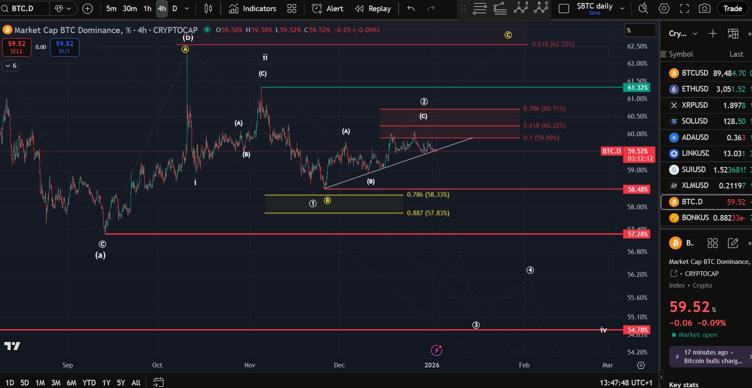
The current market dynamic is heavily influenced by Bitcoin’s inability to solidify its position above the $90,000 threshold. While the asset was recently observed trading at approximately $90,525, its failure to sustain a convincing rally beyond this psychological barrier has introduced a degree of caution into the market. Technical analysts point to the breach of a key upward trendline that had supported Bitcoin’s price action throughout the latter half of 2025.
When a benchmark asset like Bitcoin breaks below such a trendline, it often signals a temporary exhaustion of buying pressure. This exhaustion does not necessarily imply a long-term bearish reversal for the entire market, but rather a rebalancing of portfolios. For much of 2025, the market was characterized by "Bitcoin Dominance" (BTC.D), a metric that measures Bitcoin’s share of the total crypto market capitalization. As Bitcoin’s price stagnates or dips, this dominance often declines, providing the "oxygen" necessary for altcoins to breathe.
Market data suggests that the $90,000 level has transformed from a support zone into a formidable resistance area. For Bitcoin to reclaim its bullish momentum, it would need to see a significant increase in spot buying volume and a clearing of the leveraged sell orders clustered around the $92,000 to $95,000 range. In the absence of such a move, capital is beginning to flow into the "Large Cap" altcoin category, which includes Ethereum (ETH), Solana (SOL), and XRP.
The Mechanics of Capital Rotation
The phenomenon of capital rotation follows a predictable, albeit non-linear, path in the cryptocurrency ecosystem. Typically, the cycle begins with a Bitcoin rally, followed by a move into Ethereum. Once Ethereum gains momentum, investors shift toward other high-market-cap assets like Solana, Cardano (ADA), and Polkadot. Finally, the liquidity trickles down into mid-cap and small-cap projects, including decentralized finance (DeFi) protocols and memecoins.

Binance Research has previously noted that "Alt-Season" is often triggered by a combination of Bitcoin price stability and a decline in Bitcoin dominance. When Bitcoin remains relatively stable, it reduces the perceived risk of a market-wide crash, giving traders the confidence to move further out on the risk curve. Currently, the "Altcoin Season Index," a popular tool used to track whether the top 50 altcoins are outperforming Bitcoin over a 90-day period, is showing signs of a potential upward breakout.
In this environment, Ethereum and Solana are positioned as the primary beneficiaries. Ethereum continues to benefit from its role as the foundational layer for the majority of decentralized applications, while Solana’s high-throughput architecture has made it a favorite for retail-driven trading and new token launches. The rotation is further supported by the growing maturity of the DeFi and Web3 sectors, which are now offering tangible utility and revenue-generating models that were less prevalent in previous cycles.
Historical Context and the 2025 Bearish Hurdle
To understand the potential for a 2026 altcoin resurgence, one must look at the hurdles faced in the preceding year. 2025 was a year of significant volatility, characterized by regulatory shifts and macroeconomic uncertainty. Many altcoins suffered from a prolonged bearish momentum as liquidity remained concentrated in Bitcoin ETFs (Exchange-Traded Funds) and other institutional-grade Bitcoin products.
The challenge for "bulls" in the current year is to shake off the negative sentiment lingering from the previous 12 months. Historical data from the 2017 and 2021 bull markets shows that altcoin rallies often follow a period of extreme "disbelief" among retail investors. During these periods, the market often sees a "shakeout" where weak hands exit their positions, allowing long-term accumulators to build positions at lower valuations.
The current transition suggests that the market may have reached a point of maximum pain for altcoin holders. With many assets trading significantly below their 2021 all-time highs despite continued technological development, the valuation gap between Bitcoin and the rest of the market has reached a level that many institutional analysts find attractive for "value" investing within the crypto space.
Performance of Major Altcoins and Emerging Tokens
As the rotation gains steam, several key assets are being watched closely by market participants:
- Ethereum (ETH): Often seen as the leader of the altcoin pack, Ethereum’s transition to a more scalable network via Layer-2 solutions like Arbitrum and Optimism has maintained its dominance in the smart contract space. If Ethereum can break its own resistance levels against Bitcoin (the ETH/BTC pair), it is widely expected to trigger a broader market rally.
- Solana (SOL): Solana has emerged as a major competitor to Ethereum, particularly in the realm of fast, low-cost transactions. Its ecosystem has seen a resurgence in developer activity, and it remains a top choice for investors looking for "high-beta" exposure to the market.
- XRP and Cardano (ADA): These legacy altcoins often see renewed interest during periods of capital rotation, particularly as regulatory clarity in the United States and other major jurisdictions continues to improve.
- Memecoins: While highly speculative, memecoins serve as a barometer for retail sentiment. Increased trading activity in this sub-sector often precedes a wider move into more fundamentally sound altcoin projects.
Macroeconomic Influences and Institutional Sentiment
The broader financial environment also plays a crucial role in the timing of an altcoin rally. Factors such as the Federal Reserve’s interest rate policy, global inflation rates, and the strength of the U.S. dollar all impact liquidity in the crypto market. In a "risk-on" environment, where interest rates are stable or declining, investors are more likely to diversify into speculative assets like altcoins.
Furthermore, the institutionalization of the crypto market through spot ETFs has changed the way capital enters the system. While the initial wave of institutional money was almost exclusively focused on Bitcoin, there is growing evidence of interest in Ethereum-based products and diversified crypto baskets. As institutional platforms expand their offerings to include a wider range of digital assets, the barrier to entry for professional capital into the altcoin market continues to lower.
Implications for Investors and Future Outlook
The potential shift toward an altcoin-centric market presents both opportunities and risks. For short-term traders, the increased volatility inherent in altcoins offers the possibility of significant gains but also the risk of rapid drawdowns. For long-term investors, the current market dynamics may offer a window to position themselves in projects that have survived the bearish trends of the past and are now entering a growth phase.
Vigilance remains the watchword for market participants. While the technical breakdown of Bitcoin’s trendline and the struggle to hold $90,000 are compelling indicators, the cryptocurrency market is notoriously unpredictable. External shocks, such as unexpected regulatory crackdowns or global geopolitical instability, could still disrupt the projected capital rotation.
However, the underlying data points to a market that is maturing and diversifying. The era of Bitcoin being the "only game in town" appears to be evolving into a more balanced ecosystem where a variety of digital assets can thrive based on their own merits and use cases. As 2026 progresses, the ability of altcoins to maintain their current momentum will likely determine whether the market enters a sustained "Alt-Season" or remains in a state of consolidation.
In conclusion, the current indicators—from technical trendline breaks to psychological price barriers—suggest that the market is at a crossroads. The rotation of capital from the flagship cryptocurrency into the broader altcoin market is not just a speculative trend but a structural evolution of the digital asset economy. Investors who can successfully navigate this shift by identifying high-quality assets and understanding the mechanics of market liquidity will be well-positioned to capitalize on the next phase of the crypto market’s development.