


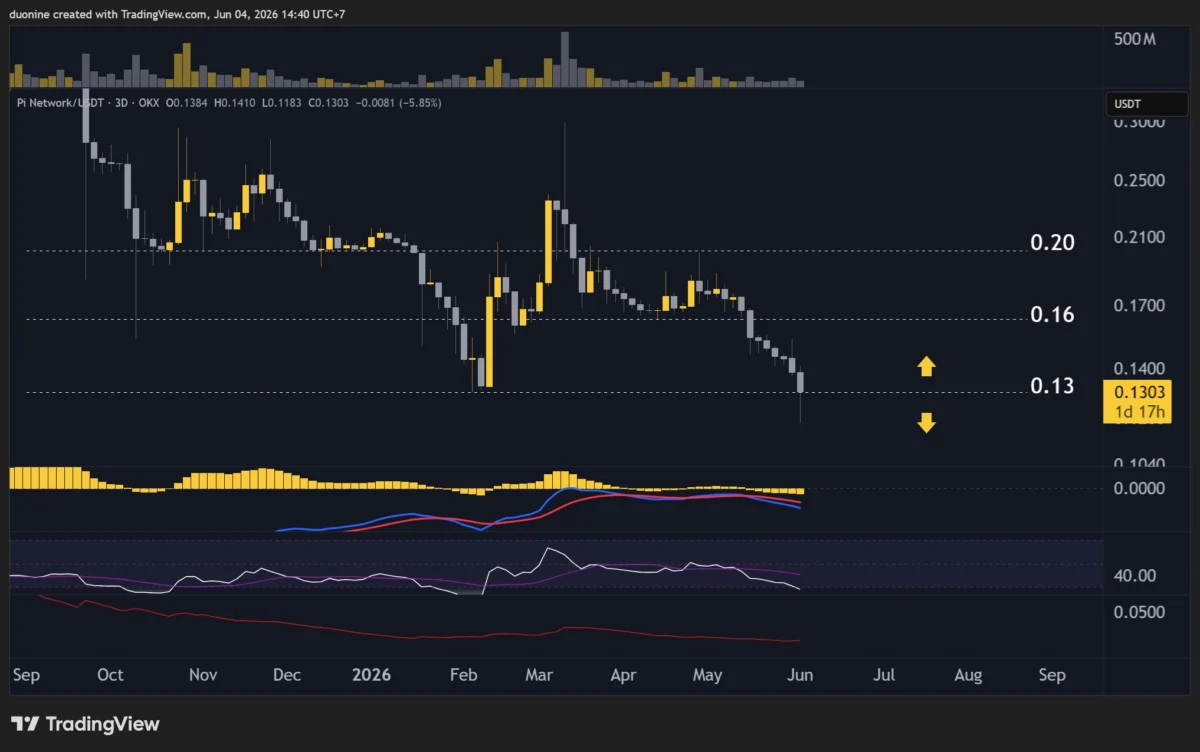
This week, PI cryptocurrency experienced a significant downturn, with its price plummeting by 10% and reaching a critical support level. The sharp decline has reignited concerns among investors and analysts about the cryptocurrency’s short-term trajectory and its ability to maintain its current valuation. Key support levels are identified at $0.13 and $0.10, while resistance is anticipated at $0.16 and $0.20. The current market sentiment leans bearish, underscored by increasing selling volume in recent days, despite a brief resurgence of buyer interest at the $0.13 mark.
Market Crash Sends PI to Key Support
The cryptocurrency market has been characterized by volatility in recent weeks, and PI has not been immune to these broader market forces. The recent 10% price drop has brought PI to a crucial technical juncture, the $0.13 support level. Historically, this level has acted as a floor for the cryptocurrency, where buying pressure has often emerged to counter downward trends. However, the current environment presents a more challenging scenario. While buyers have indeed shown up at $0.13, the persistent increase in selling volume over the past few days suggests that the bearish pressure may be overwhelming initial recovery attempts.
The formation of a lower low in PI’s price chart is a strong indicator that the established downtrend remains firmly intact. This technical pattern suggests that the downward momentum could continue, potentially leading to further price erosion. For this bearish outlook to be definitively confirmed, the current support at $0.13 would need to fail, transforming into resistance. Should this occur, it would signal a loss of confidence from buyers and an acceleration of selling activity.
Sellers Dominate Recent Price Action
On a shorter timeframe, specifically the 3-day chart, the dominance of sellers has been evident for eight consecutive trading periods. This sustained selling pressure has been instrumental in driving the price down by approximately 30%. The aggressive selloff began precisely when the previous support level at $0.16 could no longer withstand the selling onslaught. This breach of $0.16 served as a clear signal to the market that the bears were in control, prompting further liquidation.
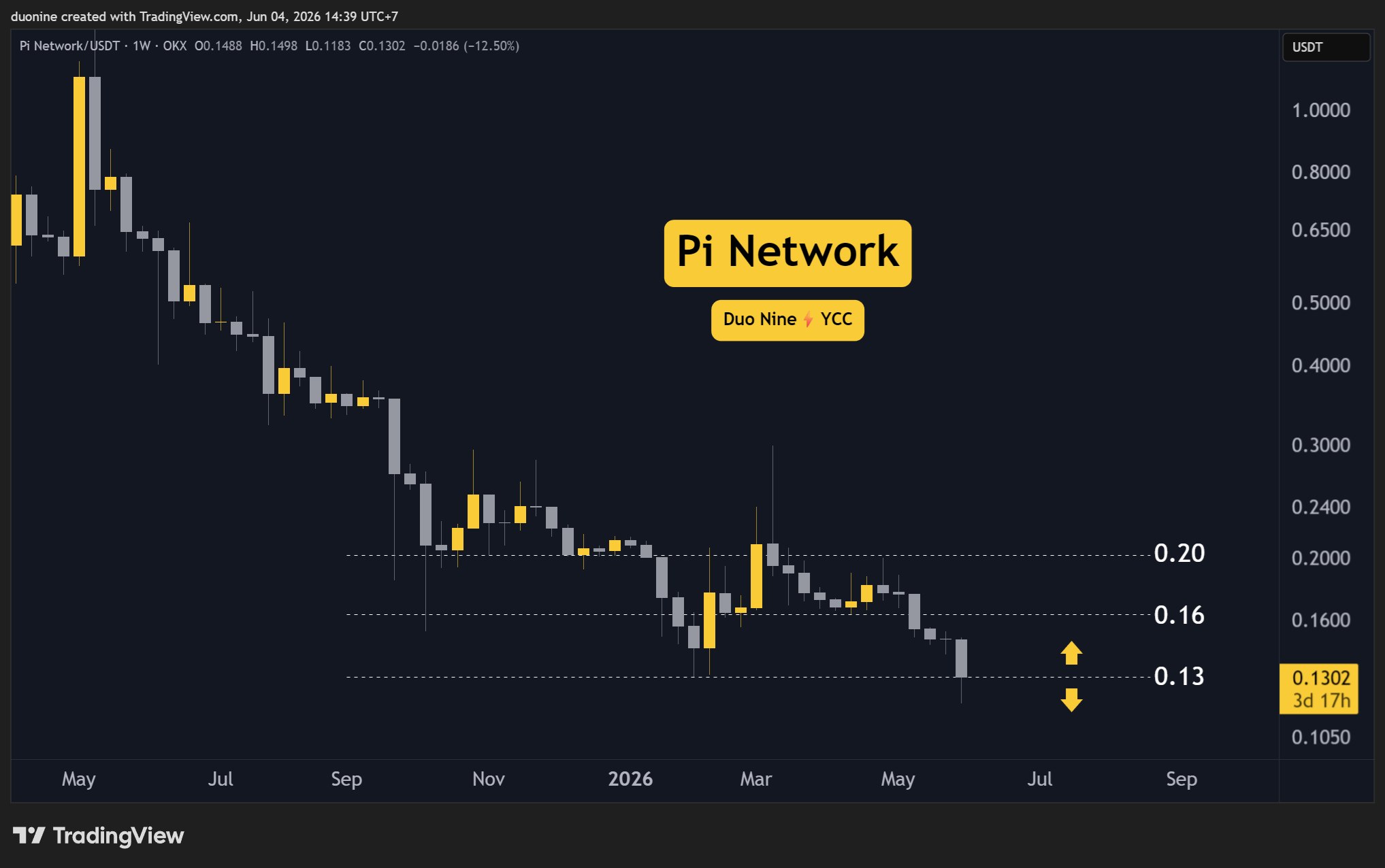
The pattern observed in the breakdown of the $0.16 support level offers a concerning precedent for the current situation at $0.13. If this $0.13 level also succumbs to selling pressure and transitions into resistance, it is highly probable that a similar, if not more accelerated, downtrend could materialize. Such a scenario would likely see PI’s price continue to fall, with the next significant technical target being the $0.10 support level. This level represents a deeper trough in the current bearish cycle and would indicate a substantial loss of value for PI holders.
Daily RSI Indicates Oversold Conditions, But Caution Remains
The Relative Strength Index (RSI) on the daily chart provides further insight into the current market dynamics. The recent price decline has pushed the daily RSI into deeply oversold territory, falling below the 30-point threshold. At the time of this report, the RSI hovers around the 25-point mark, a level typically associated with extreme selling pressure. Critically, there are currently no discernible signs of a reversal on the RSI, suggesting that further downside movement remains a distinct possibility.
However, the fact that the RSI has reached such oversold levels also carries implications for potential future price action. Historically, prolonged periods in oversold territory can indicate that sellers are becoming overly aggressive, potentially exhausting their selling power. This often precedes a bounce or a relief rally as the market seeks to rebalance. Therefore, while the immediate outlook remains bearish, the oversold RSI suggests that a short-term rebound is becoming increasingly probable.
The critical factor for investors to monitor will be the price action at the $0.13 support level. If this level can indeed hold as a support, demonstrating resilience against further selling, it could provide an opening for buyers to re-enter the market. A sustained bounce from $0.13 could signal the beginning of a short-term recovery, offering a potential opportunity for those looking to capitalize on a temporary upward price movement. Conversely, a failure to hold $0.13 would solidify the bearish narrative and likely lead to further price declines towards the $0.10 target.
Understanding PI Network and its Market Context
PI Network is a cryptocurrency project that aims to provide a mobile-first cryptocurrency experience, allowing users to mine PI tokens through their smartphones. The project has garnered a significant following due to its accessibility and the promise of a decentralized digital currency that can be earned by everyday users. However, the project has faced scrutiny and questions regarding its tokenomics, development roadmap, and the actual utility and exchangeability of its native PI token.
The PI token is not yet listed on major cryptocurrency exchanges, which significantly impacts its liquidity and price discovery. While a closed "mainnet" phase allows for some internal transactions and potential exchange of PI for goods and services within the PI Network ecosystem, it does not provide the open market access typical of established cryptocurrencies. This lack of exchange listing contributes to the speculative nature of its valuation and the challenges in accurately assessing its true market value. The price points mentioned in this analysis ($0.13, $0.10, $0.16, $0.20) are likely derived from unofficial over-the-counter (OTC) trading or estimations within communities, rather than from regulated exchange data.
The current price action of PI should be viewed within the broader context of the cryptocurrency market. The sector has experienced significant volatility in recent times, influenced by macroeconomic factors such as inflation concerns, interest rate hikes by central banks, and regulatory uncertainties. Major cryptocurrencies like Bitcoin and Ethereum have also seen substantial price corrections, creating a ripple effect across the altcoin market. Projects with less established market presence or those relying heavily on community speculation, like PI, are often more susceptible to these broader market swings.
Timeline of Recent Events and Potential Implications
The recent 10% drop in PI’s value represents a continuation of a broader bearish trend that has been in play for several weeks. The failure of the $0.16 support level, which occurred prior to the current testing of $0.13, marked a significant bearish signal. This suggests that the selling pressure has been building, and the market has been progressively re-evaluating PI’s value.
If PI fails to hold the $0.13 support, the next significant psychological and technical level to watch would be $0.10. A drop to this level would represent a substantial loss from recent highs and could trigger further panic selling, especially among newer investors who may have entered the market at higher valuations. The extended period of selling observed on the 3-day chart, combined with the oversold RSI, suggests that market participants are becoming increasingly bearish.
However, the oversold RSI also hints at a potential for a technical rebound. Such a rebound would likely be a short-term relief rally rather than a sustained recovery, unless fundamental factors or significant development announcements emerge to support a genuine turnaround. For PI, a key development would be its eventual listing on major cryptocurrency exchanges, which would provide much-needed liquidity and legitimacy. Without such developments, PI’s price movements will likely continue to be driven by community sentiment and broader market trends, making it highly susceptible to speculative trading.
The implications of the current price action for the PI Network project are multifaceted. Continued price depreciation could dampen community enthusiasm and potentially slow down the pace of development or user adoption, as speculative interest wanes. Conversely, a successful defense of the $0.13 support and a subsequent recovery could rekindle optimism and encourage further participation.
Broader Impact and Investor Considerations
The situation with PI highlights the inherent risks associated with investing in cryptocurrencies, particularly those that are not yet widely traded on established exchanges. Investors are advised to exercise extreme caution and conduct thorough due diligence. Understanding the project’s fundamentals, its development progress, and the team’s credibility is crucial.
For PI specifically, the lack of exchange listings means that any price analysis is based on less reliable data sources. Investors should be aware that unofficial trading volumes and prices can be easily manipulated and may not reflect the true market sentiment or potential. The focus for PI Network currently remains on its development and the eventual transition to a fully open mainnet. Until then, its valuation will continue to be subject to high levels of speculation.
The current market sentiment in the broader cryptocurrency space remains cautious. While some analysts predict a potential bottoming out of the market, others warn of further downside risks. This uncertainty amplifies the volatility experienced by individual cryptocurrencies like PI. Investors looking at PI should consider their risk tolerance and investment horizon. Short-term traders might look for opportunities in potential relief rallies, while long-term investors would need to assess the project’s future prospects beyond current price fluctuations.
The key takeaway from the current technical analysis is that PI is at a critical juncture. The $0.13 support level will be pivotal in determining its immediate future direction. A breakdown below this level would signal further declines, while a successful hold could pave the way for a short-term recovery, albeit within a still prevailing bearish trend. The long-term success of PI Network will ultimately depend on its ability to deliver on its promises, establish a robust ecosystem, and gain broader market acceptance, which includes overcoming the hurdle of exchange listings and demonstrating tangible utility for its token.














