The cryptocurrency market is currently traversing a significant period of evolution, characterized by both the enduring influence of established assets and a burgeoning interest in early-stage, high-potential networks. Long-term trends surrounding the XRP price prediction and the Ethereum price forecast for 2030 continue to shape investor expectations, primarily driven by Ripple’s established utility in cross-border financial networks and Ethereum’s commanding dominance over smart contracts and Web3 systems. While these foundational digital currencies serve as crucial benchmarks for overall sector growth, market participants are increasingly reorienting their focus toward nascent projects that promise substantially higher upside potential, indicative of a strategic diversification within the investment landscape.
This evolving market dynamic has brought BlockDAG (BDAG) to the forefront of discussions. The network has strategically positioned itself as a compelling investment opportunity, particularly following the launch of a substantial 100% World Cup Bonus. This initiative allows early participants to acquire tokens at a low entry point of $0.00000066 per coin while securing up to 100% in additional tokens, thereby significantly amplifying their accumulation power. The project’s momentum has been further bolstered by the introduction of BlockDAG’s AI Large Language Model (LLM), a technological expansion poised to dramatically enhance ecosystem intelligence, scalability, and overall network adoption.
Adoption Trends and Regulatory Clarity Drive Long-Term XRP Price Predictions
Ripple’s expanding footprint in cross-border payments and its integration into international financial systems are critical determinants shaping the current XRP price prediction narrative. Engineered with the explicit purpose of facilitating rapid, low-cost international transactions, XRP aims to settle payments in mere seconds. This high-speed utility and cost-efficiency make it an inherently relevant asset for global remittance corridors and institutional payment infrastructures, offering a significant improvement over traditional banking systems which can take days and incur substantial fees.
The historical context of Ripple Labs, the company behind XRP, is rooted in a vision to modernize global finance. Founded in 2012, Ripple sought to create an "Internet of Value" where money could move as efficiently as information. XRP Ledger (XRPL), the decentralized open-source blockchain on which XRP operates, was designed to be faster, more energy-efficient, and cheaper than many other cryptocurrencies. RippleNet, the company’s proprietary payment network, leverages XRP for its On-Demand Liquidity (ODL) solution, enabling financial institutions to send money across borders without pre-funding accounts in destination currencies, thus reducing capital costs and operational complexities.
Despite its technological advantages and growing adoption, XRP’s long-term market projections have been significantly influenced by its ongoing legal battle with the U.S. Securities and Exchange Commission (SEC). The lawsuit, initiated in December 2020, alleged that Ripple conducted an unregistered securities offering through its sale of XRP. A pivotal ruling in July 2023, which declared that programmatic sales of XRP on exchanges did not constitute securities offerings, provided partial clarity and ignited a substantial price surge, highlighting the market’s sensitivity to regulatory developments.
Given these variables, long-term market forecasts for XRP exhibit a range of possibilities. Conservative analysts often suggest that moderate real-world adoption and gradual integration into existing financial frameworks will likely position the asset’s long-term valuation between $1 and $5. This perspective often accounts for continued regulatory hurdles and the inherent competition within the global payments sector. For instance, XRP transactions are processed typically within 3-5 seconds, at a cost often less than $0.001 per transaction, a stark contrast to traditional SWIFT payments that can take 3-5 business days and cost $25-$50 per transaction. This fundamental efficiency underpins the conservative valuation.
Conversely, more optimistic outlooks project the XRP price prediction upward to $10 or even higher. Achieving these elevated price levels is heavily contingent upon several key factors: the establishment of clearer and more favorable global regulatory frameworks, deeper and more widespread integration into institutional banking systems, and a significant increase in liquidity demands for cross-border transactions. Ripple executives have consistently emphasized the importance of regulatory clarity, stating that a defined legal framework would unlock immense institutional capital and accelerate adoption. Analysts from major financial institutions have echoed this sentiment, suggesting that deeper integration into traditional finance hinges on predictable and harmonized global regulations. Ultimately, the long-term trajectory of XRP remains intrinsically linked to its practical banking adoption and its capacity to fulfill the liquidity demands of a rapidly digitizing global financial landscape.
Ethereum Price Forecast 2030 Reflects Network Evolution and Ecosystem Dominance

The Ethereum price forecast for 2030 is fundamentally anchored to the network’s established and continually evolving role as the world’s preeminent smart contract platform. Since its launch in 2015 by Vitalik Buterin, Ethereum has served as the foundational backbone for the vast majority of decentralized finance (DeFi) applications, non-fungible tokens (NFTs), and decentralized applications (dApps). Its robust and flexible architecture has fostered an expansive ecosystem, attracting a diverse community of developers and innovators. This ecosystem currently hosts the largest share of decentralized protocols, evidenced by its substantial Total Value Locked (TVL) in DeFi, which frequently stands in the tens of billions of dollars, dwarfing most competitors.
Ethereum’s unparalleled developer engagement and continuous network activity are critical drivers of its long-term value. The network’s ability to host complex, programmable transactions has made it indispensable for a wide array of Web3 innovations, from lending and borrowing protocols to digital art marketplaces. This pervasive utility ensures a constant demand for its native cryptocurrency, Ether (ETH), which is used to pay for transaction fees (gas) and secure the network through staking.
Long-term valuation models consistently place the Ethereum price forecast for 2030 comfortably within the range of $8,000 and $20,000. Attaining these targets is predicated on several interconnected factors: sustained institutional participation, rising global adoption of blockchain technology, and the successful implementation of ongoing network upgrades. Institutional interest in Ethereum has grown significantly, with major financial players exploring ETH-based investment products and enterprise solutions built on its infrastructure. Industry leaders foresee a future where enterprise solutions increasingly leverage Ethereum’s robust and secure infrastructure for supply chain management, digital identity, and tokenized assets.
A key component of Ethereum’s evolutionary strategy involves a series of ongoing technical upgrades designed to enhance its scalability, security, and sustainability. The most significant of these was "The Merge" in September 2022, which transitioned the network from a proof-of-work (PoW) consensus mechanism to a more energy-efficient proof-of-stake (PoS) model. This move dramatically reduced Ethereum’s carbon footprint and laid the groundwork for future scalability improvements. Subsequent upgrades, such as those focusing on "sharding," aim to increase transaction throughput and lower gas fees during periods of peak network congestion. Sharding will divide the network into multiple smaller chains (shards), allowing for parallel processing of transactions and significantly boosting overall capacity. Additionally, Layer 2 scaling solutions like Optimistic Rollups and ZK-Rollups have emerged as vital components, processing transactions off-chain before settling them on the main Ethereum network, offering immediate relief for high gas fees and slow transaction speeds.
Ethereum Foundation researchers continually stress the imperative of scalability and efficiency to maintain its competitive edge. While challenges from "Ethereum killers" – rival blockchains promising faster and cheaper transactions – persist, Ethereum’s established network effect, security, and developer community remain formidable advantages. As blockchain technology integrates further into mainstream industries, Ethereum’s capability to maintain a reliable, scalable, and cost-effective infrastructure will be paramount in dictating its long-term financial position and its continued dominance in the decentralized digital economy.
BlockDAG’s Strategic World Cup Bonus and AI Integration Boost Token Accumulation Power
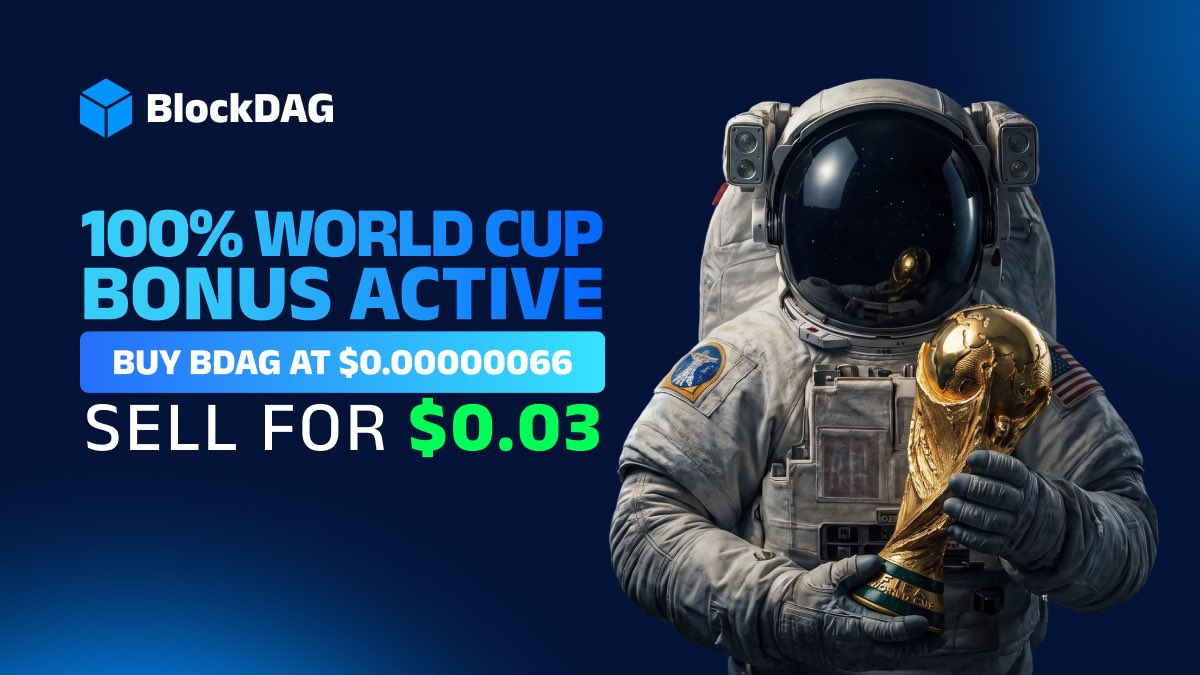
Amidst the established giants, BlockDAG is rapidly capturing widespread attention, positioning itself as a compelling new entrant in the crypto space by rolling out advanced features and expanding utility. This rapid growth trajectory is solidifying its reputation as a leading candidate for individuals seeking early network momentum and significant upside potential. A primary catalyst driving this heightened market interest is the introduction of a limited-time 100% World Cup Bonus. This promotional structure is strategically designed to dramatically boost coin accumulation for early adopters, granting buyers an additional 50% to 100% in BDAG tokens, effectively doubling their initial positions upon activation. This aggressive incentive mechanism aims to attract substantial capital and foster a strong, engaged community from its nascent stages.
BlockDAG operates on a Directed Acyclic Graph (DAG) architecture, which differentiates it from traditional linear blockchains. A DAG-based system aims to overcome the scalability limitations of conventional blockchains by allowing multiple transactions to be processed concurrently, rather than sequentially. This technology promises significantly higher transaction throughput and lower latency, addressing some of the core challenges faced by older generation blockchain networks. The project’s current entry price of $0.00000066 per coin, coupled with an anticipated buyback benchmark set at $0.03, highlights a substantial valuation gap. This difference underscores the considerable upside potential available to early investors as the ecosystem matures and market demand scales upward, presenting a compelling risk-reward profile for those willing to engage with early-stage projects.
Activating this time-sensitive World Cup Bonus provides an immediate and tangible advantage, increasing a user’s total token holdings from the very outset. This strategic incentive allows participants to gain deeper exposure to the network’s potential growth early on, reducing reliance solely on future market price appreciation and instead rewarding early commitment with a larger stake. Such early adopter programs are common in the crypto space, but BlockDAG’s 100% bonus is particularly aggressive, designed to generate significant buzz and attract a large user base quickly.
Furthermore, a major technological milestone for BlockDAG is the introduction of its AI Large Language Model (LLM). This AI integration represents a significant leap forward in enhancing the overall ecosystem intelligence and operational capabilities of the network. An AI LLM can provide numerous benefits within a blockchain context: it can optimize user interactions by offering intuitive interfaces and intelligent query responses, boost application scalability through predictive analytics and resource allocation optimization, and maximize operational efficiency by automating complex tasks. For example, an AI LLM could assist developers in writing more secure and efficient smart contracts, provide real-time insights into network health, detect security anomalies, or even automate customer support within decentralized applications built on BlockDAG. This integration fosters highly adaptive network use cases, enabling the platform to evolve and respond to market demands with greater agility.
The project’s strong market confidence is reflected in a reported $500 million valuation increase, which analysts attribute to these innovative technological advancements and strategic growth initiatives. Project developers have highlighted the strategic importance of early adopter incentives combined with cutting-edge technology, believing this fusion will drive rapid adoption and sustained growth. Industry commentators note that the integration of AI LLMs represents a forward-thinking approach, positioning BlockDAG at the intersection of two of the most transformative technologies of our era: blockchain and artificial intelligence. This technological leap, combined with aggressive market entry strategies, solidifies BlockDAG’s place as a strong contender for those seeking maximum upside in the evolving digital asset landscape.
Comparative Analysis and Shifting Market Dynamics
The crypto landscape is undergoing a significant re-calibration, balancing the utility-driven XRP price prediction and the institutionally-focused Ethereum price forecast for 2030 with the emergence of high-growth early-stage projects like BlockDAG. XRP maintains its core focus on enhancing cross-border payment efficiency, aiming to disrupt traditional remittance systems with speed and low cost. Ethereum, conversely, continues to leverage its massive smart contract ecosystem, serving as the foundational layer for decentralized finance, NFTs, and a myriad of dApps. Both legacy assets operate within long-term adoption cycles that are heavily dependent on regulatory progress, successful technological upgrades, and the influx of institutional capital. Their investment theses are rooted in their established utility, network effects, and potential for widespread integration into the global economy.
However, a discernible trend in the market indicates a shift of capital toward newer ecosystems that offer faster development cycles, innovative technological solutions, and powerful near-term catalysts. Investors, having seen the exponential growth potential of early-stage projects in past cycles, are actively seeking out opportunities with "significantly higher upside potential" than what established, larger-cap assets might offer. This is not to say that XRP or Ethereum are without growth potential, but rather that their market capitalization and maturity imply a different growth trajectory compared to a nascent project.
BlockDAG is spearheading this shift by combining a unique technological approach with aggressive market entry strategies. Its 100% World Cup Bonus, offering an entry reference of $0.00000066 paired with a $0.03 buyback framework, provides a clear incentive for early participation. The substantial difference between the entry price and the anticipated buyback benchmark highlights the project’s confidence in its future valuation. Furthermore, the integration of an expanding AI LLM and rapid ecosystem development are critical differentiators. This technological fusion promises not only enhanced scalability and efficiency but also intelligent functionality that could redefine user interaction and application development within the decentralized space. The combination of a novel DAG architecture, strategic incentive programs, and cutting-edge AI integration positions BlockDAG as a compelling investment for those seeking to capitalize on the next wave of crypto innovation.

Broader Implications for the Crypto Market
The ongoing developments across XRP, Ethereum, and BlockDAG collectively underscore the dynamic and increasingly sophisticated nature of the cryptocurrency market. XRP’s journey highlights the critical importance of regulatory clarity for the mainstream adoption of digital assets, particularly in the highly regulated financial sector. A clear legal framework for XRP would not only de-risk the asset for institutional investors but also set a precedent for other utility tokens seeking integration into traditional finance.
Ethereum’s continuous evolution, marked by its transition to PoS and ongoing scalability upgrades, emphasizes the imperative for blockchain networks to adapt and innovate to sustain their dominance. Its success in scaling while maintaining decentralization and security is crucial for the broader expansion of DeFi and Web3 applications, impacting everything from digital identity to tokenized real-world assets. Ethereum’s trajectory remains a bellwether for the entire smart contract platform ecosystem.
The rapid emergence of BlockDAG, with its focus on DAG technology, AI integration, and aggressive growth incentives, signals a maturation of the market where innovation, scalability, and strategic community building are paramount. It demonstrates that investors are actively looking beyond established narratives for projects that promise to solve existing blockchain limitations and introduce entirely new functionalities. The integration of AI LLMs into a blockchain ecosystem suggests a future where digital networks are not just secure and decentralized, but also intelligent, adaptive, and highly user-centric. This trend could lead to a new generation of dApps that offer unparalleled user experiences and operational efficiencies.
In conclusion, the cryptocurrency landscape continues to adjust around the dual pillars of established utility and groundbreaking innovation. While XRP and Ethereum maintain their foundational roles, attracting long-term capital based on their proven use cases and robust ecosystems, the market is simultaneously witnessing a significant migration of focus and capital toward newer projects like BlockDAG. These emerging networks, armed with advanced technologies such as DAG architecture and AI LLMs, coupled with strategic incentive programs, are solidifying their place as attractive propositions for investors seeking maximum upside in a rapidly evolving digital economy. This confluence of stability and disruptive potential paints a vibrant picture of the future of digital finance.