


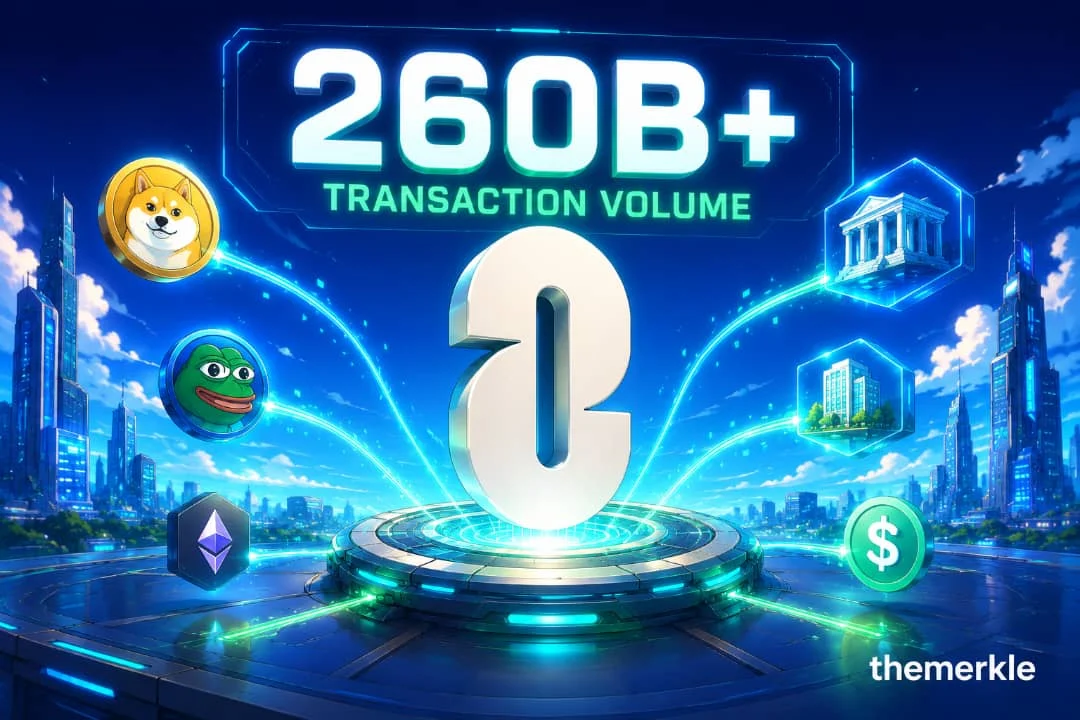
The omnichain interoperability protocol, LayerZero, has achieved a significant milestone, facilitating over $260 billion in transaction volume across more than 830 Omnichain Fungible Tokens (OFTs) deployed on upwards of 170 distinct blockchains. This formidable accumulation of value underscores LayerZero’s quiet ascent to a pivotal position within the rapidly expanding and increasingly fragmented blockchain ecosystem. From the volatile realm of speculative memecoins to the more austere domain of institutional-grade tokenized treasuries and government-issued stable tokens, the protocol has emerged as a critical piece of infrastructure, seamlessly connecting disparate digital ledgers.
This latest volume announcement distinguishes itself from typical crypto metrics not merely by its sheer scale but by the diverse spectrum of participants it represents. The builders leveraging LayerZero are far from a homogeneous group; they encompass agile, small teams launching viral tokens, as well as established financial institutions meticulously embedding complex compliance logic directly into their smart contracts. LayerZero’s capacity to serve such a broad user base is not predicated on a universal, one-size-fits-all solution, but rather on its deep configurability, which allows the protocol to adapt precisely to each builder’s unique operational requirements and security prerogatives. This trajectory signifies a foundational infrastructure that is maturing in real-time, prioritizing robust functionality over transient hype, with the $260 billion figure serving as a clear market validation of its utility and adoption.
The Persistent Challenge of Blockchain Fragmentation
The inherent design of early blockchain networks led to a largely siloed landscape. Each blockchain, whether Bitcoin, Ethereum, Solana, or Avalanche, was conceived as an independent ledger, optimized for specific functionalities but fundamentally isolated from others. This fragmentation, while fostering innovation within individual ecosystems, created significant barriers to liquidity, user experience, and the seamless flow of data and assets across the broader Web3 space.
Early attempts at interoperability largely centered around "bridges." While functional, many of these initial solutions presented significant challenges. They often relied on wrapped assets, where a token on one chain would be locked, and a synthetic "wrapped" version would be minted on another. This approach introduced additional counterparty risk, potential for de-pegging, and often involved complex multi-signature schemes or centralized custodians, making them susceptible to exploits. The history of blockchain interoperability is unfortunately punctuated by high-profile bridge hacks, underscoring the critical need for more secure, robust, and decentralized solutions. The market yearned for a mechanism that could enable native asset transfers and generic message passing without compromising security or decentralization.
LayerZero’s Genesis and Architectural Innovation
LayerZero Labs, the team behind the protocol, embarked on a mission to address this fundamental interoperability challenge by designing a generalized messaging protocol. Founded with the vision of enabling direct, secure, and trustless communication between any two blockchains, LayerZero officially launched its mainnet in early 2022, following extensive development and security audits. Its core architecture diverges significantly from traditional bridging models.
At its heart, LayerZero operates through a network of "Endpoints" deployed on each supported blockchain. These Endpoints are smart contracts that facilitate the sending and receiving of messages. Crucially, LayerZero introduces a novel security primitive that decentralizes the validation process: the Oracle and the Relayer. The Oracle is responsible for relaying the block header from the source chain to the destination chain, while the Relayer retrieves the transaction proof. For a cross-chain message to be successfully validated and executed, both the Oracle and the Relayer must independently confirm the transaction. This separation of concerns, where the Oracle provides an immutable fact (the block header) and the Relayer provides the proof of a specific transaction within that block, is a cornerstone of LayerZero’s security model.
This design empowers builders to customize their security assumptions. Instead of a single, monolithic bridge validating all transactions, LayerZero allows applications to select their own Oracle and Relayer, or even a network of Decentralized Verifier Networks (DVNs), thereby tailoring the level of security and decentralization to their specific needs. This architectural flexibility is precisely what allows LayerZero to serve a spectrum of users, from high-speed memecoin deployments to meticulously compliant financial instruments.
The Power of Configurability: Tailoring Security to Diverse Needs
While a simplistic definition describes LayerZero as a protocol connecting applications across multiple blockchains, this barely scratches the surface of its practical implications. Its true innovation lies in its highly generalizable messaging framework, which consciously avoids imposing a fixed model on its users. Instead, LayerZero provides an adaptable toolkit, enabling builders to precisely configure their security assumptions, validation mechanisms, and deployment logic to align with their unique use cases.
The disparate needs of a memecoin team, a real-world asset issuer, and a licensed financial institution highlight this necessity. A memecoin, designed for rapid viral distribution, prioritizes speed and broad market access. A tokenized treasury bill, representing a legally binding financial instrument, demands robust, verifiable security and regulatory compliance above all else. A bank or regulated entity, operating within strict legal frameworks, requires an interoperability solution that can enforce complex KYC/AML and jurisdictional policies across chains. LayerZero accommodates all these scenarios without forcing any into a restrictive, pre-defined box.
The result is a protocol that assumes different meanings depending on the user. For a burgeoning startup, it’s a gateway to new markets. For an established asset issuer, it provides critical trust infrastructure. For a bank, it functions as compliance plumbing, ensuring regulatory adherence travels with the token wherever it resides. Understanding these distinctions is fundamental to comprehending LayerZero’s impressive adoption curve and its potential to reshape the multi-chain future.
Catalyzing Market Access: LayerZero for Speculative Assets
For memecoin builders, speed and expansive reach are paramount. The window to capitalize on viral momentum is often fleeting, and confinement to a single blockchain invariably means forfeiting potential liquidity, users, and trading volume. LayerZero directly addresses this challenge by enabling seamless multi-chain deployment.
Through the deployment of an Omnichain Fungible Token (OFT), a memecoin team can list their asset across numerous chains almost simultaneously. This immediate multi-chain presence allows them to tap into the native user bases and existing liquidity pools of diverse ecosystems without the arduous task of building bespoke bridge infrastructure or relying on third-party wrappers, which often introduce additional security risks and complexity. Critically, the OFT model ensures that the token moves natively, and its total supply remains unified and consistent across every chain it reaches, preventing fragmentation of liquidity and enhancing market efficiency.
In this context, LayerZero functions primarily as a potent distribution tool. It eliminates the friction traditionally associated with multi-chain expansion, allowing teams to dedicate their resources and focus to the core drivers of memecoin success: community engagement, cultural resonance, and maintaining momentum. The underlying cross-chain mechanics are abstracted away, empowering builders to concentrate on their strategic objectives. This capability has been instrumental in the rapid proliferation of memecoins across various chains, significantly expanding their potential market reach and fostering a more dynamic, interconnected speculative asset landscape.
Enabling Institutional Trust: Real-World Assets and Custom Security
The burgeoning real-world asset (RWA) sector presents a fundamentally distinct set of challenges compared to speculative tokens. When tokenizing tangible assets such as treasury bills, real estate funds, or commodities, the underlying asset carries significant legal and financial weight. Any misstep in the security model is not merely a technical failure but a potential regulatory and reputational catastrophe, with severe financial repercussions.
LayerZero provides RWA issuers with the critical ability to define their own trust assumptions and embed these directly into the token’s configuration. This level of granular control is transformative. Builders can operate their own Decentralized Verifier Networks (DVNs), which are essentially custom sets of Oracles and Relayers. They can also establish bespoke signing thresholds and precisely determine the validation logic that governs every cross-chain message their token sends. A key innovation here is that these meticulously defined parameters are not static; they travel with the token wherever it goes. The security model, therefore, remains integral to the asset, irrespective of the blockchain it resides on.
This feature is enormously significant for institutional adoption. Asset managers, custodians, and large financial entities evaluating tokenized products demand absolute assurance that the rules governing their assets are consistent, transparent, and enforceable across every blockchain those assets might traverse. LayerZero’s configurable security model addresses this need head-on, providing the requisite framework for trust, verifiability, and compliance that is essential for mainstream institutional participation in the tokenized economy. The ability to guarantee a consistent security posture across a multi-chain environment significantly de-risks RWA deployment and accelerates the integration of traditional financial assets into the decentralized world.
Compliance-as-a-Service: LayerZero for Regulated Financial Institutions
For regulated financial institutions, the prospect of cross-chain interoperability extends far beyond a technical consideration; it fundamentally becomes a compliance imperative. Moving assets across diverse blockchains necessitates the rigorous enforcement of Know Your Customer (KYC), Anti-Money Laundering (AML) requirements, transaction monitoring obligations, and jurisdictional restrictions, often within environments that were not originally designed to accommodate such complex regulatory frameworks. This poses a significant hurdle if the underlying interoperability infrastructure lacks inherent compliance capabilities.
LayerZero approaches this challenge with a paradigm shift. Rather than treating compliance as an afterthought, bolted onto the system post-deployment, institutions can configure the protocol to enforce compliance logic directly at the messaging layer. This means that every transfer, every cross-chain message, is automatically subjected to and must pass through whatever policy checks the institution has pre-defined. For instance, a bank could configure its OFT to only allow transfers between wallets that have completed a specific level of KYC, regardless of the destination chain.
This capability represents a significant unlock for banks and asset managers venturing into the on-chain space. It eliminates the false dichotomy between leveraging blockchain’s inherent efficiencies and adhering to stringent regulatory obligations. Institutions can now achieve both. As the tokenized treasuries market continues its robust growth, and as institutional digital assets become increasingly prevalent, the ability to embed and carry compliance infrastructure seamlessly across chains will transition from a mere differentiator to a baseline requirement for any serious participant in the digital asset economy. LayerZero’s proactive integration of this functionality positions it as a crucial enabler for the compliant evolution of global finance on decentralized networks.
Broader Market Impact and Future Outlook
LayerZero’s achievement of $260 billion in transaction volume signals more than just a technical success; it heralds a new era for blockchain interoperability and the broader digital economy. By providing a secure, flexible, and scalable messaging layer, LayerZero is actively dismantling the silos that have long hindered the growth and adoption of blockchain technology.
Unlocking New Paradigms: The generalized messaging capabilities offered by LayerZero extend beyond simple asset transfers. Developers can now design truly omnichain applications (OApps) that leverage the unique strengths of multiple blockchains simultaneously. Imagine a decentralized autonomous organization (DAO) whose governance tokens are spread across several chains, yet can participate in a unified voting mechanism. Or a game where in-game assets are minted on a low-cost chain but can be seamlessly traded on a high-liquidity chain, with game logic interacting across different environments. This flexibility fosters innovation in DApp design, user experience, and overall ecosystem functionality, paving the way for applications that were previously impractical or impossible.
Economic Implications: The consolidation of liquidity and the seamless movement of assets facilitated by LayerZero have profound economic implications. By reducing friction and risk associated with cross-chain transfers, capital becomes more efficient. Users no longer need to navigate complex, risky bridges or accept fragmented liquidity. This increased capital efficiency can lead to tighter spreads, deeper markets, and ultimately, a more robust and resilient decentralized finance (DeFi) landscape. The ability for institutions to bring large pools of capital into the on-chain world, with confidence in security and compliance, is set to significantly expand the total addressable market for digital assets.
Competitive Landscape and Evolution: LayerZero operates within a dynamic and competitive interoperability sector, alongside other notable projects like Cosmos IBC, Polkadot’s XCMP, and various specialized bridging solutions. However, its distinct architecture, emphasizing configurable security and a generalized messaging layer, provides a significant differentiation. While other protocols might excel in specific use cases or within particular ecosystems, LayerZero’s "permissionless permissioning" model for security allows it to adapt to a vast array of requirements, making it a versatile choice for a diverse builder spectrum.
Looking ahead, the evolution of LayerZero will likely involve continuous enhancements to its security model, expansion to an even broader array of blockchains, and the potential for supporting more complex omnichain primitives, such as Omnichain Non-Fungible Tokens (ONFTs) and advanced cross-chain governance mechanisms. Challenges remain, particularly in maintaining the highest security standards in an ever-evolving threat landscape and ensuring the network can scale to meet burgeoning demand. Yet, the current trajectory suggests LayerZero is well-positioned to remain at the forefront of the movement towards a truly interconnected and composable blockchain future. The protocol’s commitment to empowering builders with configurable, secure, and robust interoperability tools makes it a cornerstone in the ongoing journey toward a unified digital economy.
Disclosure: This is not trading or investment advice. Always do your research before buying any cryptocurrency or investing in any services.














