


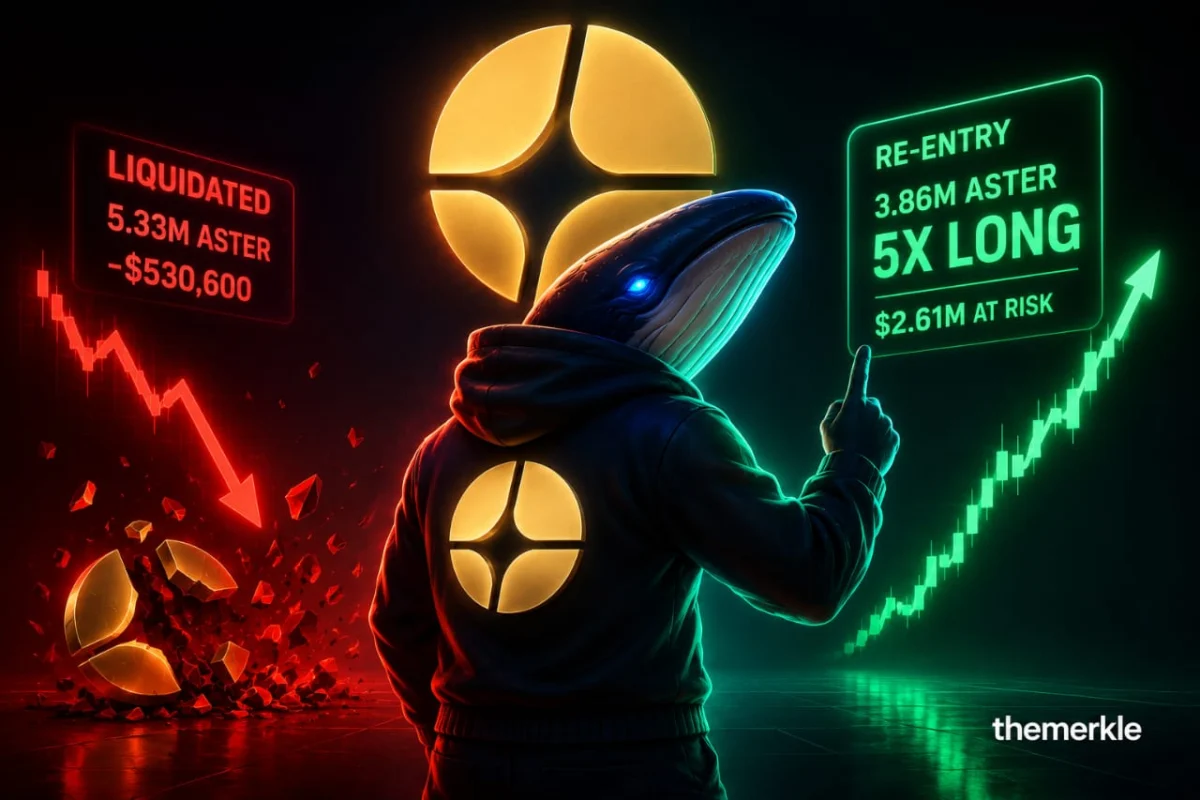
A prominent cryptocurrency wallet, identified by its address 0x5f91, has once again made headlines in the decentralized finance (DeFi) world, initiating a fresh 5x leveraged long position on the ASTER token. This bold move sees the trader committing 3.86 million ASTER tokens, valued at approximately $2.61 million at the time of the transaction. The significant re-entry into the market comes mere days after the same wallet suffered a substantial blow, experiencing a full liquidation on a previous long position that resulted in a loss of $530,600. This pattern of aggressive, high-leverage trading on the same asset, particularly after a recent and considerable loss, has quickly captured the attention of on-chain analysts and the broader crypto community, sparking debates over whether the underlying motivation is unwavering conviction in ASTER’s future or a desperate attempt to recoup recent losses.
The Unyielding Trader: A Deep Dive into Wallet 0x5f91’s Strategy
The activity of wallet 0x5f91 has become a focal point for market observers due to its distinctive and high-risk trading behavior. Often referred to as a "whale" given the substantial capital deployed, this entity’s recent actions on ASTER exemplify the volatile and often unpredictable nature of leveraged trading in the crypto sphere. The decision to re-enter a 5x leveraged long position on ASTER, an asset that just triggered a devastating liquidation for the same wallet, is a textbook case of either extreme confidence or a dangerous psychological trap known as "doubling down" or "revenge trading."
Leveraged trading, while offering amplified gains, equally magnifies potential losses. A 5x leverage means that for every 1% movement in the asset’s price against the trader’s position, the leveraged position experiences a 5% loss. This accelerated risk profile necessitates meticulous risk management, a factor that appears to have been severely tested in the case of 0x5f91’s initial ASTER long. The swift re-entry, using the same leverage multiple and directional bias, suggests an unyielding belief in ASTER’s upward trajectory, potentially stemming from the project’s recent fundamental developments.
ASTER’s Tokenomics Overhaul: The Core Catalyst
The backdrop to this dramatic trading saga is ASTER’s recent and significant overhaul of its tokenomics. This strategic update, designed to enhance the long-term value proposition of the ASTER token, introduced dramatically increased buyback and burn mechanics. Specifically, the ASTER platform announced a commitment to allocate an unprecedented 99% of its daily platform fees to automated buybacks of the ASTER token from the open market.
Furthermore, every token bought back through this mechanism is then matched 1:1 by a burn from the project’s reserves. This dual-pronged approach is engineered to create a powerful deflationary pressure on the ASTER supply over time. By consistently removing tokens from circulation, the project aims to decrease the total available supply, which, assuming stable or increasing demand, should theoretically lead to an appreciation in the token’s price. Such fundamental shifts in tokenomics are often powerful catalysts that attract aggressive traders and investors, as they signal a strong commitment from the project team to long-term value creation. It creates a compelling bullish narrative that often translates into significant price volatility and opportunities for those willing to take on higher risk.
A Chronology of High-Stakes Wagers and Swift Retribution
The sequence of events surrounding wallet 0x5f91’s ASTER trades provides a stark illustration of the rapid swings possible in leveraged crypto positions:
- Tokenomics Announcement (Pre-dating first trade): ASTER officially unveils its enhanced buyback and burn tokenomics, generating considerable market buzz and a bullish outlook among certain segments of the trading community. This serves as the initial fundamental trigger.
- The First Bet: Initial Leveraged Long (Approx. $3.97 Million Exposure): Wallet 0x5f91, evidently swayed by the bullish narrative surrounding the tokenomics update, initiated a substantial long position on ASTER. This trade involved 5.33 million ASTER tokens, valued at approximately $3.97 million at the point of entry. The position was highly leveraged, likely at 5x, reflecting significant conviction in an impending price surge.
- Market Pullback and Full Liquidation: Despite the initial bullish sentiment, the market experienced a sharp pullback. For a 5x leveraged position, even a relatively modest price drop of around 20% (depending on the initial margin and liquidation threshold) can lead to a complete liquidation. This abrupt downturn caught wallet 0x5f91’s position off guard, leading to the forced closure of the entire trade.
- The $530,600 Loss: The liquidation resulted in a substantial capital loss of $530,600. This figure represents the full collateral backing the leveraged position, a clear testament to the unforgiving nature of high-leverage trading when market conditions turn adverse.
- The Immediate Re-entry: Second Leveraged Long ($2.61 Million Exposure): Within a remarkably short window following the liquidation, wallet 0x5f91 opened a new 5x leveraged long position on ASTER. This time, the exposure is slightly smaller, involving 3.86 million ASTER tokens, valued at roughly $2.61 million. However, the leverage multiple and directional bet remain identical, indicating an unwavering, or perhaps stubbornly determined, belief in ASTER’s future price action.
This rapid succession of events underscores the high-octane environment of crypto trading, where conviction can quickly turn to devastating loss, only to be followed by an equally swift re-engagement.
Understanding the Mechanics of Leveraged Trading and Liquidation
To fully grasp the gravity of 0x5f91’s actions, it’s crucial to understand how leveraged trading operates. When a trader opens a leveraged position, they are essentially borrowing funds to amplify their exposure to an asset. A 5x leverage means that for every dollar of the trader’s own capital (margin), they control five dollars’ worth of the asset. This allows for significantly larger potential profits if the market moves in the desired direction.
However, the reverse is also true. If the market moves against the position, losses are also magnified by the leverage factor. Exchanges implement a "margin call" system. As the unrealized losses on a leveraged position increase, the trader’s margin balance (their collateral) decreases. If this balance falls below a certain threshold – the maintenance margin – the exchange will issue a margin call, requesting the trader to deposit more funds to cover potential losses. If the trader fails to add more margin, or if the price continues to move unfavorably, the position is automatically "liquidated."
Liquidation means the exchange forcibly closes the position to prevent further losses for the borrowed funds. The collateral provided by the trader is entirely lost. In the case of 0x5f91, the initial $3.97 million long position, while substantial, was backed by collateral of approximately $794,000 (assuming 5x leverage, $3.97M / 5). The $530,600 loss implies that the price moved against the position by roughly 13.3% from the entry point to the liquidation price (or 13.3% of the total position value, which is 66.8% of the initial margin). This percentage movement is well within the typical daily volatility of many cryptocurrencies, highlighting the inherent risk.
The Second Long: Conviction or Compulsion?
The immediate re-entry into a leveraged long on ASTER raises profound questions about the trader’s psychology and strategy. The new position, at $2.61 million, is smaller than the initial $3.97 million bet, suggesting a possible reduction in risk appetite or perhaps a diminished pool of available capital after the half-million-dollar loss. However, maintaining the identical 5x leverage and the same directional bet (long) on the same asset that just proved devastating is highly unconventional for prudent risk management.
Market analysts typically advise a period of reflection after a significant loss, often recommending a reassessment of the trading thesis, market conditions, and personal risk parameters. The absence of such a pause from wallet 0x5f91 indicates either:
- Unwavering Conviction: The trader possesses an extremely strong belief in ASTER’s long-term potential, particularly driven by the tokenomics update, viewing the previous liquidation as a temporary market fluctuation rather than a fundamental flaw in their thesis. They might perceive the current price as an even better entry point.
- Loss Aversion/Revenge Trading: A common psychological pitfall where traders, after a significant loss, become overly focused on "making back" what they lost. This often leads to impulsive decisions, larger position sizes (though not in this case, but same leverage), and a disregard for sound risk management, perpetuating a cycle of losses.
- Deep Pockets and High Risk Tolerance: The wallet might belong to an entity with such vast capital reserves that a $530,600 loss, while significant to most, is viewed as a manageable setback or a cost of doing business in pursuit of larger gains. Their risk tolerance might simply be exceptionally high.
Without direct communication with the wallet holder, it’s impossible to definitively ascertain the motive. However, the pattern of behavior certainly leans towards an aggressive and high-risk approach.
Broader Implications for ASTER and Market Sentiment
The actions of wallet 0x5f91, while focused on a single asset, have broader implications for ASTER’s market dynamics and the perception of its tokenomics update.
- Validation of Tokenomics Narrative (for some): If the second long position proves profitable, it could be seen by some as validation of the underlying bullish thesis driven by ASTER’s buyback and burn mechanics. Other traders might interpret the whale’s persistence as a strong signal, potentially encouraging them to also take long positions.
- Increased Scrutiny and Volatility: The public tracking of this wallet’s activity inevitably draws more attention to ASTER. Other traders and algorithms may attempt to front-run or react to the whale’s moves, potentially increasing ASTER’s price volatility in the short term.
- Test of Deflationary Mechanics: The timing of these trades directly coincides with the rollout of ASTER’s deflationary tokenomics. The market’s reaction to these mechanics – whether it supports a sustained upward trend or continues to exhibit volatility – will be crucial. While buyback and burn mechanisms are fundamentally bullish long-term, their immediate impact on price can be unpredictable, often subject to broader market sentiment and short-term trading dynamics.
- Warning for Leveraged Traders: Regardless of the outcome, this saga serves as a potent reminder of the inherent dangers of leveraged trading, especially around news events. News-driven pumps can be fleeting, and even fundamentally strong announcements don’t guarantee immediate or sustained upward price action, particularly on the aggressive timelines often assumed by leveraged positions.
ASTER Ecosystem: A Deeper Look at Its Value Proposition
ASTER, as a project, has been working to establish itself within the competitive Layer-1 blockchain space. The original article hints at its mainnet launch, which is a significant milestone for any blockchain project, signifying a functional, independent network. The "platform fees" mentioned in the tokenomics update suggest ASTER is likely a dApp platform, an exchange, or a service provider where users incur fees for various operations. By committing 99% of these fees to buybacks, ASTER is essentially tying the success of its platform’s utility directly to the value appreciation of its native token.
Deflationary mechanisms like buyback and burn are popular strategies adopted by many crypto projects to create scarcity and incentivize holding. They aim to align the interests of token holders with the long-term growth and adoption of the platform. However, the effectiveness of these mechanisms in driving immediate price action can be overshadowed by broader market sentiment, macroeconomic factors, and intense short-term trading activity. The "mismatch" between long-term mechanics and short-term price expectations is precisely where leveraged traders often face their greatest challenges.
Concluding Thoughts: A High-Stakes Bet with an Unknown Outcome
The actions of wallet 0x5f91 have transformed ASTER into a focal point of on-chain observation. This is a classic example of a high-stakes gamble in the fast-paced world of cryptocurrency, where a single whale’s moves can become a case study in market psychology and risk management. The $530,600 loss on the first trade was a significant event, and the subsequent re-entry with identical leverage on the same asset underscores an extraordinary level of commitment or perhaps a perilous chase for redemption.
As the crypto market continues to evolve, characterized by both groundbreaking innovation and extreme volatility, stories like that of wallet 0x5f91 serve as compelling narratives. They highlight the allure of amplified gains through leverage, the brutal consequences of misjudging market movements, and the enduring human element of conviction, fear, and the relentless pursuit of profit within the digital asset landscape. All eyes will now be on ASTER’s price action and the performance of 0x5f91’s latest, highly leveraged wager to see whether this bold re-entry signifies a triumphant vindication of conviction or another costly lesson in market timing.
Disclosure: This article is for informational purposes only and should not be considered financial or investment advice. Readers are encouraged to conduct their own thorough research before making any investment decisions in the volatile cryptocurrency market.














