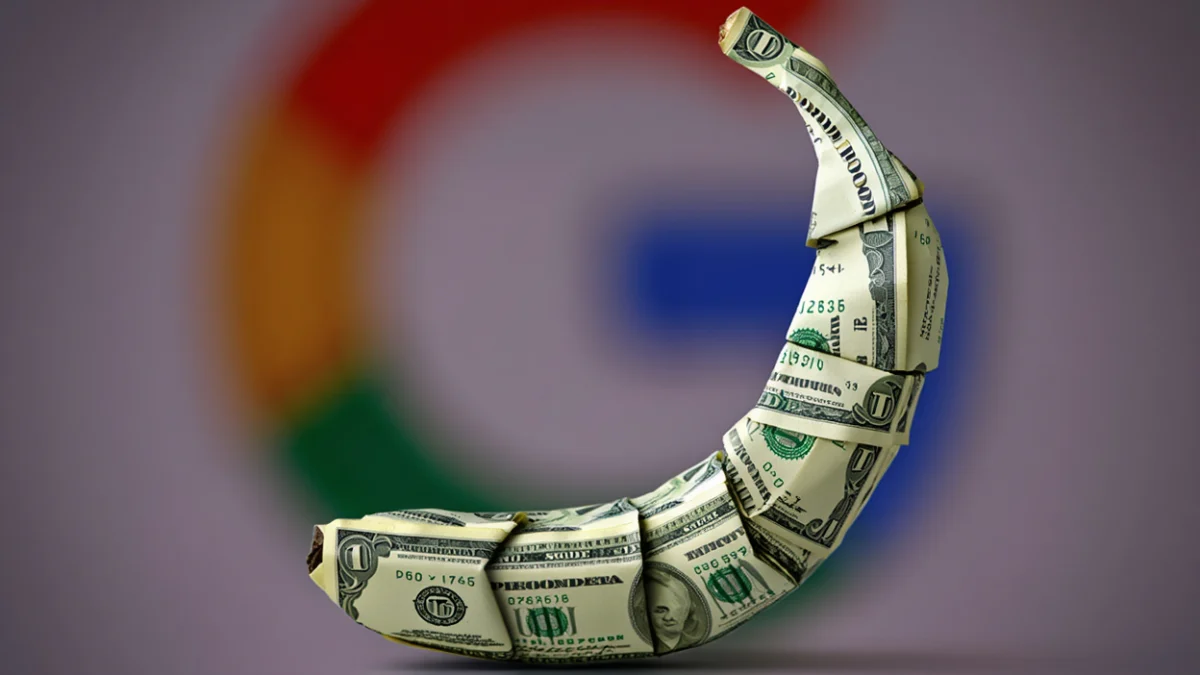
Google last week formally launched Nano Banana 2 Lite, officially designated gemini-3.1-flash-lite-image, positioning it as the new entry point in its expanding artificial intelligence (AI) image generation suite. This new model sits strategically below the existing Nano Banana 2 and considerably beneath the high-end Nano Banana Pro, aiming to democratize AI-powered visual content creation with a focus on speed and cost-efficiency. The release underscores Google’s commitment to scaling its AI capabilities across a broader user base and intensifying competition in the rapidly evolving generative AI market.
A New Tier in Google’s Generative AI Ecosystem
The Nano Banana 2 Lite is engineered to deliver text-to-image outputs in approximately four seconds, a remarkable 2.7 times faster than its predecessor, Nano Banana 2. This significant speed enhancement is a core pillar of its value proposition, making it a direct replacement for the original Nano Banana model (gemini-2.5-flash-image). Google’s explicit pitch for the new offering is compelling: users can leverage the familiar and integrated Google ecosystem for less money and with significantly reduced waiting times. This move aligns with a broader industry trend towards optimizing AI models for practical, real-world applications where speed and cost are critical factors.
The model’s availability is extensive, ensuring broad accessibility for both developers and general consumers. It can be accessed through Google AI Studio, the Gemini API, and the Enterprise Agent Platform, catering to professional developers and businesses looking to integrate AI image generation into their workflows. Crucially, Nano Banana 2 Lite is also baked into several popular consumer products, including Google Search, the Gemini app, NotebookLM, and Google Photos. This deep integration within Google’s existing product suite removes friction for everyday users, allowing them to generate images directly within the tools they already use. Furthermore, the model operates in conjunction with Gemini Omni Flash, Google’s new video generation model, via the Interactions API. This powerful pairing enables users to stack up to three sequential edits within a single session, hinting at a future where multimodal AI creation becomes increasingly seamless.
With the introduction of Nano Banana 2 Lite, the Nano Banana family now presents a clear, three-tier structure designed to meet diverse user needs. The Lite version is optimized for speed and cost, targeting users who prioritize rapid prototyping, social media content, or high-volume, less critical image generation. Nano Banana 2 strikes a balance between quality and speed, serving as a versatile option for general-purpose use. At the pinnacle, Nano Banana Pro is reserved for complex professional work, where uncompromising quality, intricate detail, and advanced capabilities are paramount. This tiered approach allows Google to cater to a wide spectrum of users, from casual enthusiasts to professional artists and enterprises.
Competitive Pricing and Market Positioning

One of the most impactful aspects of Nano Banana 2 Lite’s launch is its aggressive pricing strategy. At roughly $0.034 per image for 1K resolution, the Lite model is approximately half the price of Nano Banana 2, which costs around $0.067 per image at the same resolution. This pricing positions Nano Banana 2 Lite in direct and fierce competition with other prominent players in the AI image generation space.
For instance, Seedream 5.0 Lite, a notable competitor, is priced similarly at $0.031–$0.035 per image. This indicates a tightening market where providers are increasingly vying for users based on cost-effectiveness. However, the market also features even more aggressively priced alternatives, such as Reve 2.0, which undercuts both at approximately $0.0067 per image via API. While Reve 2.0 offers a significant cost advantage, it notably lacks the expansive deployment breadth and deep integration that comes with Google’s formidable infrastructure. Additionally, Qwen Image Edit presents a compelling option as a good, free, open-source model suitable for standard use cases, albeit without the proprietary advantages of a major tech ecosystem.
Google’s strategy with Nano Banana 2 Lite is not merely about offering a cheaper model; it’s about leveraging its ecosystem to provide an integrated, convenient, and cost-effective solution that is difficult for pure-API or open-source competitors to match. The seamless integration across Google’s consumer and developer platforms adds a layer of value that transcends raw per-image pricing, potentially reducing platform-switching costs and streamlining workflows for existing Google users.
Performance Benchmarking: Quality vs. Speed and Cost
To understand where Nano Banana 2 Lite makes its strategic trade-offs, a comprehensive evaluation across various categories is essential. The core question for users is whether the quality drop from Nano Banana 2 is significant enough to impact their specific workflows, or if it is distributed broadly enough that most users won’t notice. The answer, as testing reveals, is less predictable than one might initially expect, highlighting both strengths and weaknesses.
Realism: The Most Visible Gap
The realism test emerged as the category where the performance gap between Nano Banana 2 and its Lite sibling was most pronounced. Both models were subjected to a technically demanding portrait prompt: "a cinematic image of a 32-year-old female architect on a rooftop at sunset, wearing a beige trench coat and round glasses, holding rolled blueprints specifically in her left hand, with a defocused city skyline behind her, golden hour lighting with a soft rim light, shallow depth of field simulating a 50mm lens, a vertical 4:5 aspect ratio, realistic skin texture, and subtle film grain." This prompt was designed to test each element as a potential failure point.

Nano Banana 2 Lite successfully passed the basic requirements. The subject was correctly dressed and positioned, wore round glasses, held blueprints, and stood on a rooftop with a blurred city in the background. However, the realism suffered in the details. The subject was depicted with only one hand, which appeared oversized relative to the rest of the body. The requested rim light was barely discernible, and while skin texture held up at thumbnail scale, it deteriorated upon closer inspection. The final image, while competent, resembled a generic stock photo rather than a cinematic portrait with intricate photographic nuances.
In stark contrast, Nano Banana 2 produced an image that was photographically superior. The subject was set against a fully realized New York City skyline at magic hour, complete with blooming bokeh city lights and a subtle hint of a river in the distance. The depth of field was dramatic and impactful. A warm, distinct rim light clearly separated the subject from the background, enhancing the cinematic quality. Importantly, the blueprints were correctly placed in her left hand, as specified in the prompt. While both models showed some struggle with minor symmetry issues, such as inconsistent buttonholes or straps, these were details that required close inspection to notice.
For applications like social media content or rapid visual mockups, the Lite version’s output is perfectly workable, effectively communicating the core concept. However, for any scenario where the image is the final product—a hero image, a client deliverable, or a portfolio piece—Nano Banana 2 Lite’s limitations in photographic quality become evident at resolutions beyond a thumbnail. This category consistently demonstrated that photographic realism is the largest concession made in the Lite model’s architecture.
Prompt Adherence: Textual Accuracy Challenges
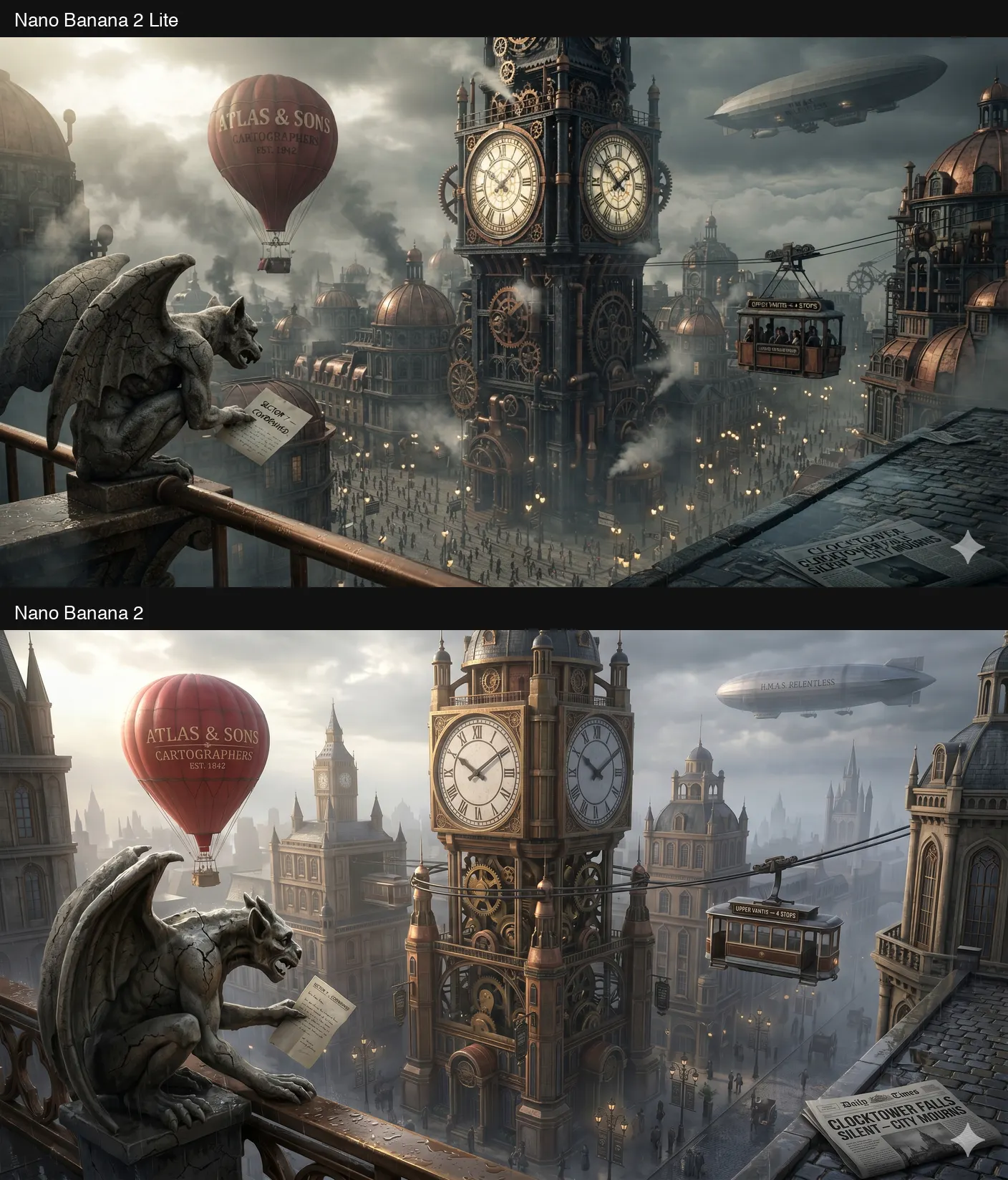
Prompt adherence testing employed a multi-element scene designed with each labeled detail functioning as an independent failure point. The prompt described a "steampunk cityscape viewed from a gargoyle’s perch," including specific elements such as a hot air balloon labeled "Atlas & Sons Cartographers, Est. 1842," a cable car with a named route, a gear-driven clock tower, a gargoyle holding a document labeled "Sector 7 – Condemned," a foreground newspaper with a specific headline, and a detailed Victorian street scene below. The objective was to gauge how well models could maintain ten specific simultaneous constraints.
Both models generated visually compelling steampunk scenes, correctly placing the gargoyle in the foreground, the clock tower centrally, the balloon in the sky, and a cable car traversing the frame. Superficially, the differences appeared cosmetic, with the Lite version presenting a darker, moodier aesthetic, and the full model offering a cleaner, brighter rendition. However, a closer examination of the specific details revealed significant discrepancies. In the Lite version, the hot air balloon’s label read "Est. 1942" instead of "1842," largely due to the AI’s difficulty in accurately rendering text. The cable car route label was partially garbled, and the foreground newspaper headline blurred at the edges, compromising legibility for requested details. While the Lite model generally focused more on the visual composition than precise text rendering, which can be acceptable for many use cases, its inaccuracies introduced a potential workflow hurdle.
Nano Banana 2, on the other hand, achieved near-perfect adherence to the prompt. The balloon clearly displayed "Atlas & Sons Cartographers Est. 1842." The cable car sign accurately read "Upper Vantis – 4 Stops." While the gargoyle held a document, the text on it remained illegible. Crucially, the foreground newspaper prominently featured the headline "Clocktower Falls Silent – City Mourns" in clean, readable type. Every specified element appeared in its correct location with legible labels. The full model’s compositional choice to use brighter, more editorial lighting also proved advantageous here, ensuring that labeled details remained readable rather than being obscured by atmosphere.

While a casual user might overlook a single-digit transposition in a fictional establishment date, concept artists, worldbuilders, and narrative illustrators—those who rely on these models to convey precise creative logic to clients or collaborators—would immediately notice such inaccuracies. The Lite model’s tendency to blur or transpose specific in-image text labels, though not catastrophic, necessitates a manual correction step that can become burdensome at scale, potentially impacting iterative design processes.
Spatial Awareness: A Minor Divergence
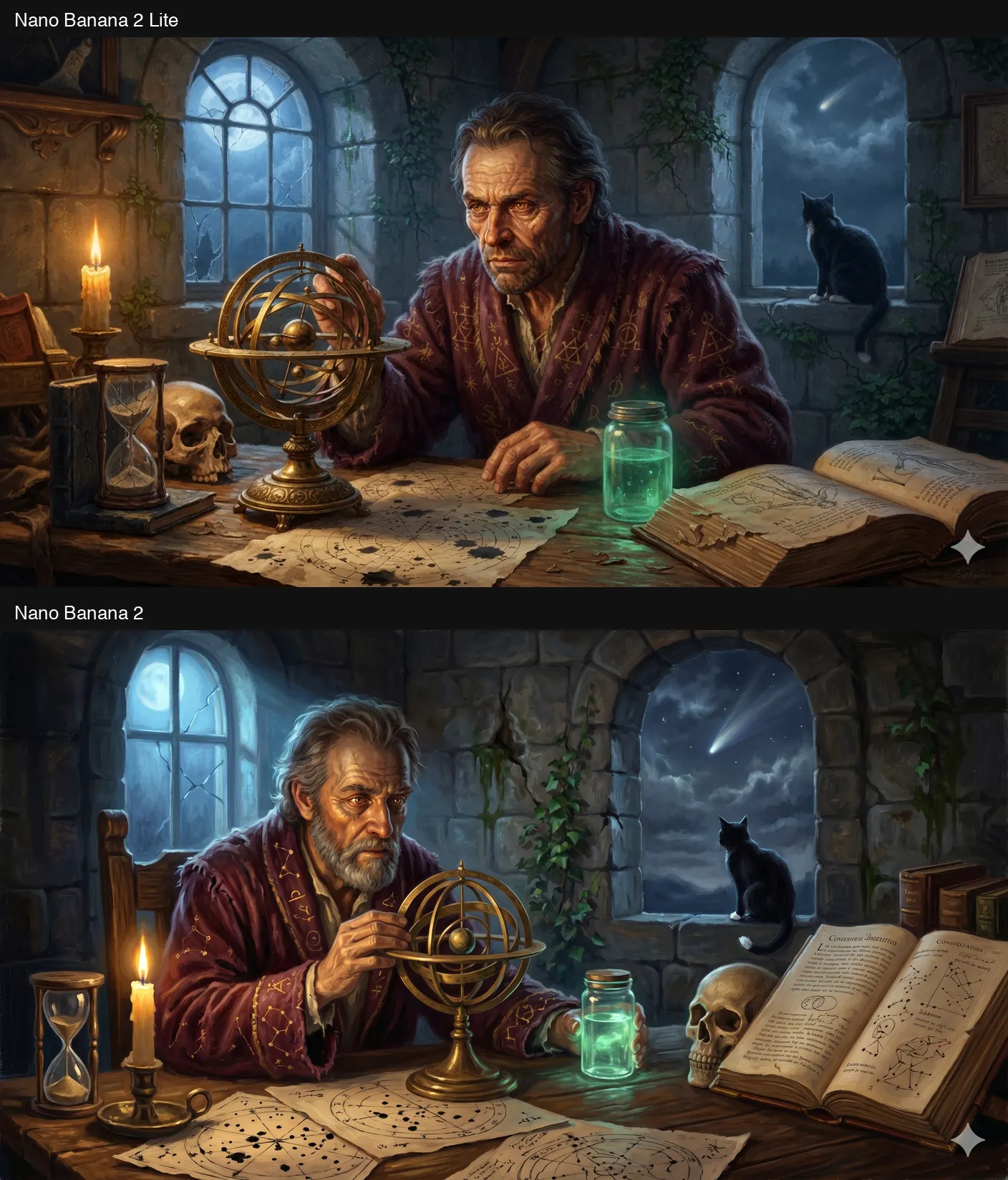
Spatial awareness testing aimed to evaluate each model’s capacity for multi-depth scene composition, featuring multiple objects at close range, a human subject in the middle distance, and atmospheric elements receding into background darkness. The chosen scene—a medieval alchemist at a cluttered wooden desk, surrounded by an armillary sphere, a lit candle, an hourglass, a skull, star charts, and a glowing green jar, with a black cat silhouetted in an arched window behind him—demanded convincing three-dimensional layering for coherence.
Both models demonstrated a fundamental understanding of the scene’s spatial grammar. Foreground objects were rendered with appropriate scale and shadow detail, the alchemist occupied the mid-ground with correct occlusion relationships to surrounding items, and the arched window with the moonlit night sky created a believable sense of recession. Neither model misplaced objects, collapsed depth planes, nor introduced spatial contradictions. The foundational scene architecture—front, middle, back—was correctly established in both outputs.
The differences, while subtle, were tangible. Nano Banana 2’s rendition exhibited a richer atmospheric depth gradient: the candlelight naturally faded into the stone walls, background haziness conveyed genuine atmospheric depth rather than mere digital softening, and the overall scene possessed a painterly warmth suggestive of volumetric space. The Lite version’s depth, while structurally correct, felt slightly compressed; the background appeared marginally more like a stage flat than a receding room filled with actual air. It felt as if the Nano Banana 2 image was the Lite version enhanced with a detailed LoRA (Low-Rank Adaptation) applied during sampling.
This category presented the smallest performance gap among all five tests. For storyboarding, game asset conceptualization, and most editorial illustration contexts, both models demonstrated adequate spatial reasoning. The Lite model’s slightly flatter depth rendering only becomes significant in high-resolution outputs or during detailed compositional analysis, and even then, the distinction is often arguable. For spatial composition, the Lite model proves to be a viable substitute for the full model in the vast majority of practical workflows.
Text Generation: An Unexpected Strength for Lite
Perhaps the most counterintuitive finding of this review emerged from the text generation tests. The prompt described a gritty nighttime hardware store filled with dozens of simultaneous text elements across various scales and styles: a hand-painted main sign with the store name, founding date, and product categories; a graffiti tag on the façade; window decals with hours and services; a concert poster with band name, venue, date, doors time, and specific ticket prices; a city council meeting notice; a lost cat notice with a phone number; political stickers on a phone booth; and a street parking restriction on the curb. Generating text at this level of complexity is notoriously difficult for AI, as each element must be correctly rendered while the overall image maintains photographic coherence.
Nano Banana 2 Lite delivered genuinely impressive results for its speed. It accurately rendered: "KELLERMAN’S HARDWARE & SUPPLY CO. – SINCE 1931 – TOOLS, ROPE, PAINT" on the main sign; graffiti reading "STILL HERE"; window signs for "OPEN 7 DAYS / WE BUY SCRAP – ASK FOR RAY / CLOSED"; a concert poster for "THE DREDGE PALE MOUTH / SUNDAY JUNE 4 / DOORS 9PM / THE ANCHOR CLUB / $12 ADV – $15 DOOR"; stickers reading "THIS MACHINE KILLS FASCISTS" and "JESUS SAVES"; and a lost cat notice with a specific and legible phone number. Every single text element specified in the prompt was correctly rendered and readable simultaneously within a single image. While the image was less realistic in its overall aesthetic, with some posters appearing as if poorly composited rather than naturally integrated into the scene (e.g., lack of natural imperfections or deterioration on phone booth posters), this was a legitimately strong outcome for any image model, especially the faster, cheaper one.
Nano Banana 2’s version was also strong, with most text correctly placed and legible, and the overall image conveying a convincing nighttime scene. However, the full model’s darker, moodier atmospheric rendering—often an asset in other contexts—worked against it here. Several smaller sticker texts fell into shadow and lost legibility. In this specific scenario, the Lite model’s brighter, more neutral lighting, a characteristic that was a weakness in portrait work, became a clear advantage when the primary evaluation criterion was the readability of all text within the scene.
While the previous prompt adherence test showed Lite struggling with accuracy of specific text details, this dedicated text generation test highlighted its capability to render multiple legible text elements effectively within a scene, especially when overall scene brightness facilitates legibility. The Lite model’s tendency to prioritize visual clarity for text, even at the expense of hyper-realistic integration, proved beneficial here.
Strategic Trade-offs and Broader Implications
The comprehensive evaluation reveals that Nano Banana 2 Lite is not a straightforward downgrade from Nano Banana 2. Instead, it is a focused tool with specific performance ceilings. Its limitations are most apparent in scenarios where photographic quality is the paramount deliverable, while it holds surprisingly steady, and in some cases even excels, in other areas.
Cinematic portrait work, sophisticated lighting physics, fine material textures, and close-inspection-quality skin rendering all expose a clear difference between the two models, with Nano Banana 2 maintaining a distinct lead. Style transfer also takes a meaningful hit with the Lite model, not necessarily in rendering quality, but in its ability to capture the contextual comprehension of the visual environment. Prompt adherence degrades specifically on in-image labeled text accuracy—a narrow failure mode, but one that carries significant weight in worldbuilding, concept art, and any pipeline where specific in-image language conveys critical meaning.
Conversely, Nano Banana 2 Lite performs admirably in areas of specificity; if a user requires a strong focus on particular elements, the model tends to ensure their presence. Spatial scene architecture and basic compositional competence are also robust. The unexpected strength in complex, multi-element text generation warrants particular emphasis: for workflows involving signage mockups, branded graphics, editorial composites with text-heavy elements, or any pipeline requiring multiple readable text strings in a single image, the Lite model is often the superior choice. Its brighter rendering defaults, a liability in high-realism portraiture, become a clear advantage when legibility is the primary metric. Spatially, it handles multi-depth scenes adequately for the vast majority of professional contexts.
On the cost front, Nano Banana 2 Lite’s price point of $0.034 per image (1K resolution) makes it highly competitive, roughly half the cost of Nano Banana 2 ($0.067) and directly comparable to Seedream 5.0 Lite ($0.031–$0.035). While Reve 2.0 offers a dramatically lower cost at approximately $0.0067 per image via API, it cannot compete with the extensive deployment footprint and seamless integration afforded by the Nano Banana ecosystem across Google Search, NotebookLM, Google Photos, and the Gemini app.
For teams and individuals already operating within Google’s vast infrastructure, this deep integration eliminates a significant platform-switching cost that pure-API alternatives cannot account for. This makes Nano Banana 2 Lite an exceptionally attractive option. If users can clearly identify their use cases—and if those cases do not fall squarely into the high-photographic-quality bucket—Nano Banana 2 Lite not only earns its place in Google’s generative AI lineup but may even present a more efficient and cost-effective solution than its more powerful sibling. The launch of Nano Banana 2 Lite signifies Google’s strategic intent to capture a broader market segment by offering tailored AI solutions that balance performance, accessibility, and cost, further cementing its position in the competitive landscape of generative AI.