


The global cryptocurrency market is currently navigating one of its most turbulent phases of the current cycle, with altcoins bearing the brunt of a massive liquidity exodus. Recent data from market analysts and on-chain intelligence platforms indicates that the broader alternative cryptocurrency sector has entered a state of structural decline, characterized by a lack of correlation with Bitcoin and a failure to maintain long-term technical support levels. This downturn comes on the heels of a broader systemic shock in the United States financial markets, where a cooling of enthusiasm for artificial intelligence (AI) and semiconductor equities triggered a massive sell-off. On a single Friday, more than $1 trillion in market capitalization was erased from US indices, a contagion that quickly spread to the digital asset space, leaving altcoins in a particularly vulnerable position.
The Macroeconomic Catalyst: A Trillion-Dollar Retraction
The current malaise in the altcoin market cannot be viewed in isolation from the global macroeconomic environment. On Friday, the S&P 500 recorded a 2.6% decline, while the tech-heavy Nasdaq plummeted by 4.7%. This volatility was primarily driven by a shift in sentiment regarding the high-valuation AI sector, which has been the primary engine of stock market growth over the past 18 months. As investors began to question the immediate profitability and sustainability of AI-related hardware and software companies, a "risk-off" sentiment took hold.
In the cryptocurrency sector, Bitcoin (BTC) initially showed resilience but eventually succumbed to the pressure, falling by approximately 4%. However, the impact on altcoins—cryptocurrencies other than Bitcoin—was far more severe. Historically, Bitcoin acts as the "reserve currency" of the crypto market; when it falls, altcoins typically drop by a higher percentage due to their lower liquidity and higher risk profiles. The recent market action confirmed this trend, but with a troubling twist: altcoins have failed to recover even when Bitcoin has stabilized, suggesting a deeper, more systemic issue within the alternative asset class.
The Technical Breakdown: 83 Percent of Altcoins Submerged
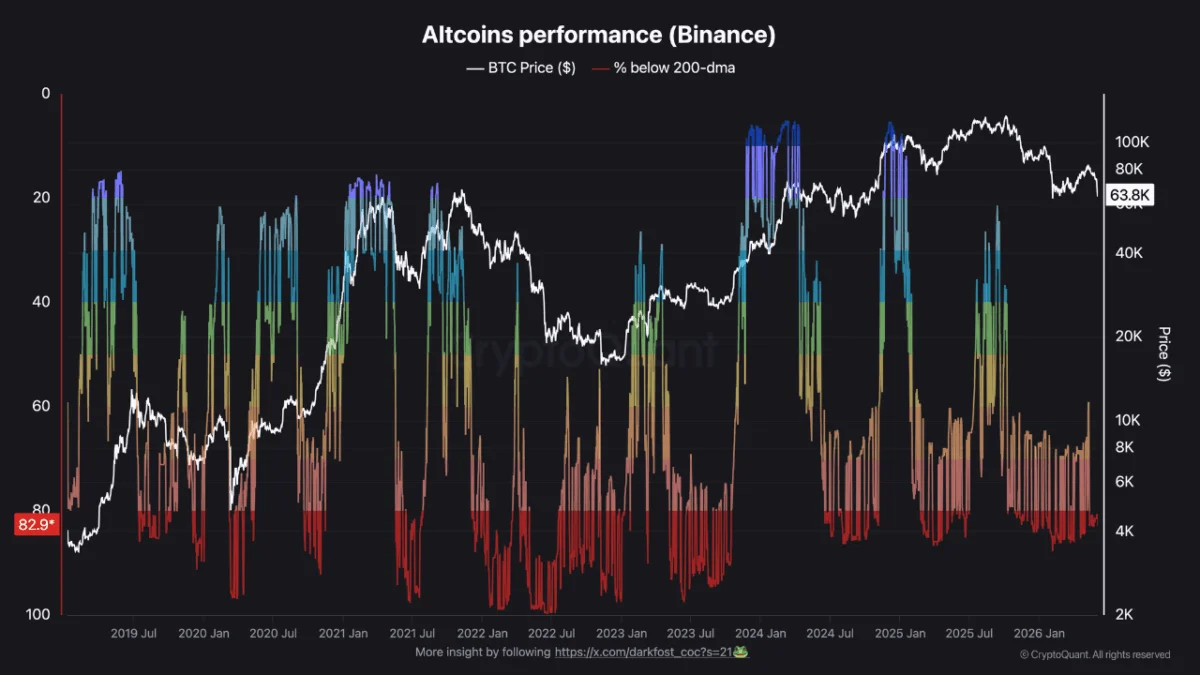
According to a detailed report by seasoned market analyst Darkfost, shared via CryptoQuant, the technical health of the altcoin market is at its lowest point in years. The analyst highlighted that approximately 83% of all altcoins are currently trading below their 200-day moving average (200DMA). In technical analysis, the 200DMA is widely considered the most significant indicator of long-term market health. It represents the average closing price of an asset over the previous 200 trading days and serves as a psychological and mechanical "line in the sand" between bull and bear markets.
When an asset trades above its 200DMA, it is generally considered to be in a long-term uptrend. Conversely, trading below this level indicates a sustained downtrend. The fact that more than four-fifths of the altcoin market is submerged below this level suggests that the "altseason"—a period where altcoins outperform Bitcoin—remains elusive. Darkfost noted that this current reading is among the weakest of the present market cycle, reflecting a profound lack of investor confidence. Since 2022, the percentage of altcoins below the 200DMA has largely fluctuated between 60% and 90%, but the current persistence at the higher end of that range points to a "structural market weakness" that has plagued the sector since December 2024.
The 520 Billion Dollar Capital Flight
The financial consequences of this technical breakdown are staggering. By analyzing the TOTAL3 chart—a metric provided by TradingView that tracks the total market capitalization of all cryptocurrencies excluding Bitcoin and Ethereum—analysts have identified a massive loss of value. From its peak in October 2024, the TOTAL3 valuation has shed nearly $520 billion. At its height, the combined altcoin market (excluding ETH) was pushing toward $1.2 trillion; it has since retracted to approximately $670 billion.
This contraction effectively erases nearly half a year of market gains. The TOTAL3 index has returned to valuation levels last seen in November 2024, essentially resetting the progress made during the late-year rally. This "round trip" in price action is particularly damaging to retail sentiment, as many investors who entered the market during the hype of mid-2024 are now holding significant unrealized losses. The data suggests a clear capital flight, where liquidity is being pulled out of speculative assets and either moved back into "safe-haven" assets like Bitcoin or exited into fiat currency entirely.
Bitcoin Dominance and the Liquidity Vacuum
One of the primary reasons for the altcoin struggle is the overwhelming dominance of Bitcoin in the current cycle. Unlike the 2017 or 2021 bull runs, where capital flowed freely from Bitcoin into mid-cap and small-cap altcoins, the 2024-2025 cycle has seen liquidity remain concentrated in the "king of crypto."
This shift is largely attributed to the institutionalization of Bitcoin through Spot ETFs (Exchange-Traded Funds). Institutional investors, such as pension funds and large asset managers, are primarily interested in Bitcoin due to its status as "digital gold" and its regulatory clarity. This institutional capital does not "trickle down" to altcoins in the way that retail capital used to. Consequently, while Bitcoin tests new highs or maintains relatively high price floors, altcoins are left in a liquidity vacuum, struggling to find the buying pressure necessary to maintain their valuations.

Furthermore, the sheer number of new tokens entering the market has led to "liquidity fragmentation." With thousands of new projects launching across various Layer 1 and Layer 2 ecosystems, the available capital is spread too thin. Without a massive influx of new retail investors, there is simply not enough liquidity to sustain upward momentum across the entire altcoin spectrum.
Historical Context: From 2017 Breadth to 2024 Contraction
To understand the severity of the current situation, it is helpful to look at historical market cycles. Darkfost pointed out that periods of "breadth expansion"—when a high percentage of altcoins trade above their 200DMA—were remarkably strong in 2017 and portions of 2021. In March and December 2024, there were brief periods where nearly 90% of altcoins were above their 200DMA.
However, these periods of extreme optimism often served as local tops. When the market is "overbought" with nearly every asset trending upward, it often precedes a significant correction. The current period represents the inverse: extreme pessimism. While the $520 billion loss is painful for current holders, historical data suggests that these moments of maximum despair often provide the most attractive entry points for long-term "value" investors. The analyst argued that while the current outlook is undeniably bearish, the exhaustion of sellers could eventually pave the way for a more sustainable recovery, though such a turnaround likely requires a shift in the global macroeconomic outlook.
Sector-Specific Impacts: DeFi, Memecoins, and Layer 1s
The impact of this downturn has not been uniform across all sub-sectors of the altcoin market. Decentralized Finance (DeFi) protocols, many of which are considered "legacy" projects from the 2020 era, have seen their token valuations hit multi-year lows relative to Bitcoin. Despite maintaining high Total Value Locked (TVL) in their protocols, the tokens themselves have failed to capture value, leading to a "decoupling" between protocol utility and token price.
The Memecoin sector, which provided a brief spark of life in early 2024 with the rise of tokens on the Solana network, has also cooled significantly. While a few high-profile memecoins have retained their value, the vast majority of "micro-cap" speculative tokens have seen their liquidity evaporate, leaving many investors with "rug-pulled" portfolios or assets that are essentially untradable.

Major Layer 1 competitors to Ethereum, such as Solana, Avalanche, and Cardano, have fared slightly better than the "long-tail" of small-cap assets but are still struggling to regain the momentum seen earlier in the year. These assets are increasingly being forced to prove their fundamental value and network adoption to attract the dwindling pool of available capital.
Implications and Future Outlook
The current state of the altcoin market serves as a stark reminder of the volatility and risk inherent in digital assets. For the market to stabilize and begin a new uptrend, several conditions likely need to be met:
- Macroeconomic Stability: A stabilization in the US tech sector and a clearer path for interest rate cuts by the Federal Reserve could restore the "risk-on" appetite necessary for altcoin investment.
- Bitcoin Stabilization: Bitcoin needs to enter a period of prolonged sideways consolidation. Historically, altcoins perform best when Bitcoin is stable, as it gives investors the confidence to seek higher returns in more speculative assets.
- Regulatory Clarity: Ongoing legal battles in the United States regarding the classification of altcoins as securities continue to weigh on the market. Clearer regulatory frameworks could encourage institutional "altcoin" funds, similar to the Bitcoin and Ethereum ETFs.
- Fundamental Sifting: The market is currently in a "purging" phase where projects without real utility or sustainable tokenomics are being devalued. This "creative destruction" is often a prerequisite for a healthy, long-term bull market.
As the market approaches the end of the first quarter of 2025, the data provided by Darkfost and other analysts paints a picture of a market at a crossroads. While the $520 billion wipeout and the 83% sub-200DMA statistic are grim, they also signal that the market may be reaching a state of "capitulation." For the seasoned investor, the current "precarious position" of altcoins may represent a period of high risk, but it also marks a historical zone where the foundations of the next major market cycle are typically laid. For now, however, caution remains the watchword as the market waits for a signal that the structural weakness has finally bottomed out.














