


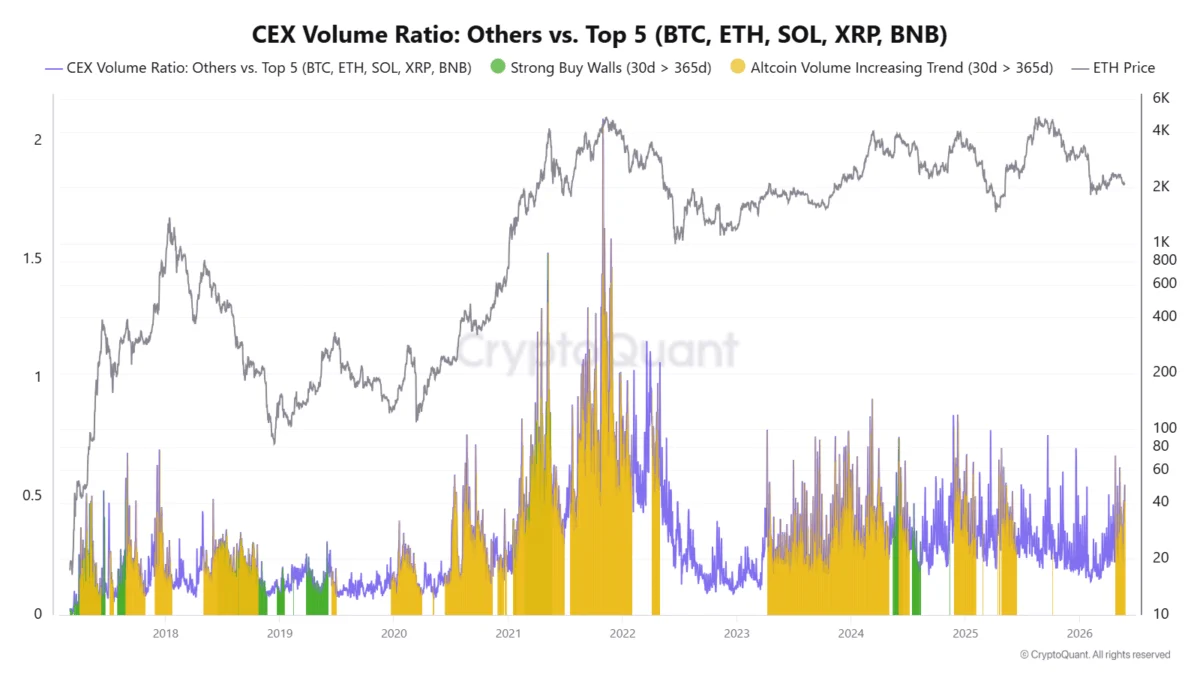
The global cryptocurrency market is currently navigating a period of profound structural transition, characterized by a notable divergence between retail sentiment and underlying capital flow. While the broader digital asset landscape has been marred by months of persistent selling pressure and a prevailing sense of investor exhaustion, recent on-chain data provided by CryptoQuant suggests that a sophisticated cohort of market participants is quietly re-engaging with the altcoin sector. This activity is occurring beneath a surface of stagnant price action and declining aggregate trading volumes, indicating a strategic shift that may signal the early stages of a market rotation.
The current macro-environment for cryptocurrencies remains historically challenging. Total exchange volumes have entered a period of steady decline, reflecting a broader withdrawal of liquidity that typically follows periods of high volatility or failed recovery attempts. Investor sentiment, often measured by indices such as the Fear and Greed Index, has transitioned from the cautious optimism seen during the brief market upswing in early 2024 to a state of entrenched negativity. As weeks of sideways movement and macroeconomic headwinds—ranging from fluctuating interest rate expectations to regulatory uncertainty—continue to weigh on the market, the general consensus has shifted toward a "wait-and-see" approach. However, it is precisely within this vacuum of general interest that a specific anomaly has emerged in the data.
According to the latest CryptoQuant analysis, exchange volume for altcoins—specifically excluding the "Big Five" assets: Bitcoin (BTC), Ethereum (ETH), Solana (SOL), XRP, and Binance Coin (BNB)—is trending upward. This divergence is significant because it highlights a localized increase in activity within the most speculative and high-risk segment of the market, even as the larger, more liquid assets experience a contraction in participation. In professional trading circles, rising volume amidst declining sentiment is often interpreted as a signal of "quiet accumulation," where informed actors build positions while the broader public remains disengaged or fearful.
Understanding the Volume Divergence and the "OTHERS" Category
To fully grasp the implications of this data, it is necessary to define the parameters of the "OTHERS" category. In the hierarchy of digital assets, Bitcoin and the top-tier altcoins represent the "blue-chip" sector, often serving as the primary entry points for institutional capital and exchange-traded fund (ETF) inflows. The "OTHERS" group consists of thousands of smaller-cap projects, ranging from established mid-cap protocols to nascent decentralized finance (DeFi) and infrastructure tokens.

Historically, this segment of the market is the last to recover during a bullish cycle but offers the highest potential for exponential returns. The fact that volume is concentrating here suggests that the participants currently active in the market are not merely reacting to price movements but are making deliberate, conviction-based allocations. This behavior contrasts sharply with the reactive selling seen in retail-heavy periods. When volume increases in a quiet market, it typically indicates that large-scale orders are being executed, likely by "whales" or specialized crypto funds looking to capitalize on undervalued assets before a broader trend reversal becomes obvious to the general public.
The CryptoQuant report emphasizes that this is not a transient spike. Unlike "pump-and-dump" scenarios characterized by a single day of massive volume followed by a total collapse, the current trend is one of gradual, session-by-session growth. This suggests a persistent directional development. As the broader market remains fixated on Bitcoin’s dominance and the potential for further corrections, this quiet accumulation in the altcoin sector is building a foundation that could eventually challenge the current market hierarchy.
Stabilization of the OTHERS/BTC Ratio
A critical metric for evaluating the health of the altcoin market is the OTHERS/BTC ratio. This index tracks the total market capitalization of all cryptocurrencies, excluding the top 10 assets, relative to the market capitalization of Bitcoin. For more than two years, this ratio has been locked in a punishing downtrend, reflecting the extreme dominance of Bitcoin during a period of high interest rates and global economic instability. In such environments, capital typically seeks the perceived safety of Bitcoin, leaving smaller altcoins to struggle for liquidity.
Technically, the OTHERS/BTC structure has remained weak on a macro basis for much of 2024 and the early months of 2025. The ratio continues to trade below its 50-week, 100-week, and 200-week moving averages, confirming that the long-term trend of Bitcoin dominance is still technically intact. However, a closer inspection of the weekly charts reveals that the momentum of this decline is beginning to deteriorate. After a sharp and aggressive sell-off, the ratio has transitioned into a prolonged sideways consolidation phase, specifically finding a floor near the 0.12 region.
In technical analysis, a transition from a vertical decline to a horizontal consolidation is often the first sign of a market bottom. This phase, known as "basing," represents a period where the selling pressure from exhausted investors is finally being met with equal or greater buying pressure from new entrants. The repeated defense of the 0.12 support level suggests that sellers are losing their ability to push the market lower, despite the lack of a confirmed breakout to the upside.

Chronology of the Altcoin Market Cycle
The journey to this current state of stabilization has been long and arduous for altcoin investors. To understand the significance of the current volume divergence, one must look at the timeline of the current market cycle:
- The 2024 Recovery Attempt: In the first quarter of 2024, the market experienced a surge in optimism driven by the approval of spot Bitcoin ETFs. This briefly lifted the altcoin market, as many anticipated a "trickle-down" effect of liquidity.
- The Q2-Q3 Retracement: As the initial ETF hype cooled and the Federal Reserve maintained a "higher-for-longer" stance on interest rates, capital retreated from riskier assets. Most altcoins lost the entirety of their early-year gains, entering a period of deep "drawdown" that lasted several months.
- The Late 2024 Exhaustion Phase: By the end of 2024, many retail participants had exited the market, leading to the decline in overall volume that persists today. This phase was marked by extreme skepticism regarding the viability of an "Altcoin Season."
- The Current Consolidation (Early 2025): We are currently in a phase where price action is largely stagnant, but the OTHERS/BTC ratio has stopped making new lows. This is where the CryptoQuant volume anomaly becomes relevant, as it indicates that while the price is flat, the "hands" holding the assets are changing.
Institutional Perspectives and Market Implications
While official statements from major financial institutions regarding mid-cap altcoins are rare, the actions of digital asset managers provide a proxy for professional sentiment. Firms like Grayscale and Bitwise have continued to expand their product offerings to include specific altcoin trusts, signaling a long-term belief in the diversification of the asset class.
Market analysts suggest that the current stabilization is a necessary precursor to a "rotation." In a typical crypto market cycle, capital flows from Bitcoin to Ethereum, then to high-cap altcoins (like Solana or XRP), and finally into the "OTHERS" category. Because the current cycle has been so heavily dominated by institutional Bitcoin inflows, the traditional rotation has been delayed. However, if the OTHERS/BTC ratio can reclaim its 50-week moving average and establish a series of higher highs, it would provide the technical confirmation needed to draw sidelined capital back into the sector.
The implications of this shift are twofold. First, it suggests that the "bottoming process" for altcoins may be further along than price action alone would suggest. Second, it highlights the importance of monitoring volume as a leading indicator. If the quiet cohort currently accumulating these assets is correct, the eventual breakout could be more explosive than previous cycles, simply because so much of the "weak hand" retail liquidity has already been flushed out.
Risks and the Path Forward
Despite the encouraging signs in the volume data, significant risks remain. The primary threat to an altcoin recovery is the continued structural dominance of Bitcoin. If Bitcoin were to experience a sudden and sharp correction, it would likely drag the entire market down with it, potentially breaking the 0.12 support level for the OTHERS/BTC ratio. Additionally, the regulatory environment in the United States and Europe remains a point of contention. Until there is a clearer legal framework for how smaller-cap tokens are classified and traded, institutional participation in the "OTHERS" segment will likely remain limited to specialized funds.

For a true "Altcoin Season" to materialize, the market requires more than just stabilization; it requires a catalyst. This could come in the form of a shift in macroeconomic policy, such as a more aggressive easing of interest rates, or a technological breakthrough within a specific sub-sector like Decentralized Physical Infrastructure Networks (DePIN) or Artificial Intelligence (AI) integration in blockchain.
In conclusion, the data provided by CryptoQuant offers a rare glimpse into the "engine room" of the crypto market. While the majority of participants see only stagnation and decline, the rising volume in the altcoin sector tells a story of strategic positioning and quiet confidence. The market is quiet, but it is far from dead. The deliberate actions of those building positions today may well define the next major phase of the digital asset evolution. As the OTHERS/BTC ratio continues its attempt to reclaim lost ground, the industry watches closely for the moment when this hidden volume finally translates into visible price momentum.














