



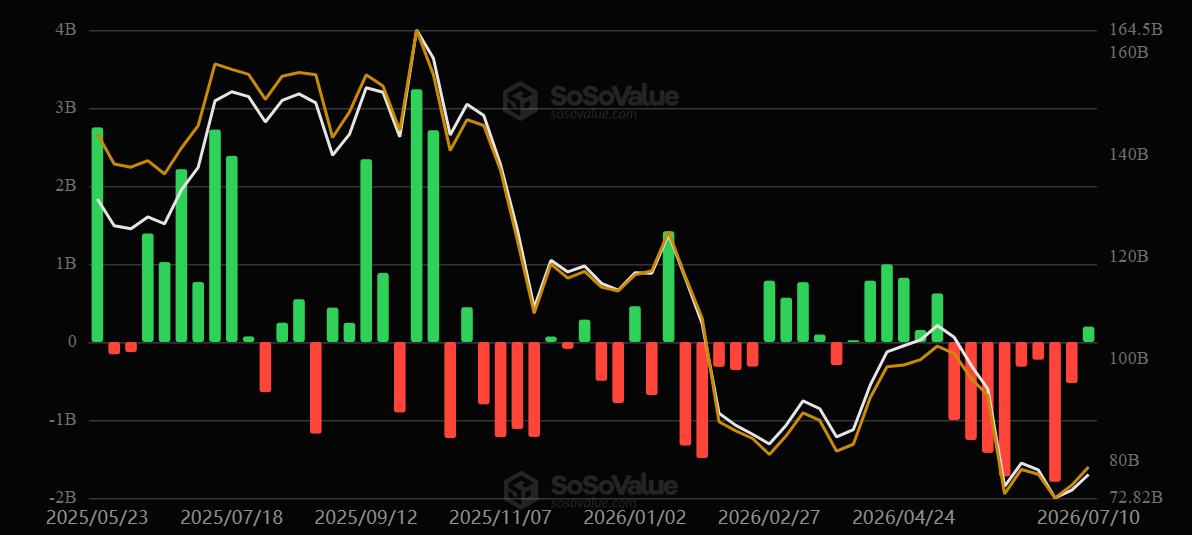
U.S.-listed spot Bitcoin Exchange Traded Funds (ETFs) have recorded their first weekly net inflows in nine weeks, attracting a total of $197.4 million, according to data from Farside Investors. This significant reversal marks the end of a prolonged period of withdrawals that saw approximately $8.26 billion removed from these funds since May 11. The renewed interest emerges as Bitcoin stages a recovery from its recent lows, though the latest inflow figure remains modest when compared to the substantial losses incurred over the preceding two months. BlackRock’s iShares Bitcoin Trust (IBIT) proved to be the primary catalyst for this shift, garnering the lion’s share of new capital, even as several competing products continued to experience redemptions, underscoring a concentrated demand rather than a broad-based resurgence.
Chronology of ETF Flows and Market Dynamics
The introduction of spot Bitcoin ETFs in the U.S. in January 2024 marked a pivotal moment for the cryptocurrency market, bridging traditional finance with the nascent digital asset space. Following their highly anticipated launch, these funds witnessed an unprecedented surge in capital, drawing billions of dollars in their initial weeks as institutional and retail investors gained easier access to Bitcoin exposure without directly holding the asset. This initial euphoric period contributed significantly to Bitcoin reaching new all-time highs in March 2024.
However, the enthusiasm began to wane as market conditions shifted. From May 11 onwards, the Bitcoin ETF ecosystem entered a protracted phase of outflows, enduring eight consecutive weeks of net withdrawals. This period, characterized by macroeconomic uncertainties, persistent inflation concerns, and a general deleveraging trend across risk assets, saw investors pull a staggering $8.26 billion from these funds. The outflows often coincided with periods of Bitcoin price consolidation or downturns, suggesting that investors were either taking profits after the earlier rally or reducing exposure amid a cautious market sentiment.
The current week, ending July 12, 2024, brought a welcome change to this trend. The week commenced with a robust performance, as Bitcoin ETFs collectively recorded $265.7 million in net inflows on Monday. However, this strong start was followed by a significant deceleration, with Tuesday’s inflows slowing to just $21.5 million. The mid-week saw a return to outflows, with combined withdrawals reaching approximately $180.2 million across Wednesday and Thursday. It was a substantial $90.4 million inflow on Friday that ultimately secured a positive weekly result, nudging the total net inflow to $197.4 million and breaking the prolonged streak of withdrawals.
Deep Dive into Issuer Performance and Investor Preferences
A closer examination of the individual ETF performances reveals a highly selective demand landscape. BlackRock’s iShares Bitcoin Trust (IBIT) emerged as the dominant force, attracting a remarkable $291.9 million in weekly inflows. This figure not only represents the largest single contribution but also exceeded the total net gain for the entire category, indicating that IBIT effectively offset redemptions from other products and drove the overall positive trend. BlackRock, a titan in the asset management industry, has leveraged its extensive distribution network and brand reputation to position IBIT as a preferred vehicle for institutional Bitcoin exposure.

In stark contrast, several other prominent Bitcoin ETFs experienced continued outflows. Grayscale’s Bitcoin Trust (GBTC), which converted from a closed-end fund to an ETF in January, recorded roughly $108.2 million in withdrawals. GBTC has faced persistent outflows since its conversion, primarily due to its higher fee structure compared to competitors and profit-taking by early investors who were previously locked into the trust. Fidelity’s Wise Origin Bitcoin Fund (FBTC), another major player, also shed approximately $93.4 million during the week. Additionally, the ARK 21Shares Bitcoin ETF (ARKB) posted a weekly outflow near $15.3 million.
This concentrated pattern of inflows into specific funds, predominantly IBIT, while others experienced redemptions, suggests that the market is not yet signaling a broad-based institutional comeback. Instead, it points to a more discerning approach from investors, who may be consolidating their positions into preferred funds, rebalancing portfolios, or selectively increasing exposure to certain issuers they perceive as having a stronger competitive edge or lower fees. The fact that Bitcoin ETFs have only recovered about 2.4% of the $8.26 billion withdrawn over the previous eight weeks further tempers claims of a robust institutional resurgence, indicating that while the bleeding has stopped, a full recovery of institutional conviction is still pending.
Broader Market Sentiment and Trading Volumes
Despite the return to positive inflows, overall trading activity within the Bitcoin ETF sector remained subdued. Weekly Bitcoin ETF volume reached approximately $84.1 billion, representing one of the lowest five-day totals observed since the initial launch period earlier in the year. This muted trading volume, even amidst net inflows, suggests that many investors, particularly larger institutions, are maintaining a cautious stance and may be waiting for clearer market signals or more sustained positive momentum before committing significant capital. Low trading volumes often indicate a lack of strong conviction from either buyers or sellers, leading to range-bound price action and hesitant participation.
The year-to-date performance further highlights the challenges faced by these products. Bitcoin ETFs collectively remain down approximately $5.34 billion in net flows since their inception in January. This underscores the volatile nature of the market and the significant impact of the recent outflow streak on their overall capital accumulation. The recent price rebound in Bitcoin, while encouraging, has not yet translated into consistent, broad-based ETF demand, particularly given the midweek redemptions observed even in a positive week. This split reinforces the view that portfolio managers are currently selective and tactical in their allocations, rather than operating in a fully "risk-on" environment.
Parallel Trends in Ether ETFs and the Broader Crypto Landscape
Mirroring the developments in the Bitcoin ETF space, U.S. spot Ether ETFs also displayed a similar pattern of recovery. These products attracted $84.4 million in net inflows during the week, effectively ending their own eight-week streak of withdrawals. Prior to this reversal, Ether funds had collectively lost around $1.2 billion over the preceding period, reflecting a shared sentiment of caution and deleveraging across major crypto assets. The combined weekly inflow for both Bitcoin and Ether ETF categories reached $281.8 million, indicating a potential, albeit nascent, shift in sentiment across the broader digital asset market.
This parallel trend suggests that the drivers behind the recent outflows and the current tentative recovery are likely systemic, affecting multiple cryptocurrencies. Factors such as macroeconomic conditions, regulatory clarity (or lack thereof), and general risk appetite in traditional financial markets tend to influence the entire crypto ecosystem. The approval of spot Ether ETFs earlier this year, following the success of Bitcoin ETFs, was another landmark event, and their performance is closely watched as an indicator of broader institutional interest in diversified digital asset exposure.
Macroeconomic Headwinds and Future Outlook
The sustainability of these renewed inflows into Bitcoin and Ether ETFs remains highly dependent on forthcoming macroeconomic data and the evolving monetary policy landscape. A critical test for market direction will arrive with the release of the June U.S. Consumer Price Index (CPI) report. The Bureau of Labor Statistics is scheduled to release this pivotal inflation data on Tuesday, July 14, at 8:30 a.m. Eastern Time.
The CPI report holds significant weight because it directly influences the Federal Reserve’s decisions regarding interest rates. A softer-than-expected inflation reading could bolster the case for potential interest rate cuts or at least signal a pause in rate hikes, which would generally be supportive of risk assets like cryptocurrencies and equity markets. Such a scenario could foster increased investor confidence, potentially extending the positive inflow trend into crypto ETFs. Conversely, a hotter-than-expected CPI figure could revive concerns about persistent inflation, prompting the Fed to maintain a hawkish stance or even consider further rate increases. This outcome could trigger another round of redemptions from risk assets, including Bitcoin and Ether ETFs, as investors seek safer havens.
Beyond immediate economic data, seasonal conditions could also add pressure to the cryptocurrency market. Historically, August and September have often brought weaker trading conditions and reduced liquidity across financial markets, including digital assets. Furthermore, Bitcoin’s recent price gains have, at times, shown a tendency to fade later in the month, suggesting that sustained upward momentum requires robust and consistent demand.
Expert Perspectives and Implications for Institutional Adoption
Market analysts are approaching the recent inflow data with cautious optimism. While the end of the outflow streak is a positive development, many observers emphasize that a single week of inflows, particularly one driven predominantly by a single issuer, does not definitively signal a broad institutional "comeback." The current demand appears selective and tactical, rather than indicative of a widespread, conviction-driven allocation shift. For a true institutional recovery to be confirmed, analysts suggest the need for several consecutive weeks of positive inflows, accompanied by higher trading volumes and a more even distribution of capital across various ETF products.
The ongoing competition among ETF issuers also plays a crucial role. Funds like IBIT, with their lower expense ratios and robust liquidity, are likely to continue attracting capital from discerning investors. The persistent outflows from GBTC highlight the market’s sensitivity to fees and the desire for more competitive offerings.
Ultimately, the trajectory of Bitcoin and Ether ETFs will serve as a key barometer for institutional adoption of digital assets. While the initial promise of these products was immense, the journey toward full integration into mainstream financial portfolios is proving to be complex, influenced by a confluence of macroeconomic forces, regulatory developments, and evolving investor sentiment. The coming weeks, particularly with the release of critical economic data, will be instrumental in determining whether this recent reversal marks a durable shift or merely a temporary reprieve in a cautious market.














