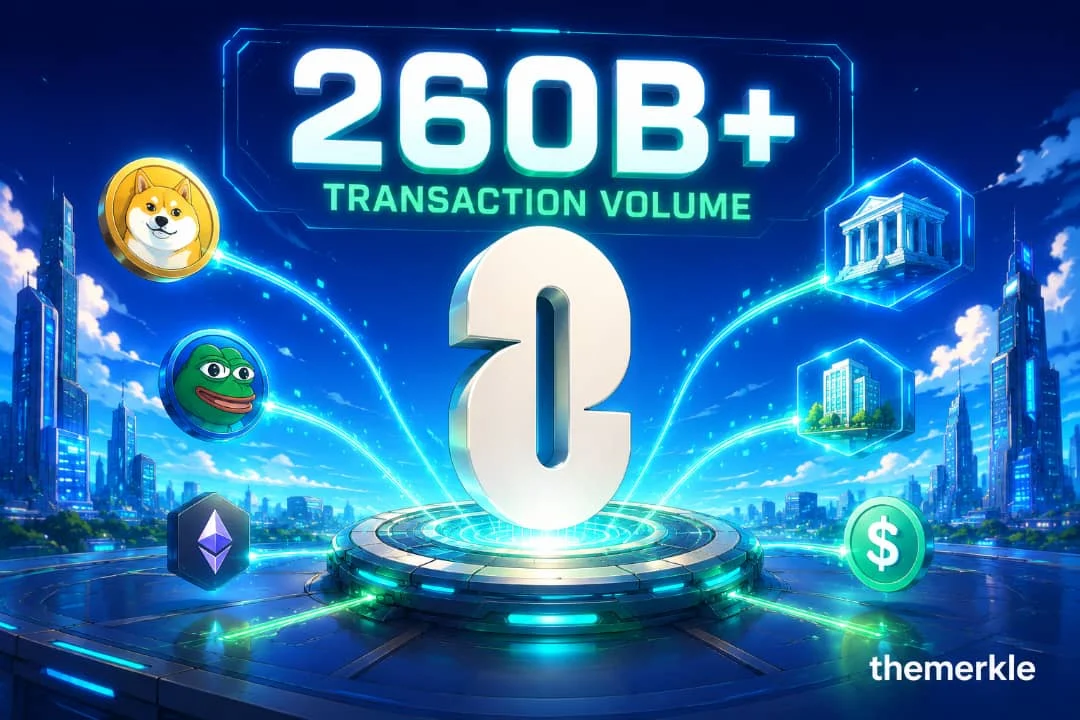
LayerZero, the omnichain interoperability protocol, has now facilitated an astounding $260 billion in transaction volume across more than 830 Omnichain Fungible Tokens (OFTs) deployed on upwards of 170 distinct blockchains. This monumental achievement underscores LayerZero’s quiet yet profound transformation of the fragmented blockchain landscape, establishing itself as a foundational layer connecting disparate digital economies. From the volatile world of speculative memecoins to the rigorously structured domain of institutional-grade tokenized treasuries and government-issued stable tokens, LayerZero has emerged as the critical conduit, enabling seamless asset and message transfer across an ever-expanding universe of distributed ledgers.
The Interoperability Imperative: Navigating a Fragmented Digital Landscape
The genesis of LayerZero’s significance lies in the inherent fragmentation of the blockchain ecosystem. Early blockchain development saw the rise of numerous independent networks, each optimized for specific use cases, security models, and communities. While this specialization fostered innovation, it simultaneously created isolated "walled gardens" – a challenge often referred to as the blockchain interoperability problem. Users and assets were largely confined to single chains, necessitating complex, often risky, and inefficient bridging solutions to move value between networks.
Traditional bridges, while serving a crucial early role, often presented significant vulnerabilities. They typically rely on locking assets on a source chain and minting wrapped versions on a destination chain, creating central points of failure and introducing additional counterparty risk. High-profile exploits targeting various bridging protocols, resulting in billions of dollars in losses, highlighted the urgent need for a more secure, robust, and truly decentralized approach to cross-chain communication. LayerZero entered this environment with a novel architectural philosophy, aiming not just to move assets, but to enable a more fundamental form of secure, customizable message passing. Its rise to prominence is a direct response to the industry’s desperate need for reliable infrastructure that can unify liquidity, user bases, and application functionality across the multi-chain paradigm.
LayerZero’s Architectural Philosophy: Beyond Simple Asset Bridging
What distinguishes LayerZero’s milestone from typical crypto volume announcements is not just the sheer scale, but the diverse spectrum of participants and use cases it serves. The builders leveraging LayerZero are far from a monolithic group; they encompass everything from lean, agile teams launching viral tokens to sophisticated financial institutions embedding complex compliance logic directly into smart contracts. The protocol’s ability to serve such a disparate user base stems from its core design principle: deep configurability rather than a one-size-fits-all solution.
At its heart, LayerZero operates as a highly generalizable messaging protocol. Unlike many conventional bridges that impose a fixed security model or asset-wrapping mechanism, LayerZero empowers builders with the tools to define their own security assumptions, validation mechanisms, and deployment logic. This flexibility is paramount. A memecoin team, whose primary concerns might be speed and broad market access, possesses entirely different requirements than a real-world asset (RWA) issuer, whose priority is immutable security and legal enforceability. Similarly, a licensed financial institution demands robust compliance integration and stringent risk management protocols. LayerZero accommodates all these distinct needs without forcing any entity into a predefined, restrictive framework.
This configurability is achieved through LayerZero’s innovative architecture, which separates the messaging layer from the security layer. It utilizes Ultra Light Nodes (ULNs) combined with independent oracle and relayer networks. When a message is sent across chains, the oracle forwards the block header to the destination chain’s ULN, while the relayer forwards the transaction proof. These two components, operating independently, must both agree for a transaction to be validated. This separation of concerns significantly enhances security by eliminating single points of failure inherent in many traditional bridging models, allowing builders to choose their oracle and relayer, thereby customizing their security parameters to match their specific risk profiles.
A Spectrum of Builders: Tailored Solutions for Diverse Needs
The $260 billion figure is not merely a testament to transaction volume; it is a clear signal that the market profoundly agrees with LayerZero’s infrastructure-first approach. This is not a protocol chasing fleeting hype; it is infrastructure maturing in real time, catering to a diverse "builder spectrum" that defines the modern blockchain ecosystem.
For a small team, LayerZero represents unparalleled market access. For a burgeoning asset issuer, it provides foundational trust infrastructure. For a traditional bank or regulated entity, it functions as compliance plumbing that seamlessly travels with a token wherever it moves across the omnichain environment. Understanding these nuanced distinctions is crucial to grasping the parabolic adoption curve LayerZero has experienced. The protocol essentially becomes a different tool depending on the hand that wields it, a testament to its design flexibility. This adaptability positions LayerZero as a critical enabler for the next phase of blockchain adoption, where specialized chains must communicate effortlessly to unlock broader utility.
Accelerating Momentum: Memecoins and the Quest for Rapid Market Access
In the fast-paced, often frenetic world of memecoins, speed and expansive reach are paramount. When a token captures viral momentum, the window to capitalize on that surge is exceedingly narrow. Being confined to a single blockchain means leaving significant liquidity, potential users, and valuable trading volume untapped on other networks. LayerZero directly addresses this critical challenge for memecoin builders.
By deploying an Omnichain Fungible Token (OFT) through LayerZero, a memecoin team gains the unprecedented ability to list their asset across multiple chains almost simultaneously. This immediately taps into the native user bases and existing liquidity pools prevalent on various ecosystems like Ethereum, BNB Chain, Avalanche, Polygon, and Solana, among others. Crucially, there is no longer a need for teams to expend valuable resources building complex bridge infrastructure from scratch, nor do they need to rely on third-party wrapped tokens that introduce additional layers of risk and management overhead. The OFT moves natively, maintaining a unified supply across every blockchain it reaches, thereby preventing liquidity fragmentation and enhancing price discovery.
For this segment of builders, LayerZero functions primarily as an unparalleled distribution tool. It dramatically reduces the friction associated with multi-chain expansion, allowing teams to dedicate their focus to the core drivers of memecoin success: community engagement, cultural relevance, and maintaining viral momentum. The underlying cross-chain mechanics are handled robustly by the protocol, freeing creators to concentrate on innovation and market capture. The ability to launch on multiple chains simultaneously or rapidly expand to new ones provides a significant competitive advantage in a market where speed to market can dictate success or failure.
Tokenized Real-World Assets: Embedding Trust and Security Across Chains
The burgeoning real-world asset (RWA) sector presents an entirely distinct, and often more complex, set of challenges compared to the memecoin space. When the underlying asset is a treasury bill, a real estate fund, a commodity, or even a carbon credit, it carries significant legal, financial, and regulatory weight that a purely speculative memecoin does not. In this domain, getting the security model wrong is not merely a technical glitch; it can lead to catastrophic regulatory penalties, severe reputational damage, and substantial financial liabilities. The projected growth of the RWA market, estimated to reach trillions of dollars in the coming decade, underscores the critical need for robust, compliant interoperability.
LayerZero provides RWA issuers with the critical capability to define their own specific trust assumptions and embed these directly into the token’s configuration. This level of granular control is transformative for institutional adoption. Builders can establish and operate their own Decentralized Verifier Networks (DVNs), set custom signing thresholds, and precisely determine the validation logic that governs every single cross-chain message their token sends. A paramount feature is that these meticulously defined parameters are not static; they travel intrinsically with the token wherever it goes. The security model, therefore, does not remain behind on the originating chain when the asset migrates to a new blockchain environment.
This "security that travels with the token" is immensely significant for institutional players. Asset managers, custodians, and large financial entities meticulously evaluating tokenized products demand absolute assurance that the rules governing their valuable assets are consistent, immutable, and fully enforceable across every single blockchain those assets might potentially traverse. LayerZero’s approach directly addresses these stringent requirements, providing a framework where the integrity and compliance of RWAs are maintained irrespective of their location within the multi-chain ecosystem. This capability is a fundamental enabler for bringing institutional capital and traditionally illiquid assets onto blockchain rails.
Financial Institutions: LayerZero as Compliance Infrastructure Across Every Chain
For regulated financial institutions—banks, asset managers, and other licensed entities—cross-chain interoperability is fundamentally more than a technical problem; it is an intricate compliance puzzle. The act of moving assets across diverse blockchains necessitates the seamless extension of Know Your Customer (KYC), Anti-Money Laundering (AML) requirements, comprehensive transaction monitoring obligations, and various jurisdictional restrictions into environments that were not inherently designed to accommodate such complexities. This poses a significant hurdle if the underlying infrastructure lacks the sophisticated capabilities to integrate and enforce these mandates.
LayerZero tackles this challenge with a fundamentally different approach. Rather than treating compliance as an afterthought—something that needs to be retroactively bolted on after a token’s deployment—the protocol allows institutions to configure and enforce compliance logic directly at the messaging layer. This means that every single transfer, every cross-chain message involving an institution’s token, is mandated to pass through whatever specific policy checks and rule sets the institution has meticulously defined. These policies can include whitelists, blacklists, geographical restrictions, transaction limits, and other regulatory parameters, all enforced omnichain.
For banks and asset managers venturing into the on-chain digital asset space, this capability represents a profound unlock. It elegantly resolves the historical dilemma of choosing between the efficiency benefits and transparency of blockchain technology and their non-negotiable regulatory obligations. With LayerZero, they can robustly achieve both. As the market for tokenized treasuries, institutional digital assets, and central bank digital currencies (CBDCs) continues its inevitable growth trajectory, the ability to carry and enforce compliance infrastructure across an interconnected web of blockchains will rapidly transition from being a competitive differentiator to an absolute baseline requirement for participation. LayerZero’s proactive integration of this functionality positions it as a vital partner in the mainstream adoption of digital assets by the traditional financial sector.
Broader Market Implications: Maturing Infrastructure for a Multi-Chain Future
LayerZero’s achievement of $260 billion in transaction volume and its widespread adoption across 170+ blockchains signal a significant maturation of the broader blockchain infrastructure landscape. The protocol’s success underscores a fundamental shift in how the industry approaches interoperability, moving beyond ad-hoc bridges towards more secure, generalized, and customizable messaging layers. This evolution has profound implications for several key areas within the digital economy.
Firstly, for the Decentralized Finance (DeFi) sector, LayerZero enables a truly unified liquidity environment. By allowing assets to move natively across chains without being wrapped, it reduces fragmentation, enhances capital efficiency, and opens up new possibilities for cross-chain yield farming, lending, and trading strategies. This facilitates a more robust and resilient DeFi ecosystem that is less susceptible to single-chain risks.
Secondly, for enterprise blockchain and large-scale institutional adoption, LayerZero provides the missing piece for creating interconnected digital asset networks. The ability to manage compliance, security, and asset provenance across diverse private and public blockchains is essential for complex supply chains, international trade finance, and tokenized securities markets. LayerZero’s configurable security and compliance features directly address the stringent requirements of these use cases, paving the way for broader integration of blockchain technology into traditional business processes.
Finally, LayerZero’s model fosters greater innovation by abstracting away the complexities of cross-chain communication. Developers can focus on building innovative applications and services, knowing that their assets and messages can seamlessly reach users and liquidity across any connected chain. This accelerates the pace of development and fosters a more vibrant, interconnected ecosystem where ideas can flourish without being constrained by blockchain silos. The future of Web3 is inherently multi-chain, and protocols like LayerZero are proving indispensable in realizing that vision, moving the industry closer to a truly global, interconnected digital economy where value flows freely and securely.
Disclosure: This is not trading or investment advice. Always do your research before buying any cryptocurrency or investing in any services.