Hangzhou, China – On Tuesday, June 16, 2026, Alibaba’s Qwen team officially announced the release of the Qwen-Robot Suite, a groundbreaking collection of three distinct yet interconnected foundation models designed to create what the company describes as a "full stack for embodied intelligence." This suite, comprising Qwen-RobotNav for mobility, Qwen-RobotManip for manipulation, and Qwen-RobotWorld for simulating the underlying physics, represents a significant leap forward in the development of intelligent robots. Alibaba is positioning this integrated software platform as the potential "Android moment" for robotics, providing a versatile operating system for diverse hardware rather than new physical bodies.
The Dawn of Embodied AI and Alibaba’s Strategic Bet
The unveiling of the Qwen-Robot Suite underscores Alibaba’s profound commitment to embodied AI, a field focused on creating intelligent agents that can perceive, reason, and act in the physical world. For a technology conglomerate like Alibaba, which uniquely spans critical sectors from semiconductor chips and cloud computing to advanced AI models, serving platforms, and consumer applications within China, robotics represents the most tangible and physical manifestation of its extensive AI investments. This holistic approach allows Alibaba to exert control over the entire technological stack, from foundational hardware to end-user applications.
Traditional robotic systems typically rely on machine-learning models that, while capable of performing specific tasks with precision, often lack the adaptability, generality, and intuitive understanding characteristic of generative AI. Current AI agents often lean on Large Language Models (LLMs) to inform their decision-making processes. However, the challenges faced by physical robots extend beyond mere textual or conceptual reasoning. Unlike software agents that primarily grapple with "prompts," physical agents must contend with the unforgiving laws of "physics"—a fundamentally harder class of failure modes that demand a deep, intrinsic understanding of the material world. The Qwen-Robot Suite aims to bridge this gap, infusing robots with a more robust and adaptive form of intelligence.
A Deeper Dive into the Qwen-Robot Suite Components
The Qwen-Robot Suite is designed with modularity, allowing each of its three foundation models to function independently while achieving synergistic effects when deployed together. This architectural choice promises flexibility and scalability for various robotic applications.
Qwen-RobotNav: Mastering Autonomous Mobility
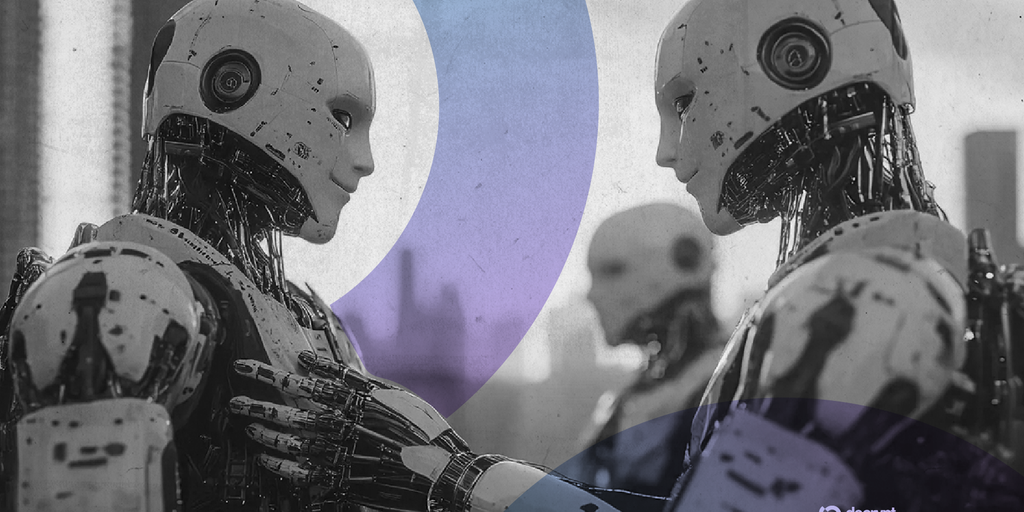
Qwen-RobotNav is the suite’s dedicated model for navigation and mobility, unifying five critical tasks that are traditionally handled by disparate systems. These include instruction following, point-goal navigation, object search, target tracking, and autonomous driving. Each of these tasks demands sophisticated visual memory strategies and real-time environmental processing. Historically, most navigation models hardcode a single visual memory strategy, limiting their adaptability across diverse scenarios.
Qwen-RobotNav innovates by exposing a highly parameterized interface, allowing planners to dynamically reconfigure crucial parameters such as token budget, temporal decay, and per-camera weights mid-episode. This flexibility enables the robot to adapt its perception and navigation strategy on the fly, optimizing for the specific demands of the current task and environment.
The model’s robust capabilities are a direct result of extensive training on a massive dataset of 15.6 million samples, incorporating randomization across all parameters to enhance generalization. Its performance metrics are highly impressive: Qwen-RobotNav achieved a 76.5% success rate on VLN-CE RxR, a prominent benchmark for vision-and-language navigation in complex, real-world environments. Furthermore, it demonstrated a 90% tracking accuracy on EVT-Bench, which assesses an agent’s ability to consistently follow moving targets amidst dynamic scenes. These results signify a substantial improvement in robot navigation, offering potential breakthroughs for applications ranging from delivery robots and industrial automation to personal assistance and search-and-rescue operations.
Qwen-RobotManip: Bridging Diverse Manipulation Gaps
Robotic manipulation presents one of the most significant challenges in the field, primarily due to the vast and fundamentally different ways various robots represent and execute actions. For instance, a Franka arm, known for its seven degrees of freedom, operates primarily through joint angles, requiring precise control over each articulation. In contrast, an ALOHA robot, a popular low-cost bimanual platform for research, defines actions through the position and orientation of its grippers, known as end-effector poses. Humanoid robots introduce another layer of complexity, often utilizing whole-body coordinates for complex, human-like movements. This diversity in action spaces creates a formidable barrier to developing universal manipulation models.
Qwen-RobotManip directly addresses this challenge by synthesizing an unprecedented approximately 38,100 hours of training data. Crucially, this vast dataset was compiled entirely from open-source robot datasets and human videos, without relying on any proprietary data collection, which is a significant differentiator in the competitive AI landscape. By learning from such a diverse and extensive range of sources, Qwen-RobotManip has developed an ability to bridge these incompatible action spaces, enabling a more generalized approach to robotic control. This innovative "alignment-first" approach is proving highly effective, as evidenced by its top ranking on RoboChallenge Table30-v1, where it outperformed previous state-of-the-art approaches by a remarkable 20%. This capability promises to accelerate the deployment of intelligent manipulation across various robotic platforms and tasks, from assembly lines to delicate laboratory procedures.
Qwen-RobotWorld: The Universal Physical Simulator
Perhaps the most ambitious component of the suite, Qwen-RobotWorld is a language-conditioned video world model that treats natural language as a universal action interface. This means a single natural language instruction, such as "Pick up the red cup and pour water on the flower," can be interpreted and executed by various robotic actors—be it a simple gripper, an autonomous vehicle, or a mobile navigation agent. This abstraction layer simplifies programming and enables unprecedented levels of flexibility in robot interaction.
The foundation of Qwen-RobotWorld is its "Embodied World Knowledge corpus," an enormous repository spanning 8.6 million video-text pairs, equivalent to over 200 million frames of video data. This corpus covers an extensive range of domains, including 5.9 million manipulation samples (encompassing over 1,300 skills and 20+ robot morphologies), comprehensive autonomous driving datasets (such as Waymo, NVIDIA PhysicalAI-AD, and Bench2Drive), indoor navigation scenarios (from VLNVerse), and critical human-to-robot transfer data across 14 different robot arms.
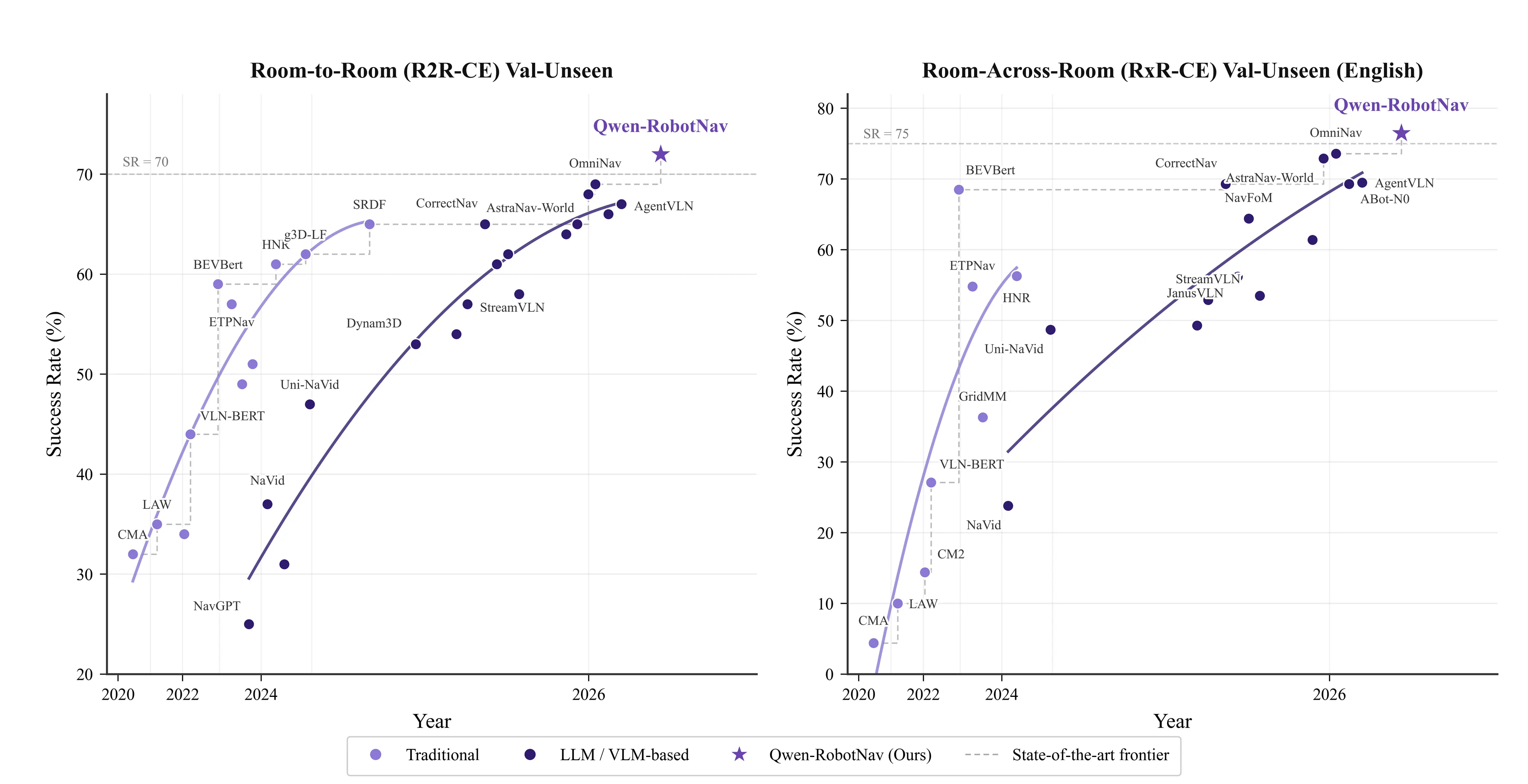
The model’s ability to accurately predict and generate realistic physical environments is validated by its top ranking on EWMBench and DreamGen Bench. Furthermore, it surpasses all open-source models on WorldModelBench and PBench, achieving a perfect score on physics adherence, flawlessly modeling Newton’s laws of motion, mass conservation, fluid dynamics, and gravity. This deep understanding of physical laws is paramount for robots to operate safely and effectively in the real world, allowing them to anticipate consequences and plan actions that respect environmental constraints.
Beyond Large Language Models: The Nuance of Robot Intelligence
It is crucial to clarify that while the Qwen-Robot Suite leverages generative AI principles for robots, these models are distinct from typical Large Language Models (LLMs) like ChatGPT. An LLM primarily predicts the next token in a sequence, focusing on linguistic coherence and factual recall. The Qwen-Robot models, however, must fundamentally understand and predict physical phenomena, spatial relationships, and the tangible consequences of physical actions.
For example, an LLM can tell you that "a glass breaks if dropped." Qwen-RobotWorld, in contrast, can predict how it breaks—simulating the shatter pattern, the fluid dynamics of spilled contents, and any secondary collisions. Complementing this, Qwen-RobotManip can plan a precise grasp that prevents the glass from being dropped in the first place. This distinction highlights the suite’s focus on actionable, physics-informed intelligence rather than purely linguistic reasoning.
The Competitive Landscape and Alibaba’s Differentiators
The development of embodied AI is a global race, with prominent Western labs such as Google DeepMind, Nvidia, Figure, and Physical Intelligence also pursuing similar objectives. However, many of these efforts tend to specialize in either navigation or manipulation, rather than offering a unified, composable suite that integrates both with a sophisticated world model. Alibaba’s strategy of vertical integration, controlling the full stack from chips to applications, provides a distinct advantage in optimizing performance and ensuring seamless interoperability across the components.
Furthermore, the decision to build the Qwen-Robot Suite on an open-source foundation differentiates Alibaba from competitors who often rely heavily on proprietary robot data. This open approach can foster a broader ecosystem of developers and researchers, potentially accelerating innovation and adoption within the robotics community. It’s also important to reiterate that these are sophisticated software models—brains, not bodies. They are designed to run on a variety of existing and future hardware platforms from manufacturers like AgileX, Franka, Universal Robots, and Unitree, emphasizing their role as a universal operating system layer.
Real-World Hurdles and Future Outlook
Despite these significant technical achievements, Alibaba candidly acknowledges the substantial gap between controlled demonstrations of robots performing tasks, such as placing fruit in a basket, and a robot reliably operating in complex, unstructured environments like a typical home. The real world introduces myriad challenges, including sensor noise, actuator drift, and the "long tail" of unforeseen edge cases that have historically humbled even the most advanced robotics efforts. Alibaba’s recognition of these practical limitations underscores a grounded approach to development.
Nevertheless, the technical advancements within the Qwen-Robot Suite are genuinely transformative. RobotManip’s alignment-first approach offers a crucial solution to the bottleneck of cross-embodiment training, enabling robots of different designs to learn from a common pool of experience. RobotNav’s parameterized observation interface provides an elegant and effective solution to the context-strategy problem, allowing robots to dynamically adapt their perceptual strategies. Most notably, RobotWorld’s innovative use of natural language as a universal action interface represents the correct abstraction for developing truly generalizable, cross-domain world models.
As of the announcement, Alibaba has not disclosed specific pricing, commercial timelines, or details regarding which customers will gain access beyond initial pilot programs. However, the introduction of the Qwen-Robot Suite marks a pivotal moment, signaling a future where intelligent robots, powered by adaptable and physics-aware AI, could fundamentally reshape industries from manufacturing and logistics to healthcare and personal assistance, ushering in a new era of practical and versatile robotic capabilities. The "Android moment" analogy highlights the potential for this suite to standardize and democratize advanced robotic intelligence, paving the way for widespread innovation.