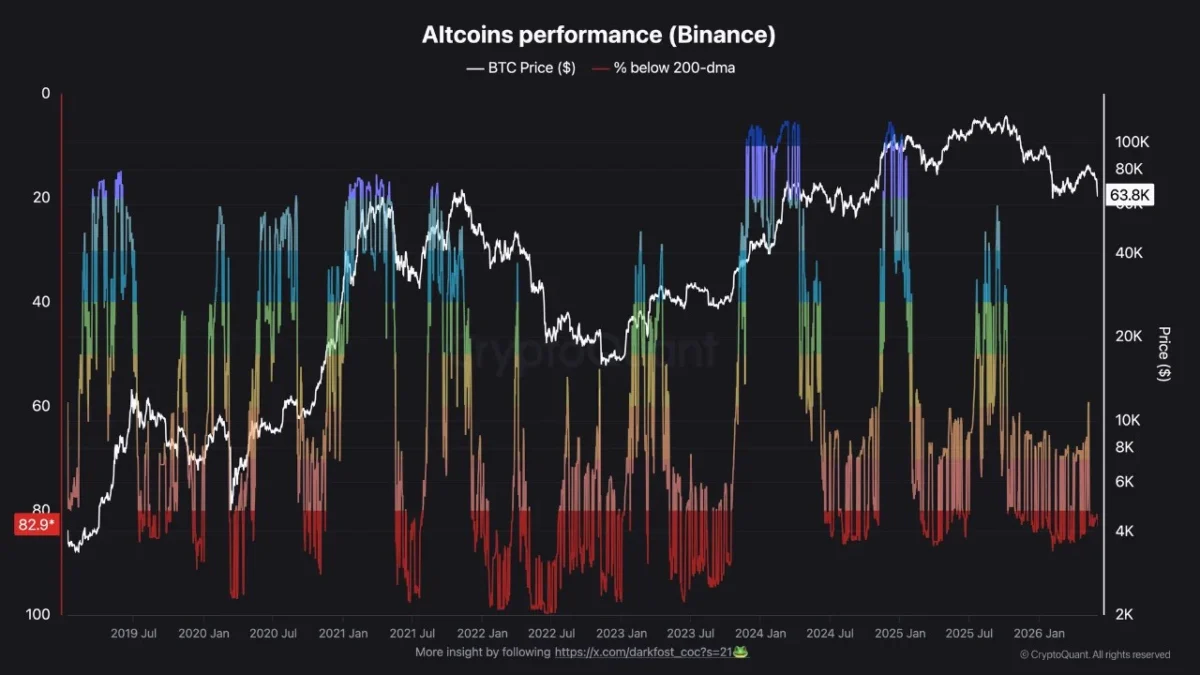
The digital asset landscape is currently grappling with a profound structural shift as altcoins—cryptocurrencies excluding Bitcoin—enter a period of severe underperformance that has effectively decoupled them from the broader bullish narratives seen in earlier market cycles. According to a comprehensive analysis by seasoned market researcher Darkfost, the altcoin sector has reached a critical juncture characterized by extreme bearish sentiment and a significant erosion of market capitalization. This downturn is not occurring in a vacuum; it follows a tumultuous period for global finance where over $1 trillion in value was wiped from United States financial markets in a single trading session. This contagion, triggered by weakening sentiment surrounding artificial intelligence (AI) and semiconductor equities, saw the S&P 500 retreat by 2.6% and the Nasdaq Composite plunge by 4.7%. While Bitcoin experienced a 4% decline, the impact on the altcoin market has been disproportionately severe and long-lasting.
The Technical Breakdown: The 200-Day Moving Average Crisis
Central to the current alarm within the analyst community is the failure of altcoins to maintain key technical support levels. Darkfost highlights that a staggering 83% of altcoins are currently trading below their 200-day moving average (200DMA). In technical analysis, the 200DMA is regarded as one of the most significant indicators of long-term health; it represents the average closing price of an asset over the previous 200 trading days and serves as a dividing line between a secular bull market and a bear market. When the vast majority of an asset class falls below this line, it suggests that the long-term trend has shifted from accumulation to distribution.
This technical decay has been a persistent theme since December 2024. Unlike previous cycles where a surge in Bitcoin’s price would typically trigger a "trickle-down" effect into smaller-cap assets—a phenomenon known as "Altseason"—the current cycle has seen a distinct lack of correlation. Investors have shown a marked preference for the relative safety and institutional backing of Bitcoin, particularly following the success of Spot Bitcoin Exchange-Traded Funds (ETFs) in the United States. This concentration of capital has left the altcoin market starved of the liquidity necessary to sustain upward momentum, resulting in the current scenario where more than four out of five alternative tokens are in a technical downtrend.
Market Capitalization Erosion: The $520 Billion Evaporation
The financial implications of this trend are starkly illustrated by the TOTAL3 index, which tracks the combined market capitalization of all cryptocurrencies excluding Bitcoin and Ethereum. Data indicates that the TOTAL3 valuation has suffered a massive contraction, shedding approximately $520 billion from its peak. At its height in late 2024, the index represented a robust segment of the crypto economy, but it has since retreated to a valuation of roughly $670 billion.
This contraction has effectively erased months of speculative gains, returning the broader altcoin market to valuation levels not seen since November 2024. The velocity of this capital flight underscores the fragility of the current market structure. Analysts point out that as the TOTAL3 index loses value, it creates a feedback loop: lower valuations lead to decreased liquidity, which in turn leads to higher volatility and further discourages institutional and retail participation. The current reading on the altcoin breadth index—the percentage of coins above their 200DMA—is among the lowest recorded in the present market cycle, signaling a level of exhaustion that historically precedes either a long period of stagnation or a final capitulation event.
Macroeconomic Headwinds and the AI Sector Drag
The recent acceleration of the altcoin decline can be traced back to broader macroeconomic instability. On a pivotal Friday in early February 2025, the US equity markets faced a "black swan" style sell-off driven by disappointing earnings and guidance from the semiconductor and AI sectors. As the primary drivers of the 2024 stock market rally, the sudden weakness in these "Magnificent Seven" style stocks triggered a global "risk-off" sentiment.
In such environments, investors typically flee high-beta assets—those with high volatility and risk—in favor of cash or gold. Altcoins, which occupy the furthest end of the risk spectrum in the digital asset space, were among the first to be liquidated. The 4% drop in Bitcoin was a measured response compared to the double-digit percentage losses seen across various mid-cap and small-cap altcoin projects. This suggests that the "crypto-native" liquidity that once supported these assets is being pulled back to cover margins in traditional markets or is being converted into stablecoins to weather the storm.

Historical Context and the Breadth Expansion Paradox
To understand the severity of the current situation, it is necessary to look at the historical behavior of the 200DMA in the crypto market. Since 2022, the share of altcoins trading below this average has fluctuated primarily within the 60% to 90% range. This indicates a structural weakness that has plagued the sector for over two years. However, there were brief moments of respite. In March and December 2024, the market experienced what analysts call "breadth expansion," where nearly 90% of altcoins were trading above their 200DMA.
Darkfost notes that these periods of expansion were the strongest seen since the 2017 bull run, reflecting a rare moment of broad market participation. However, in hindsight, these peaks of optimism often served as "bull traps." When market participation reaches such high levels of euphoria, it frequently signals a local top, as there are few buyers left on the sidelines to push prices higher. Conversely, the current state of extreme pessimism—where 83% of the market is underwater—has historically provided fertile ground for long-term "contrarian" investors.
Chronology of the Decline: A Timeline of Market Erosion
The path to the current $670 billion TOTAL3 valuation has been marked by several key phases:
- Late 2024 Peak: Altcoins hit a local cycle high as Bitcoin approached new all-time highs, leading to a brief but intense surge in speculative assets and memecoins.
- December 2024 Decoupling: As Bitcoin stabilized at higher levels, altcoins failed to maintain their momentum. The correlation between BTC and the rest of the market began to weaken significantly.
- January 2025 Institutional Rotation: Capital began to flow heavily into Bitcoin and Ethereum ETFs, while "utility" altcoins struggled to attract similar institutional interest.
- February 2025 Macro Shock: The $1 trillion wipeout in US markets served as the catalyst for the most recent leg down, pushing the majority of altcoins below their 200-day moving averages.
Implications for Investors and the Future Outlook
The current data presents a dual narrative for market participants. From a short-term perspective, the outlook remains bleak. The lack of liquidity and the dominance of Bitcoin suggest that altcoins may continue to bleed value against BTC (the "ALT/BTC" pairs) for the foreseeable future. Without a significant catalyst—such as a dovish pivot by the Federal Reserve or a breakthrough in regulatory clarity for decentralized finance (DeFi)—the sector remains vulnerable to further downside.

However, for the long-term observer, the current "blood in the streets" scenario is a classic indicator of a market bottoming process. Darkfost argues that the most attractive entry points occur when pessimism is at its zenith. When 83% of assets are trading below their long-term averages, the "weak hands" have largely been flushed out, and assets are often undervalued relative to their development progress and ecosystem growth.
The broader impact of this $520 billion loss will likely result in a "flight to quality" within the altcoin space. Projects with genuine utility, revenue-generating models, and strong community backing may survive this period of "rust," while thousands of speculative tokens without fundamental value are expected to fade into obsolescence. As the market matures, the distinction between "Bitcoin" and "the rest" is becoming more pronounced, signaling a new era of crypto-investing where indiscriminate buying of altcoins is no longer a viable strategy for success.