The digital asset ecosystem is currently navigating a period of intense structural fragility, as a vast majority of alternative cryptocurrencies—commonly referred to as altcoins—struggle to maintain long-term price supports. Recent market data and expert analysis indicate that the altcoin sector has entered a phase of significant underperformance, diverging sharply from the relative resilience of Bitcoin. This downturn is not occurring in a vacuum; it follows a broader systemic shock in the global financial markets, where a retreat from high-risk assets has left the cryptocurrency landscape particularly vulnerable to capital flight and bearish sentiment.
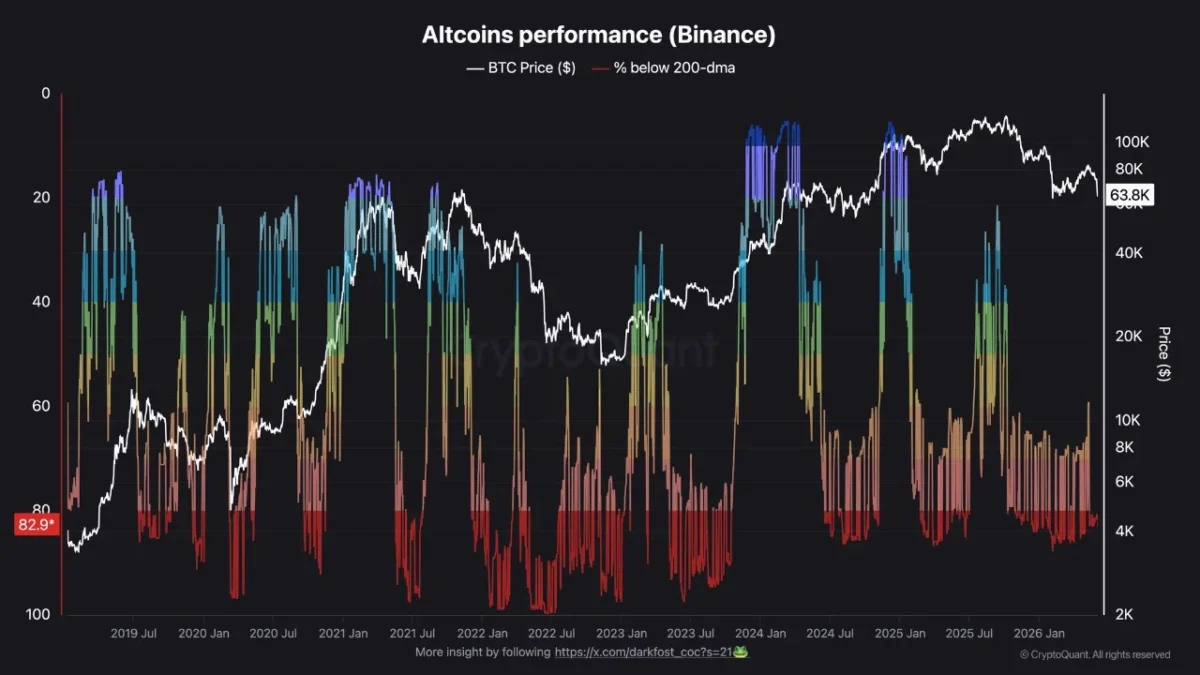
According to a comprehensive report by seasoned market analyst Darkfost, approximately 83% of all altcoins are currently trading below their 200-day moving average (200DMA). This metric is widely regarded by institutional traders and technical analysts as a primary barometer for long-term market health. When an asset falls below this threshold, it typically signals that the long-term trend has shifted from bullish to bearish, often leading to prolonged periods of stagnation or further decline. The current reading represents one of the weakest points in the present market cycle, suggesting that the "altcoin season" many investors anticipated has been replaced by a rigorous "altcoin winter."
The Global Macroeconomic Backdrop and the Trillion-Dollar Wipeout
The precarious state of the altcoin market is closely linked to broader economic instability. On a recent Friday, the United States financial markets experienced a staggering contraction, with over $1 trillion in market capitalization erased in a single trading session. This massive sell-off was primarily driven by deteriorating sentiment surrounding the artificial intelligence (AI) and semiconductor sectors, which had previously been the primary engines of stock market growth.
The ripple effects of this equity rout were felt immediately across the crypto-asset class. The S&P 500 recorded a 2.6% decline, while the tech-heavy Nasdaq plummeted by 4.7%. Bitcoin, often viewed as a high-beta version of the Nasdaq, saw a 4% retracement. However, the impact on altcoins was disproportionately severe. Unlike Bitcoin, which has benefited from the introduction of spot Exchange-Traded Funds (ETFs) and institutional "flight to quality" within the crypto space, altcoins lack a similar level of institutional support. Consequently, when liquidity dries up in the traditional markets, speculative assets like altcoins are often the first to be liquidated by investors seeking to de-risk their portfolios.
Analyzing the 200-Day Moving Average as a Critical Threshold
To understand the gravity of the current situation, one must look at the significance of the 200-day moving average. This technical indicator calculates the average closing price of an asset over the last 200 trading days, smoothing out short-term volatility to reveal the underlying trend. In a healthy bull market, the majority of assets should trade above this line, using it as a "dynamic support" level where buyers typically step in.
The fact that 83% of altcoins are trading below this level indicates a systemic failure to maintain upward momentum. Darkfost’s analysis highlights that since 2002, the percentage of altcoins below the 200DMA has generally fluctuated between 60% and 90%. The current positioning at the higher end of this range suggests that the market is nearing a state of total bearish saturation. This structural weakness implies that even if Bitcoin were to embark on a new rally, the broader altcoin market may lack the necessary momentum to follow suit, leading to a continued dilution of investor interest in smaller-cap projects.
The Half-Trillion Dollar Capital Flight: A Detailed Chronology
The financial toll of this underperformance is starkly illustrated by the TOTAL3 chart, a metric provided by TradingView that tracks the total market capitalization of all cryptocurrencies excluding Bitcoin and Ethereum. This index provides the clearest view of the "pure" altcoin market’s health.
The data reveals that the TOTAL3 index has shed nearly $520 billion in valuation since its most recent peak. From a high-water mark achieved during the height of the 2024-2025 cycle, the total valuation has plummeted to approximately $670 billion. This contraction has effectively erased several months of market gains, returning the altcoin sector to valuation levels last seen in November 2024.
This chronology of decline suggests a multi-month exodus of capital. While late 2024 saw a surge of optimism—driven by the narrative of a "supercycle" and the potential for decentralized finance (DeFi) to disrupt traditional banking—the reality of 2025 has been characterized by a "return to basics." Investors are increasingly concentrating their capital in Bitcoin, which is perceived as a "pristine" digital collateral, while abandoning alternative projects that have failed to demonstrate sustainable utility or maintain price stability.

Divergence and the Concentration of Capital in Bitcoin
One of the most notable features of the current market cycle is the lack of correlation between Bitcoin and the broader altcoin market. Historically, a rise in Bitcoin’s price would eventually lead to an "overflow" of capital into altcoins, as investors chased higher returns in more volatile assets. However, this cycle has seen a significant shift in dynamics.
The dominance of Bitcoin has remained stubbornly high, bolstered by the success of institutional investment vehicles and its growing reputation as "digital gold." In contrast, the altcoin market has struggled with an oversupply of new tokens. The proliferation of Layer 2 solutions, "meme coins," and new blockchain protocols has fragmented the available liquidity. With too many projects competing for a limited pool of capital, the majority of altcoins have failed to gain the traction necessary to stay above their 200-day moving averages.
Furthermore, the "breadth expansion" that was recorded in March and December 2024—the strongest since the 2017 bull run—appears to have been a temporary phenomenon. During those periods, nearly 90% of altcoins were trading above their 200DMA, reflecting a broad-based participation that gave investors a false sense of security. The subsequent collapse from those levels has been swift and unforgiving.
The Contrarian Perspective: Is This a Long-Term Opportunity?
Despite the overwhelmingly bearish data, some analysts argue that the current state of extreme pessimism may present a strategic entry point for long-term investors. Darkfost notes that historically, periods where the vast majority of altcoins are trading below their long-term averages have often preceded significant market bottoms.
The logic behind this contrarian view is rooted in market psychology. When sentiment is at its lowest and capital flight is at its peak, the market undergoes a "cleansing" process. Weak projects with unsustainable tokenomics are weeded out, and the remaining assets are often undervalued. Conversely, periods of extreme optimism—such as March 2024, when almost every altcoin was in an uptrend—often represent the "top" of the market, where upside potential is exhausted and the risk of a correction is at its highest.

However, this "blood in the streets" philosophy requires a high degree of risk tolerance. Unlike previous cycles, the current environment is marked by increased regulatory scrutiny and a more discerning institutional investor base. Not all altcoins that have fallen below their 200DMA will recover; many may continue to bleed value as liquidity remains concentrated in the market leaders.
Broader Implications for the Digital Asset Ecosystem
The ongoing struggles of the altcoin market have significant implications for the future of the blockchain industry. If the majority of alternative projects continue to underperform, it could lead to a consolidation phase where only the most viable protocols survive. This could ultimately be healthy for the ecosystem, as it forces developers to focus on actual utility and revenue generation rather than speculative price action.
For retail investors, the current climate serves as a cautionary tale regarding the risks of diversification in a fragmented market. The "buy and hold" strategy that worked for a wide basket of altcoins in 2017 and 2021 appears less effective in a cycle dominated by institutional demand for Bitcoin.
From a regulatory standpoint, the continued volatility and massive losses in the altcoin sector may provide further ammunition for authorities seeking to implement stricter oversight. As $520 billion in market value vanishes, the call for consumer protection and clearer guidelines for token issuance is likely to grow louder.
In conclusion, the altcoin market is currently facing a crisis of confidence and a structural breakdown of long-term price trends. With 83% of assets trading in a bearish posture and half a trillion dollars erased from the market cap, the road to recovery appears long and uncertain. While historical patterns suggest that extreme pessimism can lead to opportunity, the current cycle’s unique characteristics—including global macroeconomic instability and the institutionalization of Bitcoin—suggest that the "altcoin season" of the past may look very different in the future. Investors and participants must now navigate a landscape where technical indicators, macroeconomic trends, and fundamental utility will play a far greater role than mere speculation.