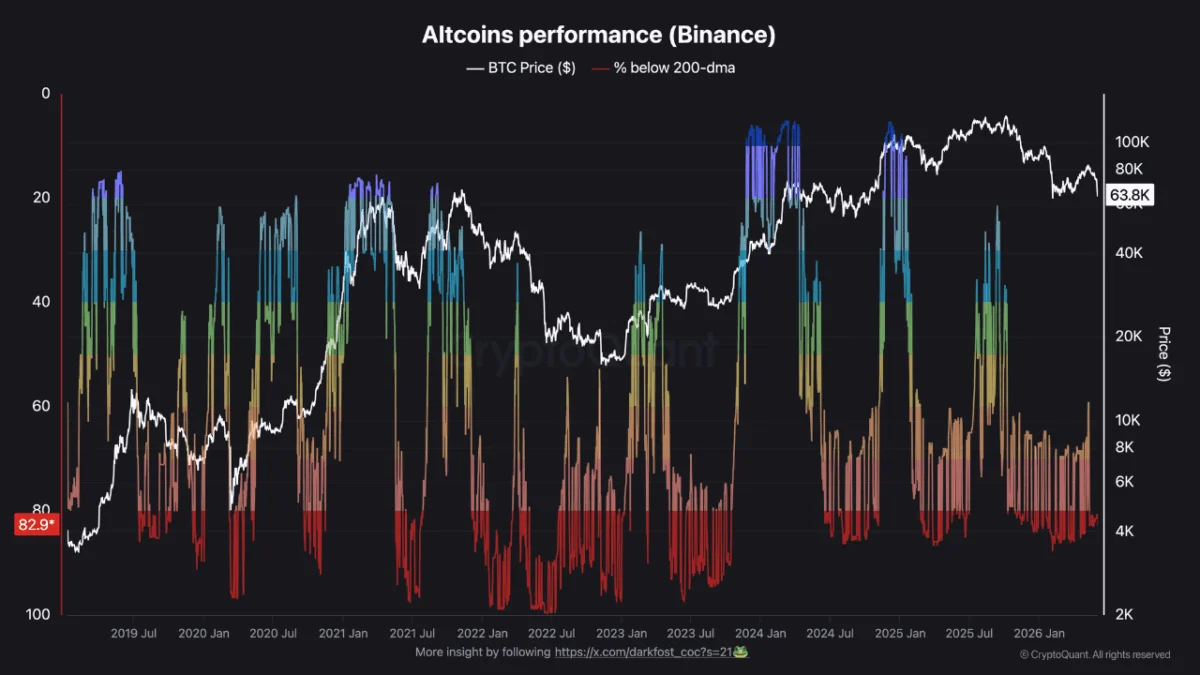
The digital asset landscape is currently grappling with a profound divergence as altcoins enter a period of sustained underperformance, failing to keep pace with Bitcoin and suffering from a significant exodus of capital. Recent market data indicates a deepening crisis for alternative cryptocurrencies, with 83% of these assets now trading below their 200-day moving average (200DMA). This technical milestone, often viewed by institutional and retail traders as a definitive barometer for long-term market health, suggests that the vast majority of the altcoin market has entered a structural bear phase. This decline is not an isolated event but is tethered to a broader retreat in global financial markets, which saw more than $1 trillion in value evaporated from US exchanges in a single trading session.
The catalyst for the most recent leg of this downturn was a sharp correction in the US equities market, particularly within the technology and semiconductor sectors. On a pivotal Friday, weak sentiment surrounding artificial intelligence (AI) and hardware manufacturing giants triggered a massive sell-off. The S&P 500 declined by 2.6%, while the tech-heavy Nasdaq plummeted by 4.7%. Bitcoin, often considered a "risk-on" asset despite its growing reputation as "digital gold," was not immune, recording a 4% loss. However, the impact on altcoins has been disproportionately severe, revealing a fragile ecosystem that has struggled to find its footing since the market peaks of late 2024.
The Macroeconomic Backdrop and the $1 Trillion Shakeout
The current fragility of the altcoin market cannot be understood without examining the macroeconomic environment. The global financial system has been under immense pressure due to fluctuating interest rate expectations and a cooling of the "AI hype" that drove equity markets to record highs throughout 2023 and early 2024. When semiconductor stocks—the backbone of the current tech rally—began to show signs of exhaustion, the resulting liquidity squeeze rippled through every speculative asset class.
For the cryptocurrency sector, this macro-volatility acted as a stress test. While Bitcoin has benefited from the massive influx of institutional capital via Spot ETFs (Exchange-Traded Funds), altcoins lack a similar institutional safety net. As investors moved to de-risk their portfolios in response to the $1 trillion market wipeout, the first assets to be liquidated were high-beta, low-liquidity alternative cryptocurrencies. This has led to a "flight to quality," where the remaining capital in the crypto space is being consolidated into Bitcoin, leaving the broader altcoin market in a state of stagnation.
Technical Analysis: The 200-Day Moving Average Crisis
According to seasoned analyst Darkfost, citing data from the on-chain analytics platform CryptoQuant, the technical outlook for altcoins is among the most bearish seen in the current market cycle. The 200-day moving average is a critical indicator used to smooth out price data and identify long-term trends. When an asset trades below this line, it generally indicates that the average investor over the last six months is currently in a losing position, creating a "ceiling" of overhead resistance as these investors look to exit at break-even points.
The fact that 83% of altcoins are currently below this level is statistically significant. Historically, since 2022, the percentage of altcoins trading below their 200DMA has fluctuated between 60% and 90%. The current reading near the top of this range suggests that the market is nearing a point of "maximum pain." This structural weakness indicates that despite various technological upgrades and ecosystem developments in the DeFi (Decentralized Finance) and NFT (Non-Fungible Token) sectors, price action remains decoupled from fundamental progress.
The $520 Billion Liquidity Vacuum
The financial toll of this underperformance is staggering. Data derived from the TOTAL3 chart—an index provided by TradingView that tracks the total market capitalization of all cryptocurrencies excluding Bitcoin and Ethereum—shows a massive contraction in value. From its local peak in late 2024, the TOTAL3 market cap has shed approximately $520 billion. At its height, this segment of the market was valued at over $1.1 trillion; it has since plummeted to approximately $670 billion.
This contraction has effectively erased nearly a year of gains. The valuation of the altcoin market has returned to levels not seen since November 2024, representing a complete "round trip" for many investors who entered the market during the late-year surge. The speed and depth of this decline underscore the lack of "sticky" capital in the altcoin space. Unlike Bitcoin, which is increasingly held by long-term institutional custodians, altcoins remain heavily influenced by retail speculation and short-term "hot money" that exits at the first sign of macro-economic distress.
A Chronology of Underperformance
The road to the current crisis began in early 2024. While Bitcoin surged toward new all-time highs, fueled by the launch of US-based ETFs, the expected "Altseason"—a period where altcoins outperform Bitcoin—failed to materialize in a meaningful way.

- Q1 2024: Bitcoin leads the market, reaching record highs. A brief "breadth expansion" occurs where nearly 90% of altcoins trade above their 200DMA, creating a sense of irrational exuberance.
- Q2 2024: The market enters a cooling phase. While Bitcoin stabilizes, altcoins begin to bleed value against their BTC trading pairs.
- Q3 2024: Regulatory uncertainty and a shift in global liquidity trends cause investors to consolidate holdings. The percentage of altcoins above the 200DMA begins to drop toward 50%.
- Late 2024 – Early 2025: A brief recovery attempt in October 2024 fails to sustain momentum. The recent February sell-off in US tech stocks provides the final blow, pushing 83% of the market into a long-term bearish trend.
The Bitcoin Divergence and Investor Sentiment
One of the most striking features of the current cycle is the breakdown of the correlation between Bitcoin and the rest of the market. In previous cycles (notably 2017 and 2021), a Bitcoin rally would typically be followed by a "trickle-down" effect, where profits from Bitcoin would flow into Ethereum and then into smaller-cap altcoins.
In 2024 and 2025, this pattern has changed. The "institutionalization" of Bitcoin has made it a distinct asset class that behaves more like a digital version of the S&P 500 or gold. Investors buying Bitcoin via ETFs are often not "crypto-native" and have no intention of rotating those gains into speculative meme coins or experimental DeFi protocols. This has created a liquidity trap for altcoins; while the "head" of the market (Bitcoin) stays relatively healthy, the "body" (altcoins) is starved of the new capital necessary to drive prices higher.
Contrarian Perspectives: The "Maximum Pain" Opportunity
Despite the grim statistics, some analysts, including Darkfost, suggest that this period of extreme pessimism could be a precursor to a long-term bottom. Market theory often posits that the best time to buy is when sentiment is at its lowest and technical indicators are at their most "oversold."
Historically, periods where 80% to 90% of the market trades below the 200DMA have eventually led to significant recovery phases. Conversely, the periods of highest optimism—such as March and December 2024, when nearly 90% of altcoins were trading above the 200DMA—were actually the most dangerous times to enter the market, as upside potential was exhausted. For long-term value investors, the current $520 billion wipeout represents a return to "baseline" valuations that may offer a more attractive entry point than the hyped-up levels of a few months ago.
Broader Implications for the Blockchain Industry
The continued underperformance of altcoins has broader implications for the blockchain industry at large. A prolonged bear market for these assets makes it more difficult for new projects to raise capital and for existing protocols to fund their operations through treasury liquidations. It also risks alienating a generation of retail investors who entered the market during the 2024 hype only to see their portfolios decline by 50% or more.

Furthermore, the concentration of capital in Bitcoin may lead to a "hollowing out" of the decentralized ecosystem if developers and users migrate toward Bitcoin-native layers (like Lightning Network or Stacks) at the expense of independent Layer 1 and Layer 2 blockchains.
Conclusion: The Path Forward
The altcoin market is currently in a state of "structural purgatory." For a true recovery to occur, several factors likely need to align: a stabilization of the US tech sector, a shift in Federal Reserve policy toward lower interest rates (which typically favors "risk-on" assets), and a return of retail interest to the crypto space.
Until then, the data remains clear: the vast majority of altcoins are struggling to maintain their long-term trend lines. With 83% of the market trading in a bearish posture and half a trillion dollars in market cap vanished, the "Altseason" that many expected has been replaced by a period of rigorous market consolidation. Investors are now being forced to move beyond speculation and focus on assets with genuine utility, sustainable tokenomics, and the ability to survive a global liquidity crunch. The current "rust" in the altcoin market may take months, if not years, to fully polish away.