The digital asset landscape is currently navigating a period of significant structural transition, as technical indicators and macroeconomic models suggest a massive capital rotation from Bitcoin to altcoins may be on the horizon. While Bitcoin has maintained a dominant position throughout much of 2024 and early 2025, analysts are increasingly identifying patterns that mirror the pre-expansion phases of previous market cycles. According to recent technical evaluations, the first quarter of 2026 is emerging as a critical inflection point where the broader cryptocurrency market, including major assets such as Ethereum (ETH), Solana (SOL), and Ripple (XRP), could begin to reclaim substantial market share.
The Current State of Market Dominance
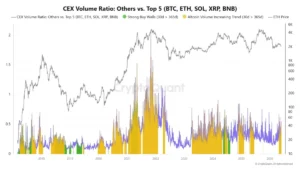
As of late 2024, the cryptocurrency market remains firmly entrenched in what is colloquially known as "Bitcoin Season." The CMC Altcoin Season Index, a metric that tracks whether the top 50 altcoins are outperforming Bitcoin over a 90-day window, currently sits at a reading of 18 out of 100. For a period to be classified as an "Altcoin Season," this index must typically cross the 75 threshold. This current reading is a stark decline from the yearly high of 78 recorded in September 2025, illustrating the immense pressure altcoins have faced as institutional capital continues to favor Bitcoin-centric products, such as spot Exchange-Traded Funds (ETFs).
Despite this underperformance, technical analysts have observed multiple bullish divergences on altcoin dominance charts. These divergences occur when the price or market share of an asset makes a lower low while a momentum indicator, such as the Relative Strength Index (RSI), makes a higher low. Historically, such patterns have served as leading indicators for upside reversals, suggesting that while the "price action" looks bearish, the underlying momentum is beginning to shift in favor of the altcoin sector.
Macroeconomic Catalysts and the Liquidity Cycle
The timing of a potential altcoin rally is inextricably linked to global macroeconomic conditions. A widely utilized macro ratio model, which compares altcoin performance against a basket of traditional financial indicators—including the U.S. Dollar Index (DXY), gold prices, and the 10-year Treasury yield—points to a setup that bears a striking resemblance to the fourth quarter of 2020.
Historically, sustained altcoin expansions require a specific "goldilocks" environment in the traditional markets. This includes a weakening U.S. dollar, which increases the purchasing power of global investors for risk-on assets; easing bond yields, which makes the fixed-income market less attractive compared to high-growth tech and crypto; and a stabilization in gold prices, suggesting a shift from defensive "safe haven" assets toward speculative growth.
Raoul Pal, a prominent macro investor and the CEO of Real Vision, has posited that the traditional four-year cryptocurrency cycle—traditionally dictated by the Bitcoin halving—has evolved into a more complex five-year structure. Pal attributes this stretching of the cycle to extended debt maturities and delayed global liquidity injections. His analysis focuses heavily on the ISM Manufacturing Index, a key indicator of U.S. economic activity. Historically, when the ISM index moves above the 50-point mark, it signals economic expansion, which often coincides with a surge in risk appetite. Pal notes that previous rallies in Bitcoin and Ethereum have been triggered by these ISM readings, with the broader altcoin market following shortly thereafter as liquidity trickles down the risk curve.
The Role of Global Liquidity and Quantitative Tightening
A critical component of the 2026 inflection point theory is the projected peak of the global liquidity cycle. Many economists expect the current era of quantitative tightening (QT)—the process by which central banks reduce the money supply to combat inflation—to fully conclude by late 2025 or early 2026. As central banks, led by the U.S. Federal Reserve, eventually pivot back toward a neutral or accommodative stance, the resulting influx of liquidity is expected to find its way into high-beta assets.
The investor consensus suggests that this liquidity cycle could reach its zenith in the second quarter of 2026. This timeline aligns with the technical "macro ratio" model, which identifies November and December 2025 as the period mirroring the structural base formed before the 2021 bull run. Under this framework, even if Bitcoin dominance sees a temporary spike in the short term, the overarching market structure remains intact, suggesting that the "Altcoin Season" is delayed by macroeconomic headwinds rather than canceled entirely.
Selective Strength in Major Altcoins
While the broader market waits for a definitive shift, selective strength has begun to emerge among top-tier altcoins. Assets such as Ethereum, Solana, XRP, Cardano (ADA), and Shiba Inu (SHIB) are being closely watched as the primary beneficiaries of the next rotation.
- Ethereum (ETH): Despite criticism regarding its high gas fees and the complexities of its Layer-2 scaling roadmap, Ethereum remains the foundational layer for decentralized finance (DeFi) and non-fungible tokens (NFTs). Analysts suggest that once the "spot ETF" narrative fully matures, institutional capital will look to ETH as the primary alternative to Bitcoin.
- Solana (SOL): Solana has emerged as a formidable competitor to Ethereum, gaining significant traction due to its high throughput and low transaction costs. Its recent performance has often decoupled from the broader altcoin market, signaling strong independent demand.
- XRP and Cardano (ADA): These assets have been heavily influenced by regulatory developments in the United States. Cardano creator Charles Hoskinson has frequently clashed with "Bitcoin maximalists" like Michael Saylor over the classification of ADA as a security. However, as legal clarity improves following the SEC vs. Ripple case, these "legacy" altcoins may see a resurgence in interest from investors seeking established projects with clear regulatory standing.
- Shiba Inu (SHIB): Representing the "memecoin" sector, SHIB has evolved from a simple joke into an ecosystem with its own Layer-2 solution, Shibarium. Its ability to post triple-digit gains during brief windows of volatility highlights the persistent retail appetite for high-risk, high-reward assets.
The Saylor vs. Hoskinson Debate: Securities and Decentralization
The path toward an altcoin resurgence is not without its ideological and legal hurdles. A central point of contention in the industry is the classification of digital assets by the U.S. Securities and Exchange Commission (SEC). This debate was recently highlighted by comments from MicroStrategy Chairman Michael Saylor, who has famously argued that Bitcoin is the only "commodity" in the space, while labeling ADA, ETH, SOL, and XRP as "unregistered securities."
This stance has drawn sharp criticism from Cardano creator Charles Hoskinson. Hoskinson argues that the decentralized nature of these protocols, combined with their utility beyond a simple store of value, distinguishes them from traditional securities. The outcome of this debate is more than academic; it dictates the level of institutional "on-ramping" that can occur. If the market moves toward a 2026 inflection point, it will likely be supported by a clearer legal framework that allows major financial institutions to offer altcoin-based products without the threat of litigation.
Chronology of Market Cycles and Future Outlook
To understand the 2026 projection, one must look at the chronology of previous cycles:
- 2016-2017: Bitcoin led the initial charge, followed by an explosion in Initial Coin Offerings (ICOs) that saw Ethereum and other early altcoins gain massive market share.
- 2020-2021: Following the COVID-19 liquidity injection, Bitcoin hit new highs in late 2020. The "Altcoin Season" followed in early to mid-2021, driven by the rise of DeFi and NFTs.
- 2024-2025: This period has been characterized by "Institutional Bitcoin," driven by ETF approvals. Altcoins have largely languished as the market waited for broader economic indicators to turn positive.
- 2026 (Projected): The convergence of the 5-year liquidity cycle, the end of quantitative tightening, and the technical "bullish divergence" on dominance charts suggests a major capital rotation.
Broader Impact and Market Implications
The transition toward a major altcoin rotation would have profound implications for the entire digital asset ecosystem. For developers, a renewed surge in altcoin valuations provides the necessary capital to continue building decentralized infrastructure. For investors, it represents a shift in strategy from "wealth preservation" in Bitcoin to "wealth generation" in the broader ecosystem.
However, market participants are advised to remain cautious. While the technical and macro models are compelling, they are not guarantees of future performance. The "Bitcoin Season" could be extended if geopolitical tensions rise or if inflation proves stickier than anticipated, forcing central banks to maintain high interest rates for longer.
In conclusion, the data suggests that the "coiled spring" of the altcoin market is tightening. With the Altcoin Season Index at historic lows and macro indicators aligning for a 2026 peak, the digital asset market may be on the verge of a structural shift that will redefine the hierarchy of the crypto economy for years to come. The coming months through the end of 2025 will be critical for observing whether the predicted "November-December" base forms, paving the way for the anticipated expansion in the first quarter of 2026.