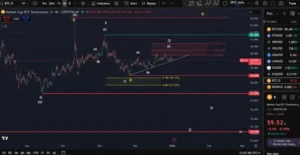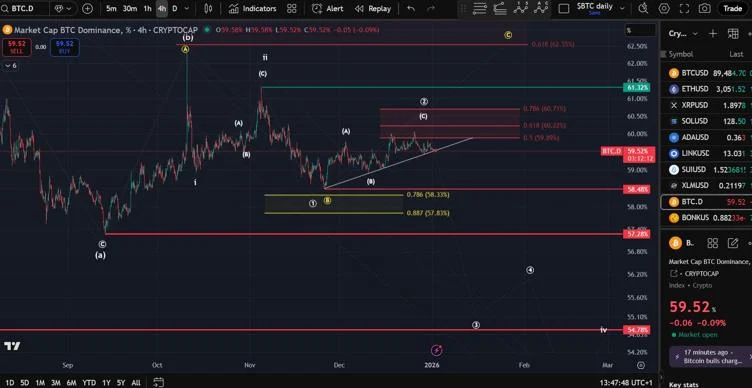
The digital asset market is currently witnessing a pivotal transition in capital allocation as Bitcoin, the world’s largest cryptocurrency by market capitalization, faces technical hurdles that suggest a cooling of its dominant rally. Market analyst Justcryptopays has highlighted a significant technical development: Bitcoin’s recent breach below a critical long-term trendline. This breakdown is widely interpreted by technical analysts as a precursor to a broader market shift, potentially igniting the long-awaited "altcoin season." As Bitcoin struggles to maintain its footing above the $90,000 psychological threshold, investors are increasingly redirecting their capital toward alternative digital assets, seeking higher beta returns in a diversifying market landscape.
The Technical Breakdown of Bitcoin’s Dominance
For much of the preceding year, Bitcoin has served as the primary engine for the cryptocurrency market’s growth, bolstered by the success of spot Bitcoin Exchange-Traded Funds (ETFs) and a general "flight to quality" among institutional investors. However, the recent break below a key ascending trendline suggests that the momentum that propelled Bitcoin to record highs is beginning to plateau. This trendline had previously served as a reliable support level throughout the late stages of 2025, providing a floor for price action during minor corrections.
The failure to sustain this support level has led to a noticeable shift in market sentiment. While Bitcoin continues to trade in the vicinity of $90,525, its inability to decisively clear and hold the $90,000 mark has introduced a layer of caution among retail and institutional traders alike. In technical analysis, when a benchmark asset fails to hold a major psychological level, it often leads to a period of consolidation or a "rotation" where liquidity flows into assets that have underperformed relative to the leader.
The Mechanics of Capital Rotation
The phenomenon of capital rotation is a recurring theme in cryptocurrency market cycles. Typically, a bull market begins with Bitcoin leading the charge, as it is perceived as the safest entry point for new capital. Once Bitcoin reaches a state of relative valuation maturity or hits significant resistance, investors begin to take profits. Rather than exiting the ecosystem into fiat currency, this capital often moves down the "risk curve" into large-cap altcoins, followed by mid-cap and small-cap projects.
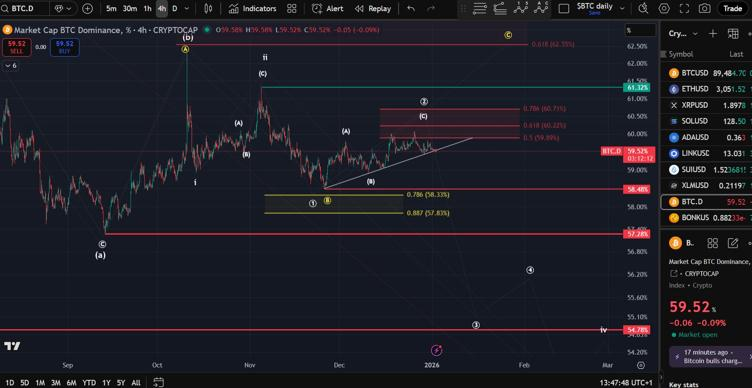
Current market data suggests we are entering the second stage of this rotation. With Bitcoin’s dominance (BTC.D) showing signs of peaking, the "wealth effect" is beginning to benefit the broader altcoin market. This transition is essential for the long-term health of the digital asset ecosystem, as it allows for the capitalization of diverse sectors including Decentralized Finance (DeFi), Layer-1 blockchains, and the burgeoning Web3 infrastructure.

Analysis of the Altcoin Landscape: Key Performers to Watch
As the market prepares for a potential altcoin resurgence, several major assets are positioned to capture the incoming liquidity. The following assets are currently under intense scrutiny by analysts:
Ethereum (ETH) and the Layer-1 Renaissance
Ethereum remains the primary beneficiary of any shift away from Bitcoin dominance. As the foundational layer for the majority of DeFi activity and Non-Fungible Tokens (NFTs), Ethereum’s price action often dictates the "alt-season" tempo. Analysts suggest that if Ether can break through its own resistance levels, it could act as a catalyst for the rest of the market. Furthermore, the continued evolution of Ethereum’s roadmap, focusing on scalability through Layer-2 solutions, provides a fundamental narrative that supports long-term capital inflows.
Solana (SOL) and High-Throughput Contenders
Solana has emerged as a formidable competitor in the current cycle, characterized by its high transaction speeds and low costs. Its ability to attract retail interest, particularly within the memecoin and decentralized physical infrastructure (DePIN) sectors, has made it a favorite for traders looking for high-growth opportunities. As Bitcoin’s volatility stabilizes, Solana is expected to see increased trading volume as a high-performance alternative.
XRP and Cardano (ADA): The Legacy Alts
Both XRP and Cardano have maintained significant communities and development activity despite the bearish momentum that plagued much of 2025. For these assets, the "altcoin awakening" represents an opportunity to reclaim lost ground. XRP, in particular, continues to be sensitive to regulatory developments, while Cardano’s focus on academic rigor and sustainable governance remains a draw for long-term institutional "value" investors in the crypto space.
Chronology of Market Events: 2025-2026
To understand the current market position, it is necessary to examine the timeline of events that led to this juncture:
- Q3 2025: The Bitcoin Peak. Bitcoin reached new heights, driven by institutional adoption and a favorable macroeconomic environment. During this period, altcoins largely traded sideways or experienced "bleeding" against their BTC pairs.
- Q4 2025: Resistance and Consolidation. As Bitcoin approached the $90,000 to $100,000 range, selling pressure intensified. Institutional "whales" began de-risking, and the market entered a period of high-range consolidation.
- Late December 2025: The Trendline Breach. A technical breakdown occurred as Bitcoin slipped below its primary ascending support line. This event signaled to algorithmic traders and technical analysts that the "Bitcoin-only" phase of the bull run was concluding.
- January 2026: The Rotation Begins. Early data from the first weeks of 2026 indicates a steady increase in the "Altcoin Season Index." Trading volumes on decentralized exchanges (DEXs) have begun to outpace centralized exchanges (CEXs) in terms of percentage growth, a classic sign of altcoin interest.
Macroeconomic Factors and Institutional Sentiment
The broader economic environment continues to play a significant role in how capital is distributed within the crypto market. Central bank policies regarding interest rates and liquidity have a direct impact on "risk-on" assets. As inflationary pressures show signs of stabilizing in early 2026, the appetite for speculative assets—including altcoins—has seen a resurgence.
Institutional players, who were previously focused almost exclusively on Bitcoin via ETFs, are now exploring diversified crypto portfolios. The potential for future altcoin-based ETFs (such as for Ethereum or Solana) remains a significant "pro-growth" narrative that could provide the necessary liquidity to sustain a multi-month altcoin rally. However, the transition is not without its hurdles. The bearish momentum of 2025 left many retail investors with significant losses, and "shaking off" this sentiment will require sustained upward price action to restore confidence.
Broader Implications for the Digital Asset Market
A shift toward an altcoin-centric market has several implications for the industry at large. First, it encourages innovation. When capital is abundant in the altcoin market, developers are more likely to receive funding for experimental projects in DeFi, gaming, and cross-chain interoperability.
Second, an altcoin rally typically leads to increased network activity across various blockchains. This "on-chain" activity generates fees, burns tokens (in the case of Ethereum), and increases the utility of native assets, creating a positive feedback loop for valuations.
However, investors must remain vigilant. The altcoin market is notoriously more volatile than Bitcoin. While the rewards can be significantly higher, the risks of "rug pulls," liquidity crunches, and extreme price swings are ever-present. The current shift signals a more "balanced" market where Bitcoin no longer sucks all the oxygen out of the room, but it also demands a more sophisticated approach to risk management and asset selection.
Conclusion and Future Outlook
The technical signals provided by analysts like Justcryptopays offer a compelling case for a structural change in the crypto markets. Bitcoin’s struggle to maintain the $90,000 level and its break below a multi-month trendline are not merely isolated technical events; they are symptoms of a maturing cycle where capital seeks new frontiers.
As 2026 progresses, the focus will likely remain on whether altcoins can successfully decouple from Bitcoin’s price action. If Ethereum, Solana, and other major protocols can establish independent bullish trends, it will confirm the start of a robust altcoin season. For now, the market stands at a crossroads, with the "Bitcoin dominance" era giving way to a more fragmented, yet potentially more lucrative, multi-asset environment. Investors and traders who can navigate this rotation strategically may find themselves well-positioned to capitalize on the next major wave of digital asset growth.