


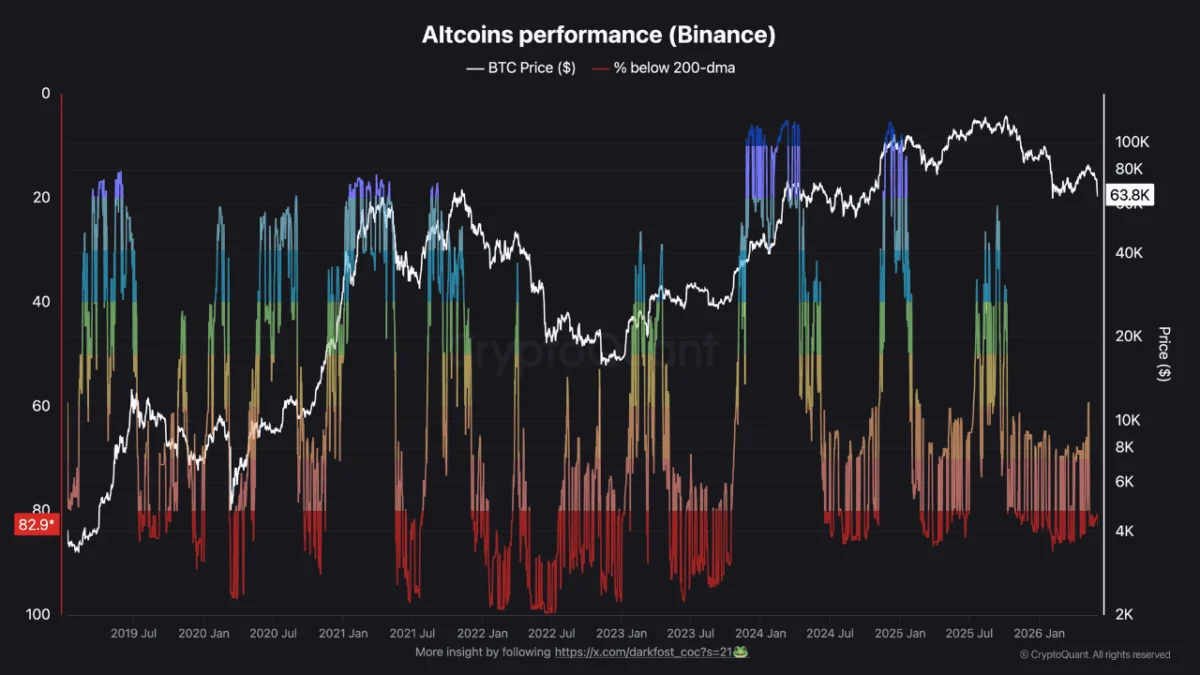
The digital asset ecosystem is currently grappling with a profound divergence in market performance, as altcoins face one of their most challenging periods in the current market cycle. While Bitcoin has historically acted as a rising tide that lifts all boats, the recent months have told a different story of fragmentation and capital concentration. According to a comprehensive analysis by seasoned market analyst Darkfost, published via CryptoQuant, the altcoin market is currently in a precarious state, characterized by significant technical breakdowns and a massive erosion of market capitalization. The data reveals that a staggering 83% of altcoins are now trading below their 200-day moving average (200DMA), a metric widely regarded by institutional and retail investors alike as the primary litmus test for long-term bullish or bearish health.
This technical deterioration comes on the heels of a broader systemic shock to global financial markets. On a recent Friday, US markets witnessed a historic wipeout of over $1 trillion in value, driven largely by a sudden cooling of sentiment surrounding artificial intelligence (AI) and semiconductor equities. The contagion from traditional finance was immediate: the S&P 500 retreated by 2.6%, the tech-heavy Nasdaq plummeted by 4.7%, and Bitcoin followed suit with a 4% decline. However, for the altcoin sector, these losses were not merely a temporary dip but rather a continuation of a structural decline that has seen approximately $520 billion in market value evaporate from the TOTAL3 index—a metric that tracks the total market capitalization of all cryptocurrencies excluding Bitcoin and Ethereum.
The Structural Weakness of the Altcoin Sector
The current underperformance of altcoins is not a sudden phenomenon but the result of a multi-month trend of diminishing investor appetite for higher-risk digital assets. Since the end of 2024, the correlation between Bitcoin and the broader altcoin market has weakened significantly. While Bitcoin benefited from consistent inflows through spot Exchange-Traded Funds (ETFs) and its growing reputation as "digital gold" amidst geopolitical uncertainty, altcoins have struggled to find a compelling narrative to attract similar levels of institutional liquidity.

The 200-day moving average serves as a critical indicator because it represents the average closing price of an asset over the last 200 trading sessions. When an asset trades above this line, it is generally considered to be in a long-term uptrend; when it falls below, it signals a bearish regime. Darkfost’s observation that 83% of altcoins are submerged below this level suggests that the vast majority of the market is currently in a state of long-term decline. This reading is among the weakest recorded in the current cycle and highlights a "rust" that runs deeper than mere price volatility.
Historical data provided by the analyst indicates that since 2002 (referencing long-term financial cycles and market analogs), the percentage of assets trading below the 200DMA typically fluctuates between 60% and 90%. The fact that the market is currently hovering at the 83% mark suggests that the sector is nearing a point of maximum bearishness. This structural weakness has led to a concentration of capital in "safe-haven" crypto assets, primarily Bitcoin, leaving the remainder of the market starved for the liquidity necessary to sustain price appreciation.
Analyzing the $520 Billion Liquidity Exit
The financial toll of this bearish sentiment is most clearly visible in the TOTAL3 chart. From its peak valuation in late 2024 and early 2025, the combined market cap of altcoins (excluding Ethereum) has dropped from its highs to approximately $670 billion. This $520 billion contraction represents a massive exit of speculative capital. Many of the gains accrued during the optimistic rallies of early 2024 have been entirely erased, with valuation levels now returning to those seen in November 2024.
Several factors have contributed to this capital flight:

- The "ETF Effect": The introduction of Bitcoin ETFs has created a silo for institutional capital. Investors who might have previously diversified into altcoins to seek higher returns are now finding sufficient exposure and regulated security within Bitcoin-only products.
- Regulatory Uncertainty: While Bitcoin has achieved a degree of regulatory clarity in the United States, many altcoins remain in a legal gray area, deterring conservative institutional players.
- The AI Bubble Correction: Many altcoins in the current cycle have pivoted toward AI-related utility. As the "AI trade" in the US stock market faced a reality check—leading to the aforementioned $1 trillion loss in traditional markets—AI-themed tokens were among the hardest hit.
- Oversupply of Tokens: The rapid proliferation of new Layer 2 solutions and niche protocols has diluted the available liquidity. With too many tokens vying for a limited pool of investor capital, the "breadth" of the market has become unsustainably thin.
Chronology of the Market Shift
The path to the current state of the market can be traced through several key milestones over the past twelve months:
- March 2024: The altcoin market reached a local peak of optimism. At this time, nearly 90% of altcoins were trading above their 200-day moving average. This period was marked by high "market breadth," where almost every sector of the crypto economy was seeing gains.
- June – August 2024: A period of stagnation began as Bitcoin dominance started to climb. While Bitcoin remained relatively stable or hit new highs, altcoins began to drift lower, failing to reclaim their March peaks.
- October 2024: A brief "relief rally" occurred, but it was characterized by low volume and a lack of participation from retail investors. This served as a "lower high" on the technical charts, a classic bearish signal.
- December 2024 – February 2025: The divergence became absolute. Bitcoin volatility began to negatively impact altcoins more severely than its upward movements helped them. The 200DMA began to act as a ceiling of resistance for the majority of the market.
- The Recent "Friday Crash": The macro-economic shock from the US semiconductor sector acted as the final catalyst, pushing the percentage of altcoins below the 200DMA from the mid-70s to the current 83%.
The Contrarian Perspective: Is a Bottom Near?
Despite the grim statistics, the analysis by Darkfost offers a glimmer of hope for long-term investors. Historically, markets move in cycles of expansion and contraction. The periods of extreme optimism—such as March and December 2024, when nearly 90% of altcoins were above their 200DMA—often represented the worst times to enter the market, as upside potential was exhausted and "froth" was at its peak.
Conversely, periods of extreme pessimism, where the vast majority of assets are "underwater" relative to their long-term averages, have historically preceded significant accumulation phases. The analyst points out that the breadth expansion seen in previous years was the strongest since 2017, suggesting that while the current contraction is painful, it is part of a healthy, albeit aggressive, market reset.
For a meaningful recovery to occur, the market likely needs to see a "capitulation event" where the remaining speculative holders exit, allowing for a new base to be formed. Furthermore, a shift in the Federal Reserve’s monetary policy or a stabilization of the tech sector in traditional markets could provide the necessary environment for "risk-on" sentiment to return to the cryptocurrency space.

Broader Implications for the Crypto Ecosystem
the current "altcoin winter" has broader implications for the development of the blockchain industry. Many decentralized finance (DeFi) protocols and infrastructure projects rely on the value of their native tokens to fund operations and incentivize network security. A prolonged period of depressed prices could lead to a "thinning of the herd," where only the most well-funded and fundamentally sound projects survive.
Additionally, the lack of an "altseason"—a period where altcoins significantly outperform Bitcoin—has changed the psychology of the retail investor. The 2024-2025 cycle has been notably different from 2017 or 2021, with less "trickle-down" liquidity. If this trend continues, the industry may move toward a "power law" dynamic, where a handful of dominant assets (Bitcoin, Ethereum, and perhaps one or two others) capture 95% of the market’s value, while thousands of other tokens struggle for relevance.
In conclusion, the data from CryptoQuant and the analysis by Darkfost paint a picture of a market at a crossroads. With $520 billion wiped out and 83% of assets in a technical bear market, the "easy money" phase of the cycle has clearly concluded. For investors, the coming months will require a disciplined approach, focusing on assets that can demonstrate genuine utility and resilience in the face of macro-economic headwinds. While the current outlook is undeniably bearish, the cyclical nature of finance suggests that the seeds of the next bull market are often sown in the depths of such widespread despair.














