On October 30, 2023, the vast majority of Balancer Protocol pools transitioned to a withdrawals-only state, marking a significant operational cutoff in the project’s announced "orderly winddown." While much of the coverage surrounding Balancer’s sunset has described a largely smooth and organized exit from the decentralized finance (DeFi) landscape, a closer examination of the Balancer Decentralized Autonomous Organization (DAO)’s internal asset ledger, dubbed "Closing the Books," and its corresponding on-chain governance payloads reveals a more nuanced reality. Discrepancies have emerged between the DAO’s published intentions for its leftover assets and the actual execution, particularly concerning dynamic liquidity positions and pending token burns.
The winddown process, a two-pronged endeavor, addresses both the fate of user liquidity pools and the meticulous collection and distribution of scattered assets still held by the DAO. This distinction is critical for understanding the ongoing complexities. While the user-facing pools largely adhered to the October 30 timeline, the DAO’s internal asset management has presented specific challenges, with some significant positions yet to be fully reconciled or acted upon as the protocol edges closer to its final closure.
The Balancer Protocol: A Brief History and the Rationale for Winddown
Balancer emerged as a pioneering force in the DeFi ecosystem, launching in March 2020. It distinguished itself as an automated market maker (AMM) and decentralized exchange (DEX) protocol, allowing users to create highly customizable liquidity pools with up to eight different tokens and adjustable weights. This flexibility offered innovative solutions for liquidity providers and traders, enabling dynamic portfolio management and efficient token swaps. Unlike traditional AMMs, Balancer’s pools could serve as self-rebalancing index funds, attracting considerable liquidity and fostering a vibrant community. The protocol’s native token, BAL, played a central role in its governance, granting holders voting rights on key operational and strategic decisions.
However, the broader crypto market underwent significant shifts in 2022 and 2023, characterized by prolonged bear market conditions, increased regulatory scrutiny, and a general deleveraging across the industry. Many DeFi projects faced immense pressure, struggling to maintain user engagement, innovate at pace, and navigate an increasingly complex operational environment. Against this backdrop, the Balancer DAO initiated discussions regarding the protocol’s long-term viability. The decision to wind down operations was not taken lightly, reflecting a strategic pivot to return value to BAL token holders rather than continue operating in an environment perceived as unsustainable or excessively challenging. The DAO ultimately voted to approve an "orderly winddown," aiming for a transparent and equitable conclusion to the project.
Chronology of the Orderly Winddown

The phased closure of Balancer has unfolded over several weeks, guided by a series of governance proposals (BIPs) passed by the DAO:
- September 2023: Initial discussions and formal proposals for the winddown began to solidify. BIP-928, titled "Orderly Winddown of Balancer and Distribution of the Treasury," was introduced to formalize the shutdown process. This comprehensive proposal outlined the general framework for ceasing operations, liquidating assets, and distributing the remaining treasury funds to BAL token holders. The proposal aimed to provide a clear roadmap for stakeholders, ensuring transparency and minimizing disruption.
- October 23, 2023: Balancer contributor mendesfabio published a crucial forum post titled "Closing the Books on Balancer DAO-Owned Assets." This post served as an official ledger, detailing all remaining assets under the DAO’s control and outlining the proposed disposition for each item. It was intended to be a definitive statement of the DAO’s financial position ahead of the final distribution.
- October 30, 2023: This date marked the primary operational cutoff for the Balancer Protocol. As per BIP-928 and its technical counterpart, BIP-936, most Balancer pools transitioned to a withdrawals-only status. This meant users could no longer add liquidity or create new pools, effectively halting the protocol’s core functions while allowing existing liquidity providers to retrieve their assets.
- Ongoing Post-October 30: The period immediately following the operational cutoff has been dedicated to the meticulous process of collecting and consolidating the DAO’s scattered assets. This phase is characterized by the execution of specific governance payloads and on-chain transactions, which are now under scrutiny against the "Closing the Books" ledger.
- November 30, 2023: This is the anticipated final date for partner-requested v3 pools to remain live, after which all Balancer pools are expected to be fully decommissioned. This milestone is particularly relevant for the Balancer v3 buffers, whose values remain dynamic until this point.
The October 30 Operational Cutoff: What Was Frozen, What Was Not
The technical implementation of the October 30 cutoff was primarily governed by BIP-936. This proposal’s Ethereum payloads, published in Balancer’s multisig-ops repository, were designed to enact three core changes:
- Disable Pool Creation: New liquidity pools could no longer be initiated on the Balancer Protocol. This measure prevented any further expansion of the protocol’s operational footprint.
- Pause Pausible Pools: For pools with pause functionalities, these features were activated, effectively halting their trading operations. This provided a controlled environment for users to withdraw their funds without further market exposure within those specific pools.
- End Protocol Fee Income: The generation of protocol fees from trading activities ceased. This signaled the definitive end of Balancer’s revenue-generating operations.
Crucially, these technical measures, while comprehensive for user-facing pool operations, did not directly address or freeze the DAO’s internal treasury assets listed in the "Closing the Books" ledger. The management of these remaining assets required separate, deliberate governance actions, which have proven to be a more complex and drawn-out process.
The DAO’s Published Ledger vs. On-Chain Reality: Unpacking the Discrepancies
The "Closing the Books" post on the Balancer forum meticulously itemized the DAO’s remaining assets and their intended disposition. A comparison of this list with on-chain data as of October 31, 2023, reveals that while many items are proceeding as planned, several significant assets remain in a state of flux or awaiting final execution.
Assets Already Moved or Reconciled:

Several smaller, more straightforward assets have already been successfully moved to the DAO’s Treasury Safe or accounted for, demonstrating the partial success of the winddown’s asset consolidation efforts. These include various minor token holdings and specific fund allocations that were less susceptible to dynamic value changes or complex governance procedures.
Still Pending: A Detailed Examination of Unresolved Assets
The core of the current scrutiny lies in the assets that remain pending, each presenting its own set of challenges or delays:
-
Innovation Fund:
- Description: This fund represents capital allocated for innovation initiatives, now being reclaimed by the DAO.
- Status: The figures align closely with previous accounting. BIP-928’s September 20 update valued the fund at $155,692. As of the end of October, consisting of 92,822 USDC and 25.58 WETH, its value stood at approximately $149,000, assuming an ETH price of roughly $2,200. The slight reduction is consistent with the general decline in ETH prices between the September snapshot and the end of October. While largely reconciled, the final transfer and liquidation still represent an active task for the Treasury Council.
-
Balancer v3 Buffers:
- Description: This is perhaps the most dynamic and complex asset. Balancer v3 buffers hold liquidity designed to optimize swaps through yield-bearing tokens. Unlike standard tokens, this liquidity is not held in a conventional wallet but resides "in internal Vault accounting," meaning its value fluctuates based on ongoing swaps routed through these buffers.
- Status: The "Closing the Books" post explicitly labeled the withdrawal of this position as "time-sensitive" due to its shifting balance. On October 23, the DAO’s share in these buffers was estimated at $394,614. By October 31, this figure had reportedly shrunk to $346,801. This represents a significant drop of approximately $47,813, or about 12%, in just over a month.
- Implication: The October 30 operational cutoff did not fully halt the movement of these buffers. This is because BIP-928 permits certain partner-requested v3 pools to remain active until November 30. As long as swaps are routed through these pools, the DAO’s buffer balance can continue to change. This exposure means the value of this asset, which is the largest single item on the pending list, remains uncertain until the Treasury Council successfully executes its withdrawal. The delay in this action directly impacts the final sum available for distribution to BAL holders.
-
Claims Written into BIP-933 and BIP-935 (Fixed Amounts):
- Description: These are smaller, fixed claims that have already been codified as executable payloads, meaning their amounts are locked in code and are not subject to market fluctuations or ongoing protocol activity.
- BIP-933 – Timeless veBAL Grant USDC Fees: This proposal aims to claim leftover USDC from Balancer’s FeeDistributor, originating from the Timeless veBAL grant contract. The forum post estimated approximately 10,000 USDC remaining after the Timeless position was unwound. The payload calls
claimFeesand directs the funds to the DAO multisig. - BIP-935 – Leftover AAVE Rewards: This proposal seeks to claim exactly 9.306104517152944285 AAVE tokens from the stkAAVE contract, sending them to the Treasury Safe. This precisely matches the "~9.3061 AAVE" mentioned in the asset review.
- Status: Both payloads have reportedly passed Tenderly simulations in Balancer’s operations repository, confirming their technical viability. Crucially, neither depends on any pool remaining live, rendering them unaffected by the October 30 cutoff. The execution of these claims is a matter of administrative action by the DAO’s multisig signers.
-
The 10 Million BEETS Still Waiting To Be Burned:

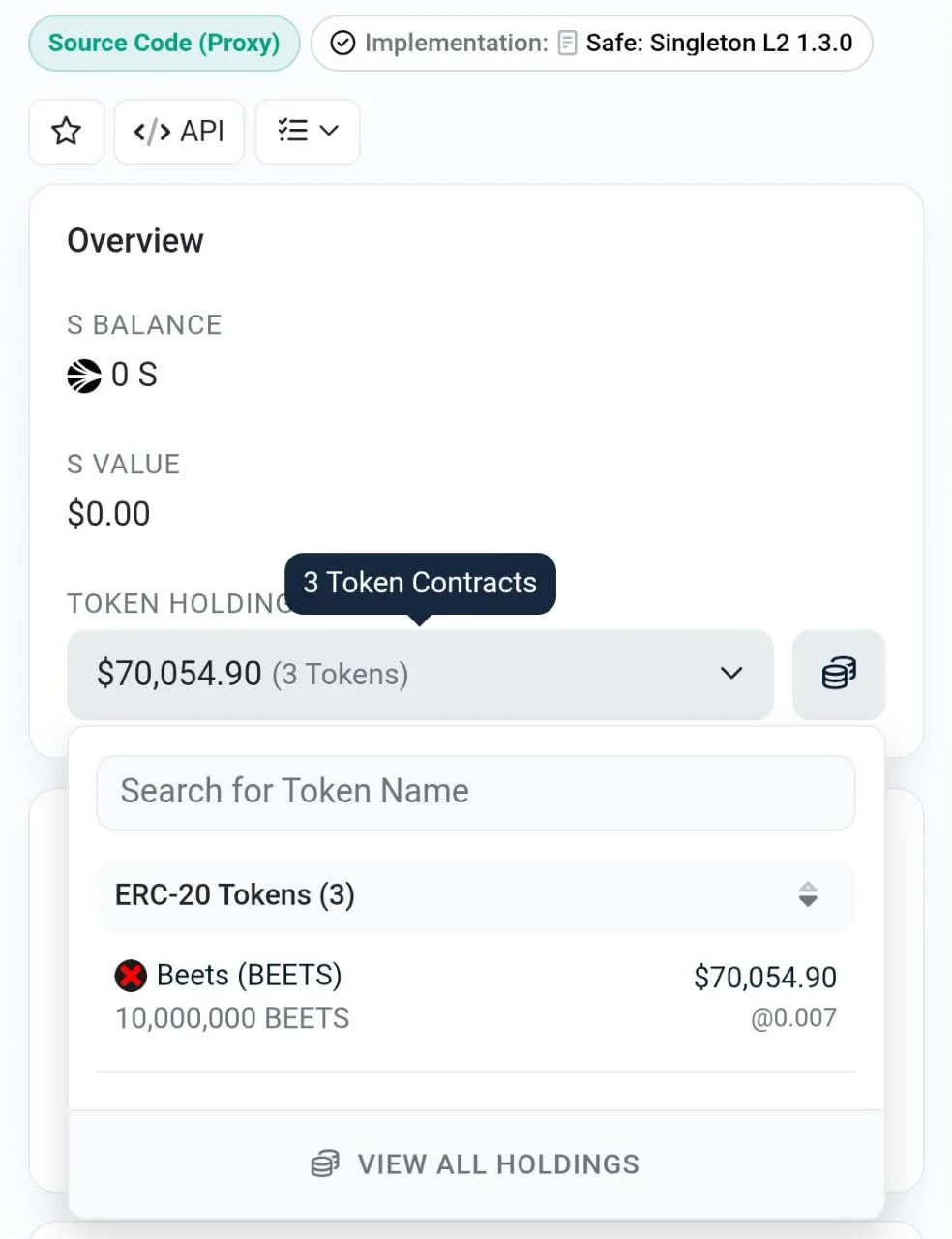
- Description: This position consists of 10,000,000 BEETS tokens (Beethoven X, a Balancer fork project) held by the Balancer DAO on the Sonic network.
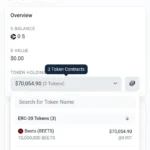
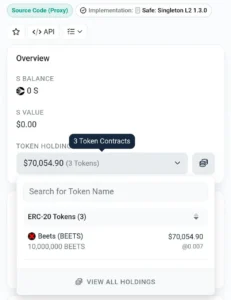
- Status: As of October 31, the DAO’s Safe on Sonic (0x4f22…3c2e) visibly still held these tokens. Sonicscan, a blockchain explorer, valued this holding at approximately $70,055 (roughly $0.007 per token). This is the Safe’s sole priced asset.
- Implication: The proposed action for these tokens, outlined in BIP-934 (listed alongside BIP-928), is to burn them, meaning they would be permanently destroyed rather than sold or distributed. The "Closing the Books" asset review had indicated that the vote for this burn was expected to go to Snapshot, a common off-chain voting platform for DAOs, the weekend following October 23. However, a week later, the tokens remained unmoved in the Safe. This delay signifies a holdup in a critical governance decision. The 10 million BEETS holding is one of the larger items by dollar value on the DAO’s list, exceeding the combined value of the Grants Safe and Timeless fees. Its disposition represents a deliberate governance choice, directly impacting whether approximately $70,000 is removed from the market supply or potentially contributes to the final treasury. Divided across the approximately 63 million redeemable BAL tokens estimated in BIP-928, this amount equates to about a tenth of a cent per token, a small but notable figure that underscores the meticulousness required in such a winddown.
Official Responses and the Role of Decentralized Governance
The various BIPs and the "Closing the Books" post serve as the official pronouncements from the Balancer DAO, articulating its intent and strategy for the winddown. These documents underscore a commitment to transparency, a hallmark of decentralized governance. The DAO’s structure, relying on a multi-signature wallet for asset control and community voting for decision-making, inherently introduces layers of coordination and execution challenges. The Treasury Council, as the operational arm responsible for executing these asset movements, plays a crucial role in translating approved proposals into on-chain actions. While the winddown is largely proceeding according to plan, the delays and dynamic nature of certain assets highlight the practical complexities of managing a decentralized treasury, even with clear directives. The community’s ongoing engagement through forums and voting platforms remains vital in ensuring that the final stages of the winddown are completed as intended.
Broader Implications and Lessons for the DeFi Ecosystem
The Balancer winddown, particularly the detailed scrutiny of its asset reconciliation, offers several key insights and implications for the broader DeFi ecosystem:
- Complexity of Decentralized Asset Management: Even in an "orderly" closure, managing diverse, dynamic, and sometimes internally accounted assets within a DAO structure is far from trivial. The case of the v3 buffers, whose value continues to fluctuate post-cutoff, exemplifies the challenge of freezing or precisely accounting for assets intrinsically linked to ongoing, permissionless protocol activity. This underscores the need for highly sophisticated asset management strategies and rapid execution in such scenarios.
- The Nuance of "Orderly Exit": While Balancer’s winddown has been framed as an orderly process, the revealed discrepancies and delays challenge the notion of a perfectly seamless transition. It suggests that even with clear governance frameworks, the practicalities of on-chain execution and the inherent dynamism of certain DeFi assets can introduce unforeseen complexities and potential value erosion. This serves as a cautionary tale for other protocols contemplating similar transitions.
- Transparency and Verification: The ability to compare a DAO’s published ledger with on-chain data is a powerful mechanism for accountability in DeFi. This case reinforces the importance of meticulous on-chain verification by both internal teams and external observers to ensure that stated intentions align with actual actions. It strengthens the argument for robust auditing and real-time monitoring of DAO treasuries.
- Impact on BAL Holders: For BAL token holders, the outstanding assets, while relatively small compared to the total distributable base of approximately $9.96 million (estimated at $0.158 per BAL in September), still represent a material difference. The $48,000 lost from the buffer and the $70,000 tied to the BEETS burn decision collectively account for roughly $118,000. While this is approximately 1.2% of the total, it is a non-trivial amount that directly impacts the final redemption value per token. The prompt resolution of the buffer withdrawal and the BEETS burn vote are therefore crucial for maximizing the value returned to token holders.
- Precedent for Future Winddowns: As the DeFi space matures, more protocols may face similar decisions regarding cessation of operations. Balancer’s experience, with its blend of successful execution and emergent challenges, will likely serve as a valuable case study. It highlights the need for even more granular planning, contingency measures for dynamic assets, and streamlined governance processes to ensure true "orderly" closures.
Conclusion
Balancer’s "orderly winddown" is progressing, with many of its operational and asset distribution mandates being met. The October 30 cutoff successfully transitioned most user-facing pools to a withdrawals-only state, demonstrating the DAO’s ability to execute broad operational changes. However, the ongoing process of reconciling the DAO’s internal assets, as revealed by the "Closing the Books" ledger, highlights the inherent complexities of winding down a sophisticated decentralized protocol.
The dynamic nature of the v3 buffers, which continue to see their value fluctuate due to ongoing swaps, and the pending governance decision regarding the 10 million BEETS tokens, represent key unresolved issues. These items, while not derailing the entire process, underscore the need for swift and decisive action from the Balancer Treasury Council and the community. As the final stages of the winddown unfold, all eyes will remain on the DAO’s on-chain actions to ensure that the "orderly exit" concludes with the highest possible degree of transparency, efficiency, and fidelity to its stated commitments to BAL token holders. The precedent set by Balancer’s conclusion will undoubtedly inform future endeavors within the ever-evolving landscape of decentralized finance.