



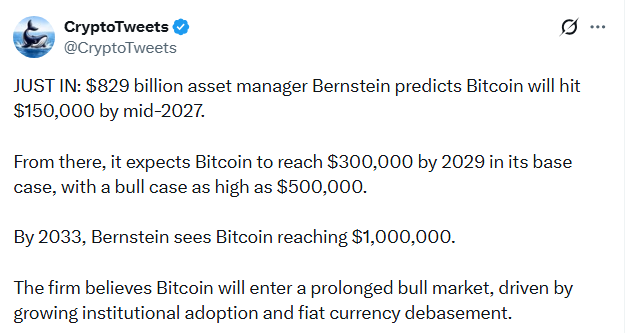
American asset management firm Bernstein has issued a bullish outlook for Bitcoin, projecting a potential surge to $300,000 by the year 2029. This ambitious forecast, shared with a current market valuation of $829 billion for Bitcoin, suggests that the flagship cryptocurrency is on a trajectory to reach $150,000 by mid-2027, with further expansion to the $300,000 to $500,000 range by the end of the decade. The firm’s analysis underscores a confluence of factors, including the digital asset’s inherent programmatic scarcity, a growing global demand driven by concerns over fiat currency debasement, and an evolving regulatory landscape, all contributing to this optimistic price discovery.
The recent upward momentum observed in Bitcoin’s price has captured the attention of a wide array of market participants, from individual traders and seasoned analysts to major asset management institutions. This renewed interest has spurred numerous investment firms to offer their perspectives on Bitcoin’s future price trajectory. Bernstein’s projection aligns with a growing sentiment within certain financial circles that views Bitcoin not merely as a speculative asset but as a potential store of value in an increasingly complex global economic environment. The firm’s analytical models reportedly indicate that Bitcoin is currently laying the groundwork for a significant upward re-rating, a process that has historically been driven by its fixed supply and increasing adoption.
Key Catalysts Driving Bitcoin’s Projected Growth
Gautam Chhugani, Managing Director at Bernstein, elaborated on the firm’s conviction, identifying several critical factors poised to propel Bitcoin towards new all-time highs. He posits that the cryptocurrency is on the cusp of a significant price discovery phase, with multiple catalysts aligning to support this advance. Bernstein’s research suggests a phased approach to this growth, with an initial target of $150,000 by mid-2027, followed by a more substantial leap to the $300,000-$500,000 bracket by the close of the fourth quarter of 2029.
One of the most significant drivers highlighted by Chhugani is what he terms the "debasement trade." This refers to the increasing global monetary supply, particularly evident in the actions of governments and central banks, which can lead to a dilution of the purchasing power of traditional fiat currencies. In such an environment, investors increasingly seek alternative assets that offer protection against inflation and currency devaluation. Bernstein’s analysis indicates that Bitcoin, alongside gold, is a primary beneficiary of this trend. The firm points to recent buybacks of U.S. government bonds as an example of policies that contribute to increased money supply. This uncontrolled growth in government debt, according to the analyst, is eroding confidence in fiat currencies, prompting a migration of capital towards assets perceived as more stable and less susceptible to inflationary pressures.

Furthermore, Bernstein emphasizes the crucial role of an improving regulatory environment in fostering the growth and acceptance of cryptocurrencies. The anticipated passage of legislation such as the CLARITY Act is expected to provide clearer guidelines for both institutional and retail investors. Such regulatory clarity, the firm suggests, will significantly reduce friction and uncertainty, making it more accessible and appealing for a broader range of market participants to engage with Bitcoin through buying, holding, and trading. This increased ease of access is predicted to inject greater enthusiasm and capital into the crypto market, further bolstering demand.
The persistent reduction in the supply of new Bitcoin tokens through scheduled halving events also remains a cornerstone of Bernstein’s bullish thesis. These programmed events, occurring approximately every four years, effectively cut the reward for mining new blocks in half, thereby decreasing the rate at which new Bitcoins enter circulation. This programmatic scarcity is a fundamental aspect of Bitcoin’s design, intended to create a deflationary or disinflationary monetary policy. As demand continues to rise while the supply growth rate diminishes, basic economic principles suggest upward pressure on prices. Bernstein’s analysis posits that the ongoing interplay between a more favorable regulatory framework, increasing institutional adoption, wider global acceptance, and the continuous reduction of supply through halvings will inevitably drive Bitcoin’s value to unprecedented levels.
Bitcoin’s Current Consolidation and Future Outlook
Currently, Bitcoin is observed to be consolidating in the range of $78,000 to $79,000. This period of consolidation follows a robust rally that saw the cryptocurrency recover significantly from its July lows of $57,800, reaching a peak of $81,000 in August. This price action suggests that the market is digesting a complex interplay of evolving geoeconomic shifts and the strong performance recorded in August, as the broader cryptocurrency market anticipates upcoming mid-September FOMC (Federal Open Market Committee) meetings.
The ability of Bitcoin to maintain its price above the critical support level of $76,000-$77,000 is seen as a strong indicator that its bullish underlying structure remains intact. This resilience, according to market observers, is a testament to the combined forces of its inherent programmatic scarcity, the sustained influx of institutional investment, and the other macroeconomic factors identified by Bernstein. The dynamic interaction of these elements appears to be providing a solid foundation for continued price appreciation, even amidst periods of short-term market choppiness.
Historical Context and Market Evolution
To understand the current projections, it is essential to consider Bitcoin’s historical performance and the evolution of its market perception. Launched in 2009 by the pseudonymous Satoshi Nakamoto, Bitcoin was initially conceived as a decentralized digital currency, an alternative to traditional financial systems. Its early years were characterized by niche adoption and significant price volatility, often driven by speculative interest and technological advancements.
However, over the past decade, Bitcoin has transitioned from a fringe concept to a recognized asset class. The increasing institutional interest, beginning with early adopters like MicroStrategy and later expanding to major financial institutions, has lent significant legitimacy to Bitcoin as an investment. The approval of Bitcoin Spot Exchange-Traded Funds (ETFs) in various jurisdictions, notably the United States in early 2024, marked a watershed moment, providing a regulated and accessible avenue for traditional investors to gain exposure to the digital asset. This development has significantly broadened the investor base and contributed to the price appreciation observed in recent years.
The narrative surrounding Bitcoin has also evolved. While initially promoted for its transactional capabilities, the focus has increasingly shifted towards its role as a store of value, often referred to as "digital gold." This narrative is amplified by its fixed supply of 21 million coins, a stark contrast to the unconstrained money printing by central banks worldwide. This inherent scarcity, coupled with its decentralized nature and increasing network security, positions Bitcoin as an attractive hedge against inflation and currency devaluation.
Broader Implications and Future Considerations
Bernstein’s ambitious forecast, if realized, would have profound implications for the cryptocurrency market and the broader financial landscape. A sustained rise in Bitcoin’s price to such levels would further solidify its position as a legitimate and significant asset class, potentially attracting even more capital and innovation into the blockchain and digital asset space.
The projected growth also underscores the growing influence of macroeconomic factors on digital asset prices. The concerns about fiat currency debasement and sovereign debt levels are not isolated to one nation but are global phenomena, suggesting that the demand for alternative stores of value like Bitcoin could continue to strengthen.
However, it is crucial to acknowledge the inherent volatility and risks associated with cryptocurrency investments. While Bernstein’s outlook is optimistic, the cryptocurrency market remains susceptible to regulatory shifts, technological disruptions, and broader market sentiment. Geopolitical events, changes in monetary policy, and unforeseen technological challenges could all influence Bitcoin’s price trajectory.

The regulatory landscape, while improving, remains a key area to monitor. While the CLARITY Act and similar initiatives aim to provide a clearer framework, the global regulatory approach to cryptocurrencies is still fragmented and evolving. Unexpected regulatory crackdowns or unfavorable policies in major economies could pose significant headwinds.
Furthermore, the long-term viability of Bitcoin’s "digital gold" narrative will depend on its ability to maintain its network security, its capacity to scale, and its continued adoption by both individuals and institutions. The energy consumption associated with Bitcoin mining has also been a point of contention, although advancements in renewable energy adoption by mining operations are gradually addressing these concerns.
In conclusion, Bernstein’s projection of Bitcoin reaching $300,000 by 2029 presents a compelling vision for the future of the digital asset. Supported by factors such as programmatic scarcity, debasement concerns, and a more favorable regulatory environment, this forecast suggests a significant re-rating of Bitcoin’s value. While the path forward will undoubtedly involve periods of volatility and require careful navigation of various market dynamics, the underlying fundamentals and evolving investor sentiment appear to be building a strong case for continued growth and wider acceptance of Bitcoin as a major global asset. The coming years will be critical in determining whether this ambitious forecast becomes a reality, further cementing Bitcoin’s place in the evolving financial ecosystem.














