


The prevailing wisdom regarding cryptocurrency wallet security has long centered on one cardinal rule: safeguard your seed phrase above all else. While undeniably crucial, this singular focus has, perhaps inadvertently, cultivated a dangerous blind spot, leaving users vulnerable to a new generation of sophisticated attacks that bypass the need for stolen private keys altogether. These incidents, responsible for some of the largest thefts in Web3 history, do not involve breaking into a wallet; rather, they trick users into willingly granting access through seemingly innocuous signature requests, token approvals, or permission clicks. The unsettling reality is that victims often facilitate their own losses, one authorized interaction at a time, without ever comprehending the true scope of their agreement.
This evolution in attack methodology underscores a critical paradigm shift in blockchain security. Malicious actors have moved beyond brute-force key compromises, instead leveraging the very permission systems designed to empower users within decentralized applications (dApps). By exploiting trust in interfaces and a lack of granular understanding of smart contract interactions, scammers are now draining millions of dollars by convincing users to authorize the transfer of their own funds. This article delves into the most prevalent and effective methods employed by these attackers, drawing on real-world incidents to illustrate the profound implications for Web3 security.
The Dangerous Blind Spot: Why Seed Phrases Aren’t the Whole Story
For years, every crypto wallet onboarding guide and security warning has hammered home the imperative of protecting one’s recovery phrase. This advice remains foundational, as a compromised seed phrase grants complete control over a wallet. However, by overemphasizing this single point of failure, the industry may have inadvertently fostered a false sense of security. Once users internalize "never share my recovery phrase" as the entirety of their security model, they become less critical of other prompts and requests originating from their wallets or connected dApps. This psychological gap is precisely what sophisticated attackers have learned to exploit with devastating efficacy.
Attackers no longer need to steal private keys if they can simply persuade users to authorize them to move funds directly. This is achieved through the wallet’s own legitimate permission system, which, when misused, can become a vector for theft. The following sections detail five primary methods through which this exploitation occurs, each validated by significant real-world incidents.
1. Malicious Token Approvals: The BadgerDAO Playbook and Unlimited Spending
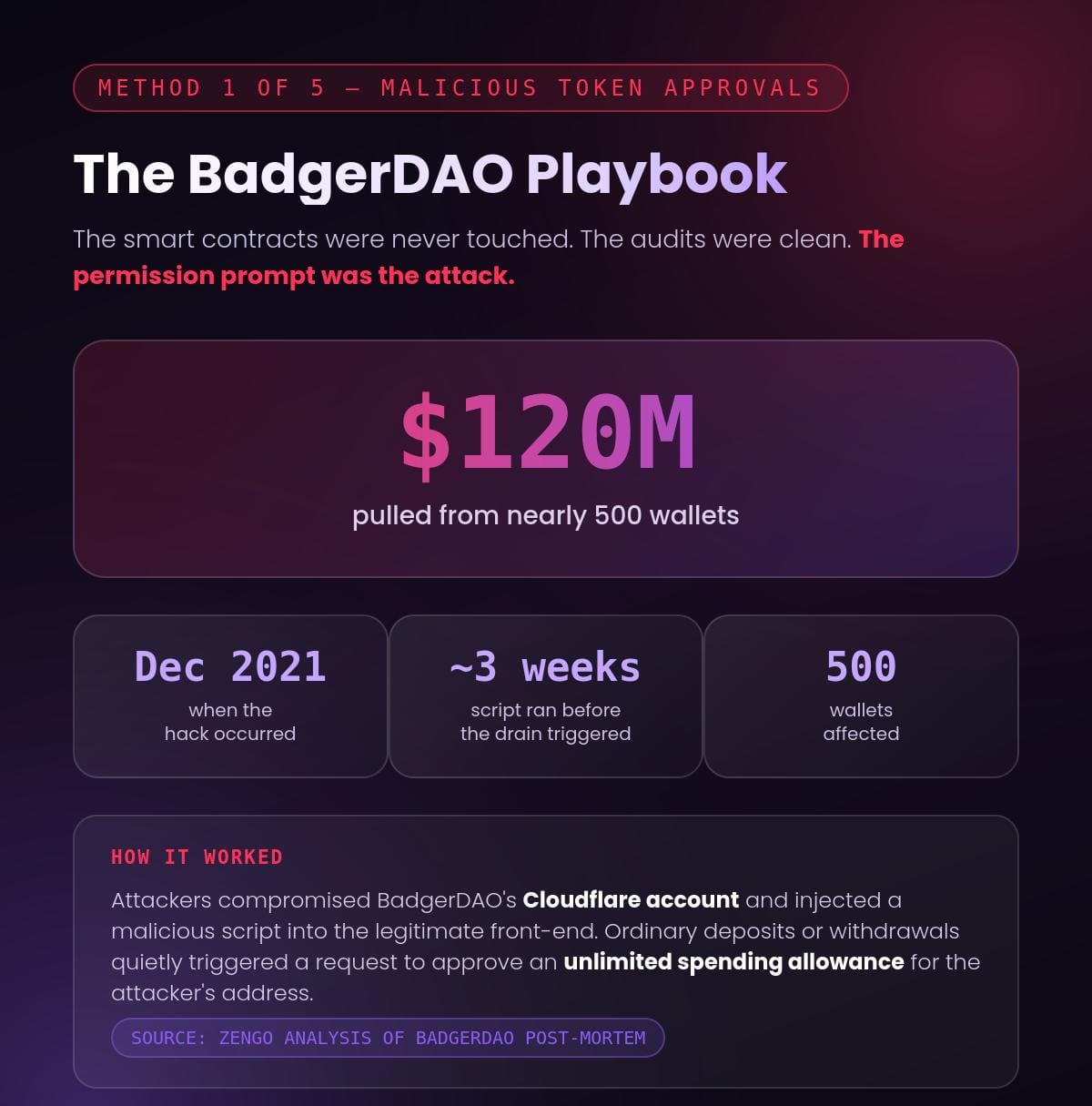
One of the most emblematic and costly examples of permission-based attacks remains the BadgerDAO hack of December 2021. This incident serves as a stark reminder of how seemingly legitimate interactions can be weaponized. Attackers successfully compromised BadgerDAO’s Cloudflare account, a crucial content delivery network, enabling them to inject a malicious script directly into the project’s front-end website. This was a critical breach, as the website was the primary interface through which users interacted with BadgerDAO’s DeFi protocols, which had been trusted for months.
When users navigated to the compromised website to perform routine operations like depositing or withdrawing funds, the injected script quietly inserted an additional, hidden request into their wallet interface. This request asked users to approve an "unlimited spending allowance" for the attacker’s wallet address on their ERC-20 tokens. For the uninitiated, an ERC-20 token approval grants a smart contract or an external address the ability to move a specified amount of a user’s tokens on their behalf. An "unlimited" approval, as the name suggests, gives the approved address permission to move any amount of that specific token from the user’s wallet, up to the total balance.
According to ZenGo’s detailed analysis of BadgerDAO’s technical post-mortem, the malicious script operated stealthily for approximately three weeks. During this period, hundreds of users, accustomed to approving routine transactions, unknowingly granted these broad permissions. When the attacker finally triggered the drain, they siphoned off an estimated $120 million from nearly 500 individual wallets.
The BadgerDAO incident is pivotal for several reasons. Crucially, the underlying smart contracts of BadgerDAO were never compromised; audits had cleared them as secure. The website itself appeared entirely legitimate: the URL was correct, the SSL certificate was valid, and the interface was familiar. The only discernible change was a subtle permission prompt requesting more access than the actual transaction required. Yet, hundreds of experienced DeFi users approved it, mistaking it for routine wallet activity. This highlights a critical vulnerability: user trust in the front-end interface, even when it presents a technically dangerous request.
In response to such incidents, security-conscious users now regularly scrutinize and manage their token approvals. Tools like Etherscan’s free Token Approval Checker allow anyone to review and revoke standing approvals tied to their Ethereum address. Periodically performing such checks is a vital security practice, even in the absence of an active threat, as it can mitigate potential future exploits.
2. Blind Signature Requests: When "Sign This Message" Becomes a Trap
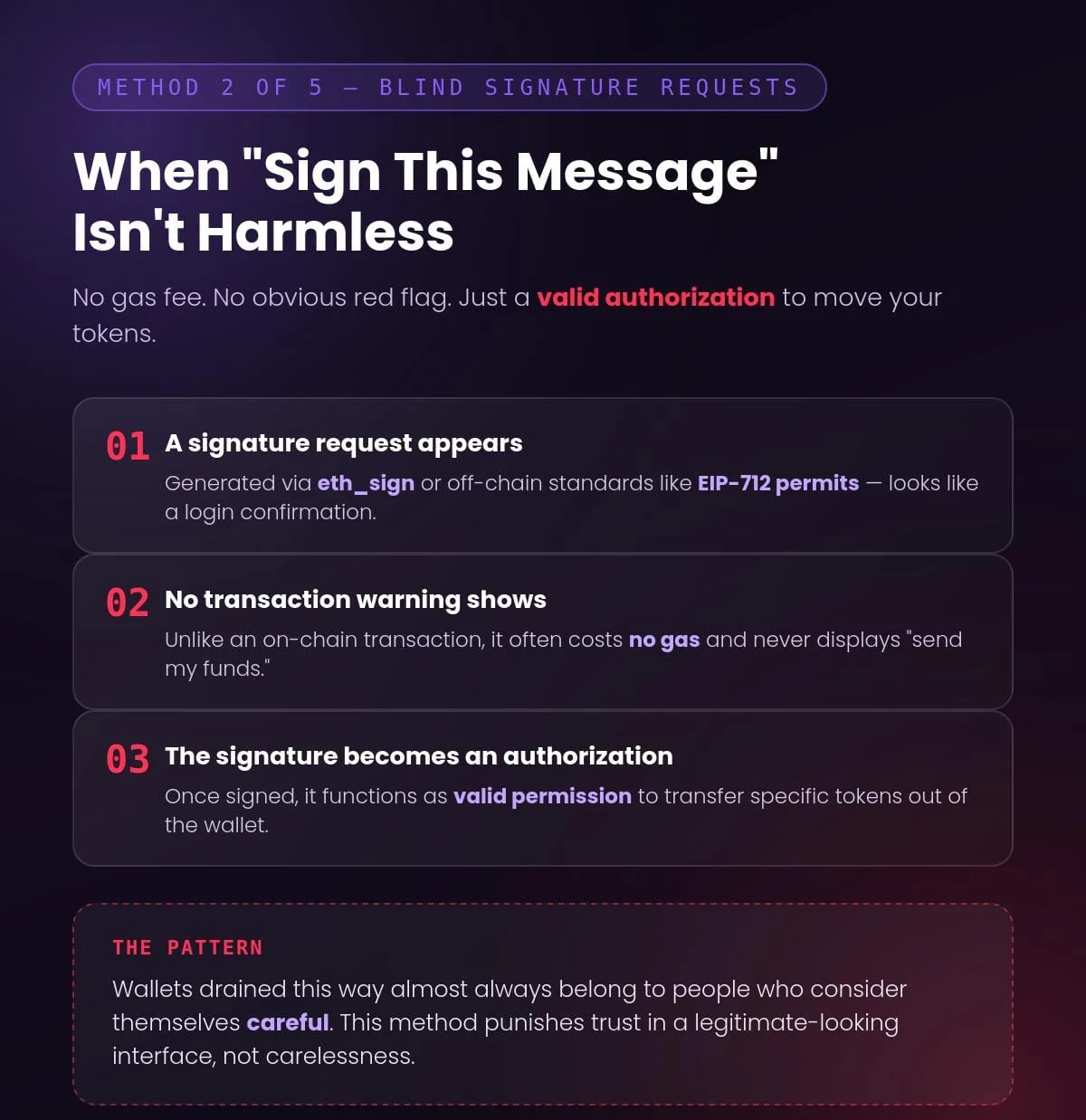
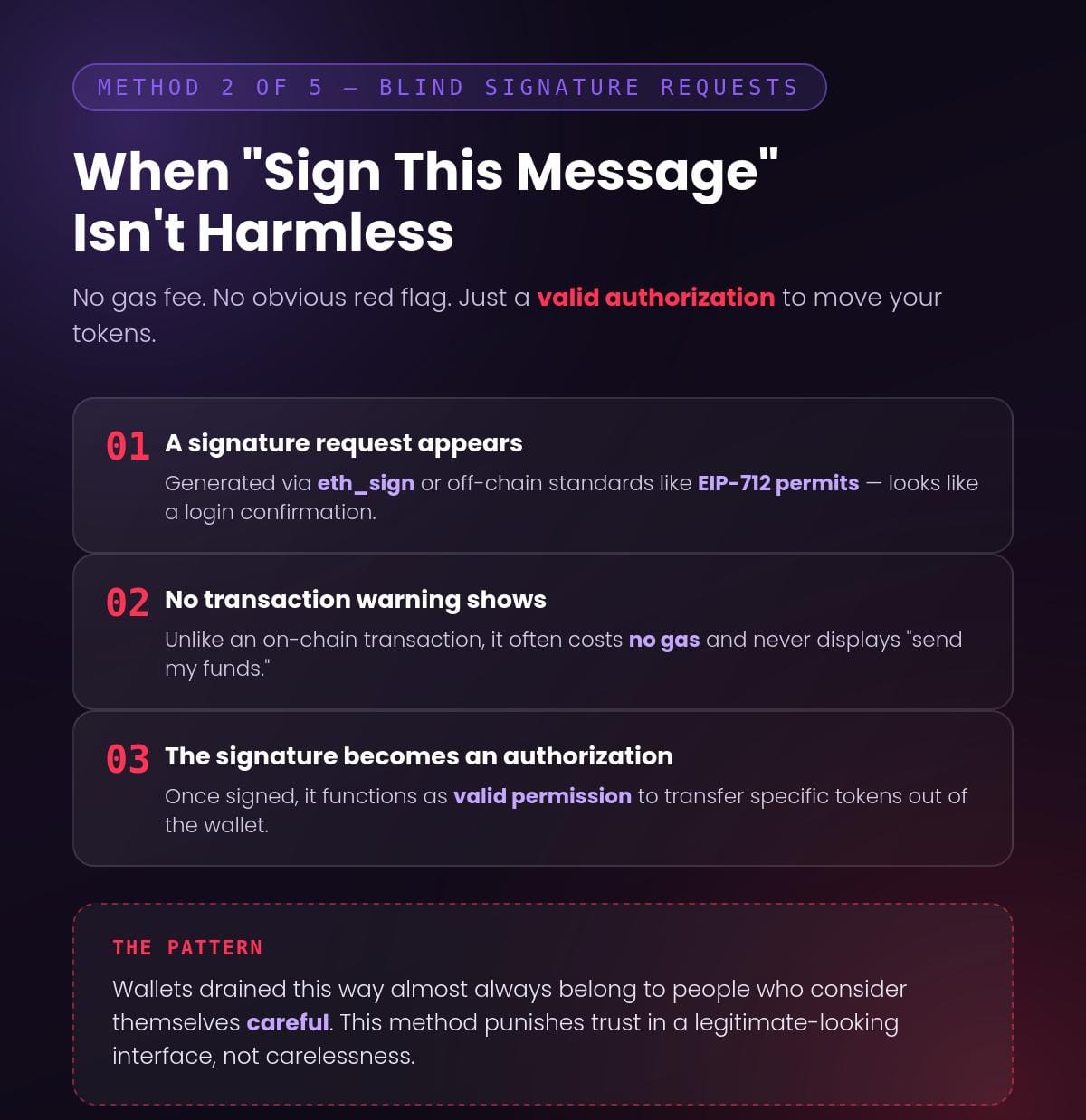
Beyond token approvals, a more insidious method involves signature requests, particularly those generated through generic eth_sign calls or off-chain signing standards like EIP-712 permits. Unlike on-chain transactions, which typically incur gas fees and clearly state their intent (e.g., "Send 1 ETH"), signature requests often cost no gas and can appear, on the surface, as harmless proof of identity or a simple login confirmation. This ambiguity is precisely what makes them so exploitable.
A malicious dApp can craft a signature request that, once signed by the user, functions as a valid authorization to transfer specific tokens out of their wallet. The critical distinction is that the user never sees a clear transaction prompt explicitly stating "send my funds." Instead, they sign a message that, unbeknownst to them, contains the cryptographic authorization for a future token transfer.
Security researchers have collectively termed this broader category "ice phishing." The term gained traction because of how the BadgerDAO incident, among others, tricked users into signing permission grants rather than outright stealing credentials. These attacks leverage the psychological principle of trust: users are conditioned to trust interfaces that look legitimate, and a "sign message" prompt often appears less threatening than a "send transaction" prompt. Reports frequently show that victims of blind signing attacks are often individuals who consider themselves diligent about security. Ice phishing does not punish carelessness as much as it punishes a misplaced trust in an interface that appears authentic, leading users to sign data they do not fully comprehend.
3. Malicious dApp Permissions Through Fake WalletConnect Sessions: The Rise of Wallet Drainers
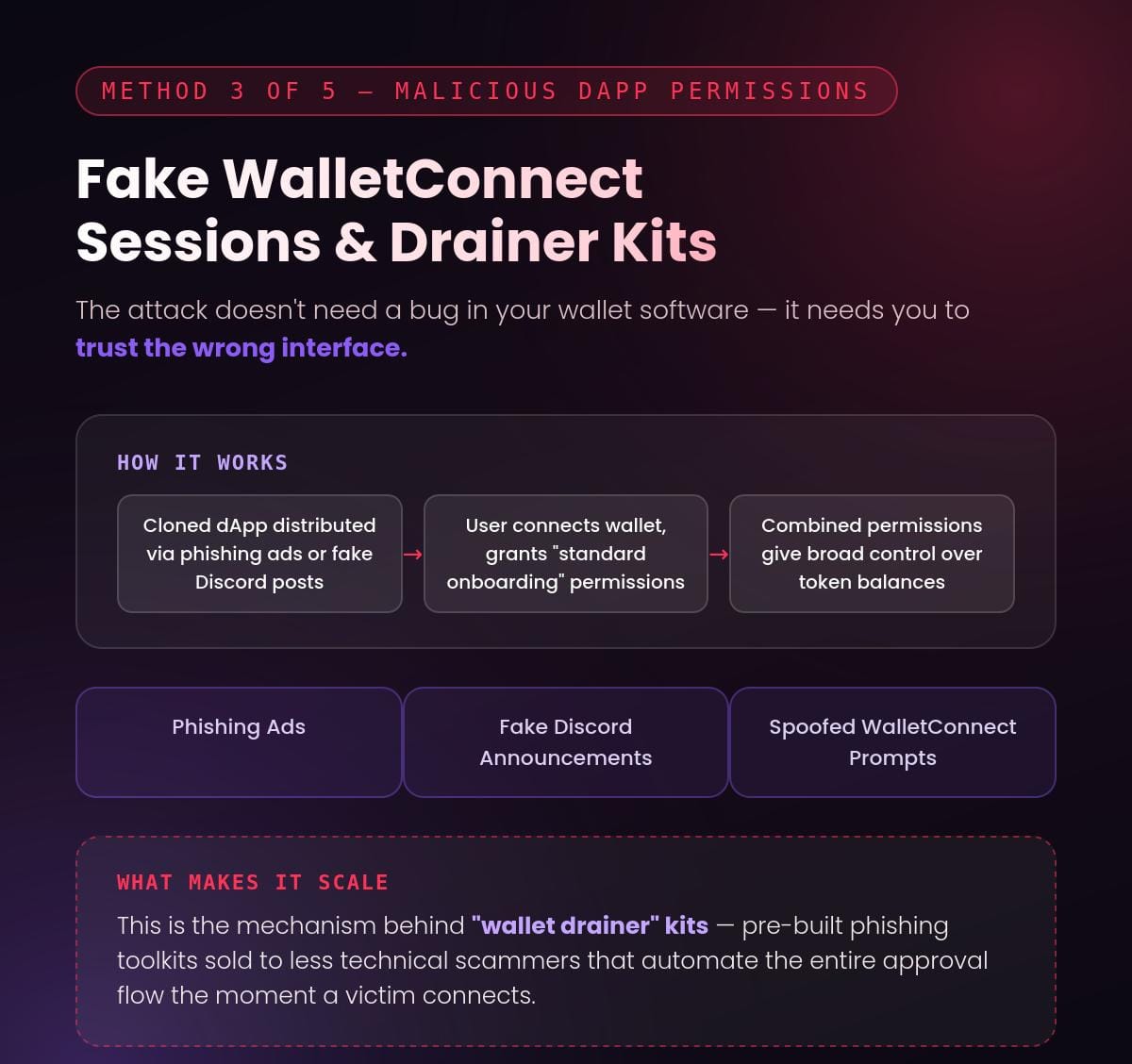
A third pervasive method operates at the connection layer, exploiting the initial handshake between a user’s wallet and a dApp. This typically involves fake or cloned decentralized applications, distributed through highly effective social engineering tactics. These include phishing advertisements on search engines, fake announcements on platforms like Discord or X (formerly Twitter), or spoofed WalletConnect prompts designed to mimic popular, trusted platforms.
These fake dApps are meticulously crafted to look identical to legitimate ones. Once a user connects their wallet, the deceptive dApp immediately requests a batch of permissions. These requests are disguised as standard onboarding steps or necessary functionalities, but when combined, they grant the attacker’s smart contract broad authority over the user’s token balances. This could include unlimited approvals for various tokens, permissions to execute arbitrary calls, or even delegate voting rights in some advanced cases.
This method is the backbone of what the industry now refers to as "wallet drainer" kits. These are pre-built phishing toolkits, often sold as a service to less technical scammers, that automate the entire malicious approval flow. The moment a victim connects their wallet to such a site, the drainer script automatically initiates a series of malicious permission requests designed to empty the wallet of its valuable assets. These kits have become increasingly sophisticated, often incorporating anti-detection measures and targeting specific high-value assets.
What makes wallet drainers particularly difficult to defend against is that they do not rely on any inherent bug in popular wallet software like MetaMask, Trust Wallet, or Ledger Live. Instead, they exploit the user’s perception and trust. The entire scam hinges on the interface convincing the user that a fraudulent site is the genuine article. Every permission subsequently granted by the user is, from a technical standpoint, something they authorized, making recourse exceptionally challenging. The sheer volume and professional quality of these phishing sites, often promoted through paid advertising, make them a persistent threat to even vigilant users.
4. Address Poisoning: Exploiting Human Habit, Not Wallet Permissions
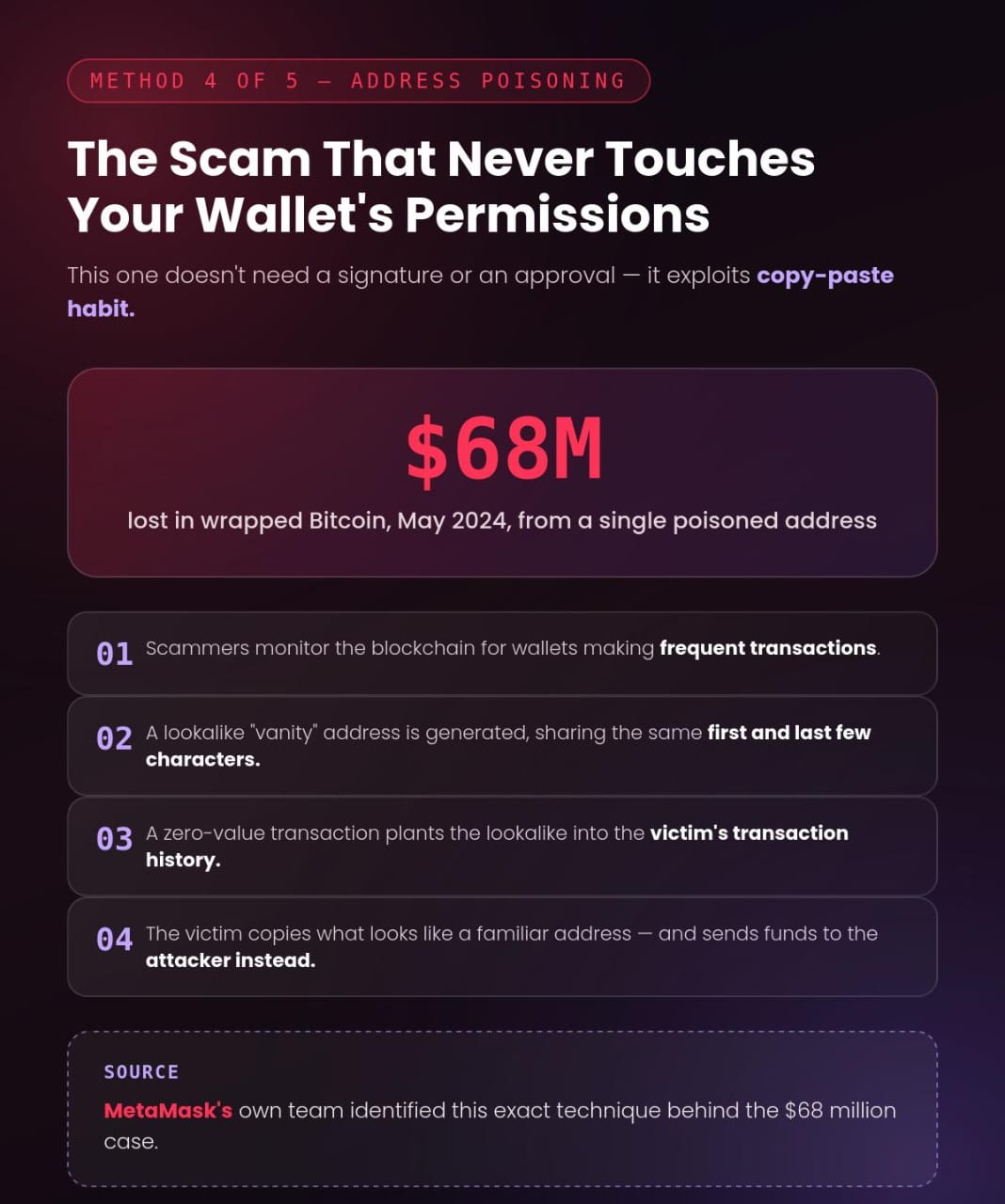
Not all sophisticated scams require a user to sign or approve a transaction. Address poisoning operates on a different, arguably more insidious principle: exploiting simple human habit rather than any wallet mechanism. As detailed in MetaMask’s guide on address poisoning scams, attackers meticulously monitor the blockchain for wallets that engage in frequent transactions, particularly those involving high-value transfers.
Once a target is identified, the scammer generates a "vanity" address. A vanity address is one that is specifically crafted to share the same first and last few characters as an address the victim has genuinely interacted with before. For instance, if a victim frequently sends funds to 0xAbc...Xyz, the attacker will generate an address like 0xAbc...123Xyz. The intermediate characters will differ, but the visual similarity at the beginning and end—where users typically glance for verification—is highly deceptive.
The attacker then sends a zero-value or negligible-value transaction (e.g., 0 ETH) from this lookalike address to the victim’s wallet. This seemingly harmless transaction quietly plants the poisoned address into the victim’s transaction history, often appearing among legitimate past interactions. The next time the victim intends to send funds to their genuine, frequently used address, they might, out of habit and a quick visual check, copy the attacker’s poisoned lookalike address directly from their transaction history instead of their actual contact list or a verified source.
MetaMask’s own team highlighted this exact technique as the mechanism behind a devastating incident in May 2024, where a single victim reportedly lost an estimated $68 million in wrapped Bitcoin (wBTC) after copying a poisoned address straight from their own transaction history. This specific case underscores the sheer effectiveness of the attack, particularly against high-net-worth individuals who might process numerous transactions and rely on muscle memory. The insidious nature of address poisoning lies in its ability to bypass all wallet security prompts, relying purely on human error and the visual complexity of blockchain addresses.
5. Fake Airdrop Claims and Permit-Based Drainer Signatures
The phenomenon of token airdrops, where projects distribute free tokens to users, has exploded in popularity, and with it, a new vector for scams. The fifth method combines elements of phishing, social engineering, and advanced signature requests into a particularly effective drainer technique. Scammers construct elaborate fake "claim your airdrop" websites, often promoted through spoofed official-looking social media accounts or even paid advertisements, carefully timed to coincide with genuine token launches or anticipated airdrop eligibility checks.
These fraudulent sites are designed to capitalize on the urgency and excitement surrounding legitimate airdrops. Instead of simply requesting a wallet connection, these sites prompt users for a "Permit" signature. The Permit standard (e.g., EIP-2612 for ERC-20 tokens) is a legitimate and valuable innovation in DeFi, allowing users to authorize token transfers off-chain without paying gas fees for an approve transaction. This makes certain DeFi interactions more convenient and cost-effective.
However, in the hands of an attacker, a signed Permit message becomes a potent weapon. Once a user signs a malicious Permit request on a fake airdrop site, that signature grants the attacker the ability to move the specified tokens out of the victim’s wallet at any point afterward. Crucially, this can happen days or even weeks later, making it significantly harder for the victim to trace the theft back to the original phishing site. The delay between the signature and the actual fund drain obscures the connection, often leading victims to believe their wallet was "hacked" rather than having self-authorized the transfer.
This method thrives on the emotional state of anticipation and urgency that genuine airdrop announcements tend to evoke. Scammers skillfully time the launch of these fake sites to coincide precisely with real ones, preying on users’ fear of missing out (FOMO) and their desire for quick gains. The technical sophistication combined with highly effective social engineering makes fake airdrop claims a persistent and dangerous threat.
Industry Responses and Mitigating Risks
The increasing sophistication of these attacks has spurred the Web3 security industry to develop countermeasures and enhance user education. Wallet providers like MetaMask regularly update their security warnings and produce comprehensive guides on various scam types, including address poisoning and phishing. Browser extensions and dApp security tools are emerging that offer more granular insights into transaction details and potential malicious approvals.
Etherscan’s Token Approval Checker stands as a vital, user-accessible tool, allowing individuals to audit and revoke active token approvals on their addresses. This proactive step can significantly reduce exposure to previously granted malicious permissions. Similarly, services that analyze smart contract interactions and provide human-readable summaries of complex transaction data are gaining traction, aiming to bridge the information gap between raw blockchain data and user understanding.
Hardware wallets, while not impervious to social engineering, offer an additional layer of protection by requiring physical confirmation for transactions and signatures, making it harder for blind signing attacks to go unnoticed. However, even with hardware wallets, users must still diligently review what they are signing.
The Broader Impact and The New Security Paradigm
These incidents collectively paint a clear picture: the landscape of crypto security has fundamentally changed. The threat is no longer confined to crude phishing attempts for seed phrases or direct attacks on blockchain protocols. It has evolved to exploit the nuances of Web3 interactions and, critically, human psychology. The sheer scale of losses, often in the tens or hundreds of millions of dollars for individual incidents, underscores the urgency of addressing this challenge.
The implications extend beyond individual financial losses. A pervasive environment of scams erodes user trust, hindering mainstream adoption of Web3 technologies and tarnishing the reputation of legitimate decentralized applications. For the DeFi ecosystem to mature, users must feel secure, and that security now demands a more nuanced understanding of wallet permissions and dApp interactions.
If there is one overarching lesson to be learned from this new wave of exploits, it is this: every approval, signature, and connection request from your crypto wallet must be treated with the same level of suspicion and scrutiny one would apply to someone directly asking for a seed phrase. Functionally, for an attacker, granting a malicious approval can amount to the exact same outcome as a stolen recovery phrase—the complete loss of funds.
Periodically reviewing and revoking old approvals through tools like Etherscan’s Token Approval Checker, utilizing wallet safety documentation from providers like MetaMask, and cultivating a habit of critical verification for every digital interaction are no longer optional best practices; they are essential survival strategies in the complex and often treacherous world of Web3. The few minutes invested in these precautions can mean the difference between safeguarding one’s digital assets and suffering catastrophic, often irreversible, losses.
Disclosure: This is not trading or investment advice. Always do your research before buying any cryptocurrency or investing in any services.
Follow us on Twitter @themerklehash to stay updated with the latest Crypto, NFT, AI, Cybersecurity, and Metaverse news!














