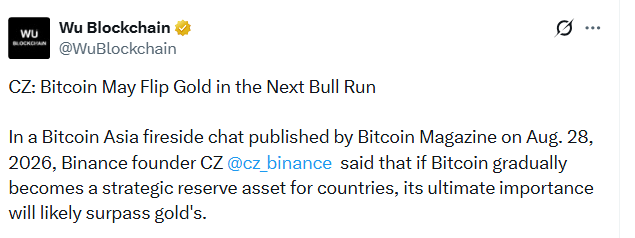
Changpeng Zhao (CZ), the influential founder of Binance, the world’s largest cryptocurrency exchange, has articulated a bold prediction: Bitcoin is poised to transcend gold’s historical dominance as the preeminent global reserve asset. This forward-looking assessment was shared during a fireside chat at the recent Bitcoin Asia 2026 event, a prominent gathering for blockchain and cryptocurrency enthusiasts and industry leaders. The sentiment, amplified by market analyst Wu Blockchain, suggests a significant shift in how nations and institutional investors may perceive and allocate their strategic reserves in the coming years.
The historical preeminence of gold as a store of value is undeniable. For millennia, it has served as a bedrock of financial stability, its intrinsic value and scarcity making it the ultimate safe-haven asset for individuals and governments alike. Currently, gold boasts a staggering market valuation estimated at approximately $15.899 trillion. This figure dwarfs Bitcoin’s market capitalization, which stands at around $1.6 trillion. Gold’s enduring appeal stems from its perceived stability, its historical role in hedging against inflation, and the deeply entrenched systems of custody and reserve management that sovereign nations have established over centuries. Its position as the world’s most-invested asset is a testament to this long-standing trust and its consistent performance during periods of economic uncertainty.
However, CZ’s perspective challenges this entrenched paradigm. He posits that the next major bull run in the cryptocurrency market could witness Bitcoin not only rivaling but potentially surpassing gold in terms of its strategic importance to global economies. This dramatic shift, according to CZ, hinges on the increasing adoption of Bitcoin by sovereign nations as a key component of their reserve assets. He argues that gold’s current dominance is less about its inherent value and more about the historical inertia of established institutional custody frameworks and robust reserve systems developed by countries over generations.

CZ elaborated on this point, suggesting that gold’s perceived liquidity is not solely derived from the physical asset itself, but rather from the maturity of its market, the widespread investor confidence, and the sophisticated reserve mechanisms that have been built around it by nation-states. He highlighted an ongoing trend of diversification within global reserves, a phenomenon that sees investors increasingly rotating funds from traditional assets like gold into alternative assets, with Bitcoin emerging as a prominent beneficiary of this shift. This reallocation is indicative of a growing recognition of Bitcoin’s potential as a digital store of value and a hedge against traditional financial system risks.
The ten-fold difference in market capitalization between gold and Bitcoin, while substantial, is not an insurmountable barrier in CZ’s view. He believes this gap will narrow considerably as institutional investors and sovereign countries embrace Bitcoin with greater fervor. The driving force behind this projected transition, he explained, is the progressive channeling of national reserve assets into Bitcoin. He cautioned, however, that such a fundamental shift in global financial strategy will inevitably be a gradual process. Nations have significant existing investments in gold reserves, and divesting from or reallocating these substantial holdings requires careful planning, robust regulatory frameworks, and a sustained period of confidence in alternative assets.
The Bitcoin Asia 2026 event, where CZ shared these insights, serves as a crucial barometer for the evolving landscape of digital assets in the Asian market, a region increasingly at the forefront of blockchain innovation and adoption. The conference brought together a diverse array of stakeholders, including entrepreneurs, investors, policymakers, and academics, fostering discussions on the future of cryptocurrency, decentralized finance (DeFi), and their integration into the global economic system. CZ’s participation and his pronouncements at such a high-profile event underscore the growing mainstream acceptance and strategic consideration being given to digital assets by industry leaders.
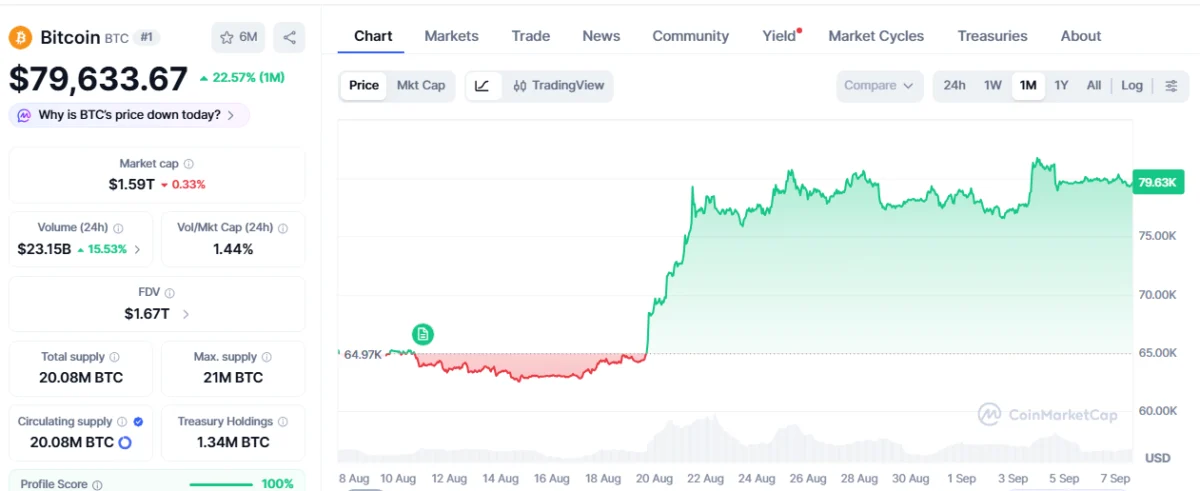
CZ’s bullish outlook on Bitcoin is further substantiated by recent market performance. The flagship cryptocurrency has demonstrated remarkable resilience and upward momentum. Following a dip to $59,352, Bitcoin experienced a significant rebound, surging to a high of $81,000 in the preceding month. At the time of reporting, it was trading around $79,045, reflecting a solid performance with gains of 1.61% over the past week and an impressive 22.2% over the last month. This consolidation and upward trend suggest a strengthening market conviction and a potential prelude to further price appreciation.
The Binance founder’s vision extends beyond mere price speculation. He anticipates Bitcoin reaching the million-dollar mark far sooner than many market analysts currently project. This optimistic forecast is underpinned by his belief in the accelerating adoption of Bitcoin across various sectors, including institutional capital markets, pension investment schemes, and, crucially, national capital reserves. CZ’s call to action for governments worldwide is clear: the establishment of well-defined and supportive regulatory frameworks for cryptocurrencies is paramount. He urges nations to actively consider allocating portions of their capital reserves to Bitcoin, viewing this as a strategic move that will accelerate the transformation of global financial reserves and potentially enhance economic sovereignty and stability in an increasingly digital world.
He pointed to the growing interest and, in some cases, proactive engagement from countries like the United States, the United Arab Emirates, China, and Japan as indicators of this global trend. While specific policies vary, the general direction suggests an increasing acknowledgment of Bitcoin’s potential as a legitimate financial asset and a hedge against traditional economic vulnerabilities. The development of Central Bank Digital Currencies (CBDCs) by many nations, while distinct from decentralized cryptocurrencies like Bitcoin, also signifies a broader embrace of digital forms of money and a re-evaluation of reserve asset strategies.
The implications of CZ’s prediction are far-reaching. If a significant number of sovereign nations begin to allocate even a small percentage of their reserves to Bitcoin, it could trigger unprecedented demand, further driving up its price and solidifying its status as a global reserve asset. This would necessitate the development of more sophisticated custody solutions, regulatory oversight, and integration with existing financial infrastructure. Furthermore, such a move could signal a fundamental rebalancing of global financial power, potentially diminishing the entrenched dominance of traditional fiat currencies and gold.
However, the transition from gold to Bitcoin is not without its challenges. Gold’s physical nature, its long history as a recognized store of value, and the established international frameworks governing its trade and custody provide a level of security and familiarity that Bitcoin, as a relatively nascent asset class, still needs to fully replicate. The volatility inherent in Bitcoin, although decreasing over time, remains a concern for risk-averse central banks. Moreover, the technological infrastructure required for secure and efficient management of national Bitcoin reserves is still evolving.

The debate between gold and Bitcoin as the ultimate store of value is likely to intensify in the coming years. While gold offers historical stability and tangible security, Bitcoin presents the potential for decentralized ownership, censorship resistance, and a global, borderless digital network. CZ’s prediction, coming from a figure with unparalleled influence in the cryptocurrency space, serves as a powerful signal of the growing momentum behind Bitcoin as a serious contender for global reserve status. The coming decade will likely be a critical period in determining whether this prediction evolves from a bold forecast into a tangible reality, reshaping the future of international finance and the global economic order. The success of this transition will depend on continued technological innovation, clear regulatory guidance, and sustained confidence from both institutional investors and sovereign nations.