
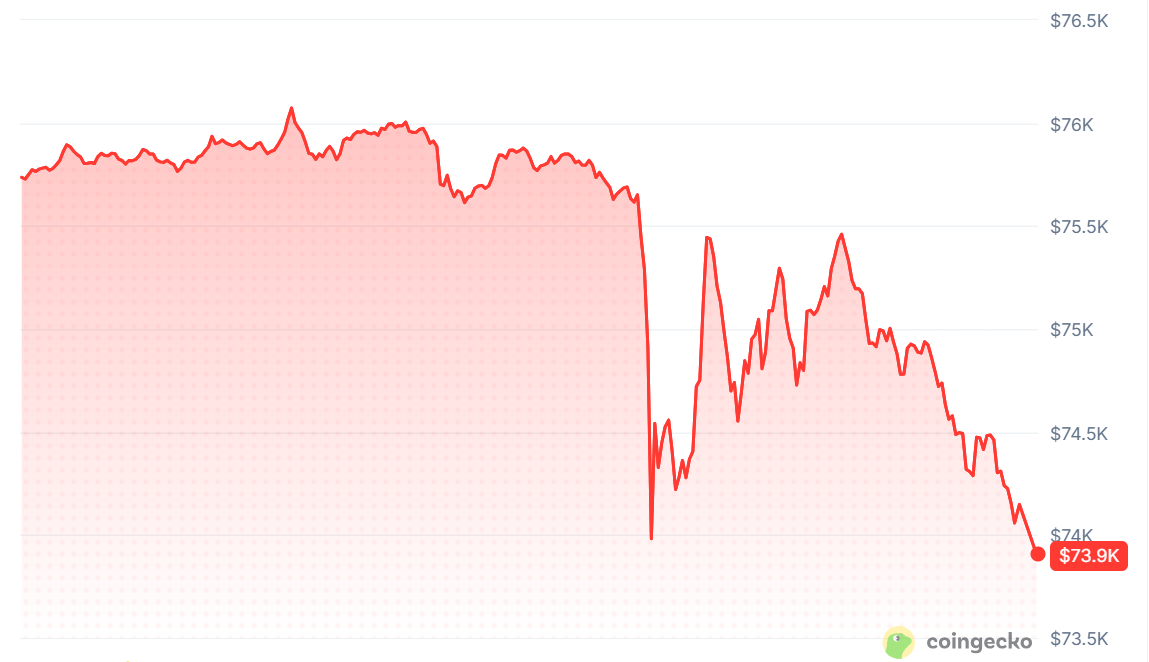
Bitcoin (BTC) is currently positioned at a critical juncture, trading near the $74,000 mark as market participants meticulously monitor significant liquidation clusters situated both above and below its immediate price. According to CoinGecko data, the flagship cryptocurrency is quoted at $73,976.11, reflecting a 2.13% decline over the past 24 hours and a 5.00% dip across the last seven days. This delicate technical landscape is unfolding against the backdrop of an exceptionally dense United States economic calendar for November 2026, featuring crucial inflation reports, Federal Reserve commentary, and Treasury operations, which collectively set the stage for potentially heightened volatility across the broader cryptocurrency market.
The Intricate Dance of Liquidation Zones and Market Dynamics
The immediate technical outlook for Bitcoin is heavily influenced by the presence of concentrated liquidation zones, as highlighted by analytics platforms like CoinAnk. A three-day liquidation heatmap shared by CoinAnk on X (formerly Twitter) reveals a particularly strong lower liquidation cluster positioned between $72,850 and $73,250. This zone exhibits a maximum relative strength score of 100 out of 100, with peak heatmap intensity reaching an astonishing 289.58 million – indicating a substantial volume of leveraged long positions that could face forced closure if prices dip into this range. Such a scenario would likely trigger a cascade of selling pressure, potentially accelerating a downward price movement.
Conversely, significant resistance levels, marked by short liquidation clusters, are identified overhead. CoinAnk’s snapshot, taken with Bitcoin near $74,500 after a retreat from the mid-$76,000 range, pinpointed several key areas. The nearest overhead zone spans $76,250-$76,550, approximately 2.43% above the reference price, carrying a strength score of 81. A second, even denser cluster resides between $76,850 and $77,200, roughly 3.24% away, boasting a strength score of 95. Further above, another notable layer appears at $78,350-$78,600, positioned around 5.25% higher than the current trading levels. Should Bitcoin rally into these regions, the forced closure of leveraged short positions could trigger buy orders, thereby fueling upward momentum.
Understanding liquidation heatmaps is crucial for traders operating in the volatile cryptocurrency derivatives market. These visual tools aggregate data on open leveraged positions across various exchanges, estimating price levels at which a significant number of these positions would be automatically closed due to insufficient margin. Long liquidations occur when the price falls, while short liquidations happen when the price rises. The concentration of these liquidation points creates magnetic price levels, as price movements towards them can become self-fulfilling prophecies, accelerating further due to the cascading effect of forced closures. In a market often characterized by thin liquidity, especially during periods of uncertainty, these cascades can lead to rapid and substantial price swings, sometimes referred to as "liquidation squeezes."

Analyst Perspectives on Bitcoin’s Immediate Trajectory
Market analysts are closely watching these technical levels, emphasizing their potential to dictate Bitcoin’s short-term direction. Daan Crypto Trades, a prominent analyst, identified $75,000 and $77,000 as critical local levels on X, suggesting that a decisive break above or below either could instigate a rapid 5% price movement. Below the current trading range, Daan highlighted the $72,000-$73,000 area as a broader support zone, while the $80,000 mark looms as a significant upper resistance and psychological barrier.
This analysis underscores the prevailing tension in the market. A successful defense of the $72,000-$73,000 support, especially if the $72,850-$73,250 liquidation cluster holds, could signal resilience and encourage bullish sentiment. Conversely, a breach of these lower levels could open the door to further downside, potentially triggering the concentrated long liquidations and accelerating a descent. On the upside, conquering the $75,000 and $77,000 resistance levels, and subsequently the associated short liquidation zones, would be a strong indication of renewed buying interest and could pave the way for a test of the $80,000 psychological threshold. Institutional investors and algorithmic trading desks are known to strategically place orders around these high-liquidity areas, often amplifying the volatility when these levels are approached.
A Crucial Week for Macroeconomic Data in November 2026
The technical setup described above is intricately linked to a packed macroeconomic calendar for the week of November 2026, which promises to inject significant fundamental catalysts into the market. The influence of traditional financial indicators on Bitcoin’s price has grown considerably, particularly since the increased institutional adoption and the launch of regulated investment products like Bitcoin ETFs. These macroeconomic releases could serve as the primary drivers determining whether traders attempt to test the nearby liquidation clusters.
The week’s macroeconomic highlights include:
- Tuesday, 8:30 a.m. Eastern Time: Release of October 2026 Consumer Price Index (CPI) and Core CPI data. These are arguably the most anticipated inflation metrics, providing critical insights into consumer price pressures. Core CPI, which strips out volatile food and energy components, is particularly scrutinized by the Federal Reserve for underlying inflationary trends.
- Friday: Producer Price Index (PPI) and Core PPI data follow. The PPI measures inflation from the perspective of producers, often serving as a leading indicator for future consumer price inflation.
- Throughout the week: The calendar is further crowded with jobless claims data, offering a snapshot of the labor market’s health; housing data, providing insights into a significant sector of the economy; an OPEC report, which could impact global energy prices; and scheduled speeches from no fewer than 17 Federal Reserve officials. Each of these public statements from Fed members offers a potential glimpse into the central bank’s thinking and future monetary policy direction.
Adding to the liquidity picture, Sweep’s post on X highlighted a planned $3.65 billion Fed injection on Monday, which could ease short-term credit conditions and provide a modest boost to market liquidity. Furthermore, the Treasury is scheduled to buy back $750 million of its own debt on Wednesday, an operation that can also impact bond yields and overall market sentiment by reducing the supply of government securities.
Federal Reserve’s Stance and Bitcoin’s Evolving Correlation
The macroeconomic releases this week are pivotal because they directly influence expectations for the Federal Reserve’s interest rate policy. The Fed operates under a dual mandate: achieving maximum employment and maintaining price stability. Inflation and labor market data are therefore central to its decision-making process.
A stronger-than-expected inflation reading from the CPI or PPI data, particularly if accompanied by robust employment figures, would likely reinforce expectations that borrowing costs will remain elevated or even increase further in December 2026. Conversely, softer-than-expected figures could support the opposite view, potentially fueling hopes for a more dovish stance or even future rate cuts, easing the financial conditions. The market’s reaction, however, can vary significantly across different asset classes, with risk assets like Bitcoin often exhibiting heightened sensitivity.
The October 2026 jobs report, which added a robust 165,000 jobs and pushed the unemployment rate to 4.1%, had already lifted December 2026 rate-hike odds to between 77% and 80%. This suggests that even in late 2026, the Federal Reserve might still be contending with persistent inflationary pressures or maintaining a restrictive monetary policy stance to ensure price stability. Market participants will meticulously compare the upcoming inflation figures against this strong labor market signal to gauge the Fed’s likely trajectory. If inflation remains sticky despite a strong jobs market, it could solidify the "higher for longer" interest rate narrative, which has historically proven to be a headwind for growth-oriented assets and cryptocurrencies.
Bitcoin’s correlation with traditional financial markets, particularly its sensitivity to interest rate expectations, has become increasingly pronounced. While initially hailed as a digital hedge against inflation and traditional financial instability, its behavior has increasingly mirrored that of a risk-on asset, reacting sharply to changes in liquidity and monetary policy. In an environment where interest rates are high, the opportunity cost of holding non-yielding assets like Bitcoin increases, often leading investors to favor safer, interest-bearing instruments. Conversely, expectations of lower rates tend to make riskier assets more attractive.

Potential Scenarios and Broader Market Implications
Given the confluence of technical and fundamental factors, several scenarios could unfold for Bitcoin this week:
- Hotter-than-expected Inflation: If CPI and PPI data come in above market expectations, it would likely solidify the narrative of persistent inflation and reinforce the Fed’s hawkish stance. This could lead to a strengthening of the U.S. dollar and a sell-off in risk assets, pushing Bitcoin towards its lower liquidation clusters ($72,850-$73,250 and $72,000-$73,000). A breach of these levels could trigger a long liquidation cascade, potentially leading to a sharp downward move.
- Softer-than-expected Inflation: Conversely, if inflation figures surprise to the downside, it could ignite hopes of a more dovish pivot from the Federal Reserve, potentially leading to a relief rally in risk assets. Bitcoin could then attempt to reclaim the $75,000 and $77,000 levels, testing the overhead short liquidation zones and potentially paving the way for a move towards $80,000.
- In-line Data: If the inflation data largely meets market expectations, Bitcoin might continue its consolidation within its current range. In this scenario, market attention would likely shift to the numerous Federal Reserve speakers throughout the week, as their nuanced comments could provide further clues regarding the future path of monetary policy.
The implications extend beyond Bitcoin itself. The broader altcoin market, which often exhibits higher beta to Bitcoin’s movements, would likely experience amplified volatility in either direction. A significant downturn in Bitcoin could trigger widespread altcoin liquidations, while a strong rally could fuel a broader crypto market recovery. For institutional adoption, sustained macroeconomic uncertainty and heightened volatility could lead to a more cautious approach, although long-term conviction in Bitcoin’s value proposition may remain intact, especially considering the post-2024 halving dynamics that typically lead to supply shock narratives.
In conclusion, the week ahead presents a formidable test for Bitcoin. Its price is currently poised precariously between major liquidation zones, creating a highly sensitive technical environment. This setup is compounded by a packed calendar of critical macroeconomic data releases and Federal Reserve commentary for November 2026, which possess the power to significantly alter market expectations for interest rates and overall liquidity. Whether Bitcoin can reclaim the $75,000 mark or is pushed towards its lower liquidity pockets remains to be seen, but traders and investors alike will need to remain exceptionally vigilant as these dual forces converge to shape the cryptocurrency’s immediate future.