



Bitcoin is currently trading around $72,050, experiencing a minor 0.14% dip in intraday trading. This price action occurs against a backdrop of bearish sentiment that has seen the cryptocurrency shed 7% over the past month. However, amidst this prevailing caution, some analysts are projecting a dramatic surge in Bitcoin’s value, with targets as high as $300,000. This ambitious forecast is tempered by a strong consensus that a substantial price correction must precede such a rally.
Analyst Forecasts a Bitcoin Price Drop Before Massive Rally
Prominent market observer Crypto Patel has voiced a perspective that resonates with historical market cycles. In a recent post on the social media platform X, Patel articulated that while the $300,000 target for Bitcoin remains on the radar for some investors, any significant upward movement will likely be preceded by a substantial price decline.
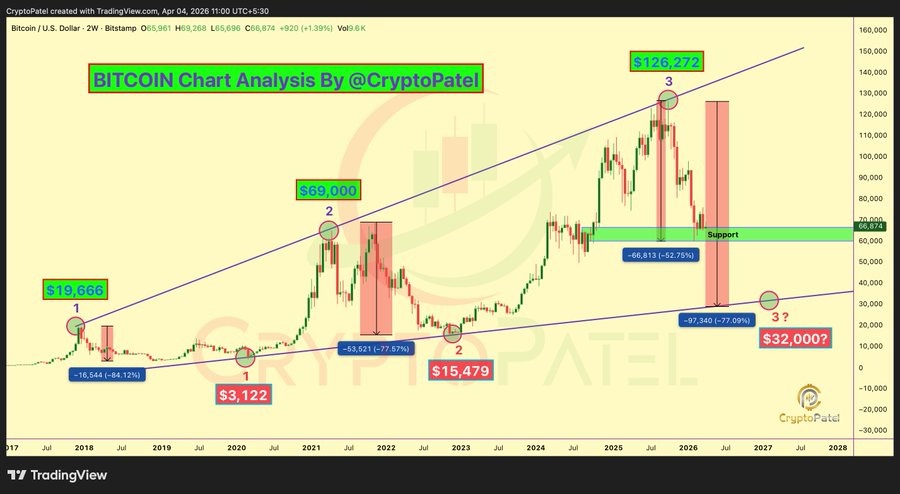
"If you’re targeting $300K Bitcoin, you should also be prepared for a drop to $30K-$40K," Patel stated, emphasizing a cyclical pattern he has observed. "History Repeats: Every Cycle Has Seen 70-85% Corrections Before The Next ATH," he added, referencing the phenomenon of All-Time Highs (ATHs).
Patel’s analysis draws upon historical data, highlighting previous instances where Bitcoin experienced steep declines before embarking on its most significant rallies. He pointed to the 2018 bear market, where Bitcoin’s price plummeted from approximately $19,000 to a low of $3,122. A similar pattern was observed in 2022, when the price retreated from its all-time high of $69,000 to a low of $15,479. These historical corrections, representing declines of roughly 83% and 77% respectively, serve as the foundation for his current prediction.
The analyst’s assessment is further supported by the identification of a rising wedge pattern on Bitcoin’s price chart. This technical indicator often suggests a potential bearish reversal. According to Patel, the current market conditions, characterized by a consolidation and potential testing of lower support levels, align with this bearish pattern. He posits that for Bitcoin to sustain an upward trajectory towards higher price levels, a corrective phase, potentially seeing the price dip to around $32,000, may be necessary to re-establish a strong foundation for future growth.
Supporting Views from Other Analysts
The notion of a pre-rally correction is not isolated to Crypto Patel. Another well-respected figure in the cryptocurrency analysis space, PlanB, has also echoed this sentiment. PlanB, known for his Stock-to-Flow (S2F) model, anticipates a continued price decline for Bitcoin before it embarks on its next significant upward leg.
PlanB’s forecast suggests that Bitcoin’s price may fall below the 200-week moving average, which currently stands around $59,000. This level is often considered a critical long-term support indicator. Following this potential dip below the 200-week moving average, PlanB projects a substantial rally, with price targets ranging broadly from $250,000 to an ambitious $1 million. This wide range reflects the inherent volatility and speculative nature of long-term cryptocurrency price predictions.

The consensus among these analysts suggests a market undergoing a necessary cleansing or re-calibration phase. Such corrections, while painful for existing holders, are often viewed by seasoned investors as crucial for shedding excess speculation, capitulating weaker hands, and establishing a more sustainable base for future growth. The severity of these potential corrections, ranging from $30,000 to $40,000 or a dip below the 200-week moving average, indicates a significant retracement from current levels, underscoring the cautious optimism surrounding Bitcoin’s long-term prospects.
Bitcoin Losses Spike as Retail Interest Drops
The prevailing bearish sentiment in the market has coincided with a notable decline in retail investor interest in Bitcoin. Data from Google Trends indicates that search interest for Bitcoin has reached some of its lowest levels in recent years. This waning interest from the broader public often correlates with weaker price movements, as retail traders tend to shy away from markets perceived as volatile or experiencing downturns.
This reduction in retail engagement is occurring simultaneously with substantial realized losses across the Bitcoin network. On-chain data analytics firm Glassnode has reported that significant portions of Bitcoin holders, including "sharks" and "whales" (large-scale investors), are currently holding their assets "underwater," meaning they have purchased Bitcoin at a higher price than its current market value.
According to on-chain metrics, wallets holding between 0.1 and 10,000 Bitcoin are realizing considerable losses. The seven-day moving average of realized losses has reportedly exceeded $200 million per day. This metric quantifies the aggregate loss incurred by Bitcoin holders who sell their assets at a loss. A sustained high level of realized losses can indicate capitulation, where investors are forced to sell their holdings due to financial pressure or a loss of conviction.
The combination of declining retail interest and increasing realized losses suggests a market environment where conviction is being tested. For long-term investors and analysts like Patel and PlanB, this period of pain and reduced enthusiasm is precisely what is often observed before the commencement of a new bull cycle.
Historical Context of Bitcoin Cycles and Corrections
Understanding Bitcoin’s price history is crucial to interpreting these current predictions. Bitcoin operates on a cyclical pattern, largely influenced by its halving events. Approximately every four years, the reward for mining new Bitcoin blocks is cut in half, a pre-programmed event designed to control the supply and create scarcity.
The first halving occurred in November 2012, followed by a significant bull run in 2013. The second halving in July 2016 preceded the monumental bull market of 2017, which saw Bitcoin reach its then-all-time high of nearly $20,000. The third halving in May 2020 preceded the bull market of 2021, culminating in the $69,000 all-time high.
These cycles typically involve a period of accumulation following a bear market, followed by a parabolic surge leading up to a peak, and then a prolonged bear market characterized by significant price corrections. The magnitude of these corrections, as highlighted by Crypto Patel, has historically been substantial, often exceeding 70% from the previous peak.
The current market environment can be viewed as being in the post-halving phase of the 2020-2021 cycle. While the previous cycles have shown a tendency for Bitcoin to reach new all-time highs following each halving, the path to these new highs has consistently involved periods of significant drawdown. The analyst’s warnings of a $30,000-$40,000 or a dip below the 200-week moving average are therefore not entirely out of step with historical precedent.
CME’s Bitcoin Futures Events Contracts and Market Infrastructure
While the current discussion revolves around price predictions and market cycles, it’s important to acknowledge the evolving infrastructure surrounding Bitcoin trading. The Chicago Mercantile Exchange (CME) has played a significant role in institutionalizing Bitcoin derivatives. The introduction of CME Bitcoin Futures Contracts has provided a regulated avenue for institutional investors to gain exposure to Bitcoin.
More recently, CME has launched Bitcoin Futures Events Contracts. These are smaller, shorter-term contracts designed to track the daily settlement price of the CME Bitcoin Futures contract. The debut of such contracts signifies a continued effort to provide more granular and accessible trading tools for market participants. These instruments can offer opportunities for hedging, speculation, and price discovery on a more frequent basis.
The presence of regulated futures markets like CME’s is crucial for the maturation of the cryptocurrency asset class. They provide liquidity, price transparency, and a framework for risk management. While these futures contracts do not directly dictate the spot price of Bitcoin, they can influence market sentiment and provide insights into institutional demand and expectations. The increased accessibility and flexibility offered by events contracts could potentially lead to more active trading and a greater ability for market participants to react to short-term price movements, although their impact on long-term price trajectories remains to be seen.
Broader Market Implications and Future Outlook
The current phase of Bitcoin’s market cycle, characterized by declining retail interest and substantial unrealized losses among some holders, presents a critical juncture. The predictions of a significant correction followed by a massive rally suggest a potential for substantial wealth creation for those who can navigate the volatility and maintain conviction. However, the risks associated with such a strategy are equally significant.
For retail investors, the current market conditions might be discouraging. The temptation to exit positions during periods of decline is strong, especially when accompanied by negative news and sentiment. However, history suggests that the most significant gains are often realized by those who remain invested through these challenging periods and re-enter the market during or after the correction phase.
The growing maturity of the Bitcoin market infrastructure, including regulated futures markets and potentially spot Bitcoin ETFs in various jurisdictions, could play a role in the future. Increased institutional adoption and clearer regulatory frameworks can lead to greater price stability and reduce the extreme volatility often associated with Bitcoin. However, the cyclical nature of Bitcoin, driven by factors like halving events and investor sentiment, is likely to persist.
The divergence in price forecasts, from immediate bearish concerns to long-term bullish targets, underscores the inherent uncertainty and speculative nature of the cryptocurrency market. Investors are advised to conduct thorough research, understand their risk tolerance, and consider diversifying their portfolios. The journey to $300,000, if it materializes, will likely be a testament to Bitcoin’s resilience and its ability to overcome significant market headwinds, but the path there is expected to be anything but smooth. The coming months will be crucial in determining whether Bitcoin embarks on its predicted corrective phase or if current market conditions lead to a different trajectory.














