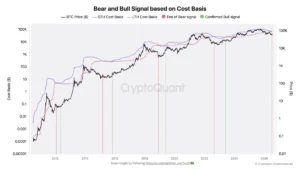
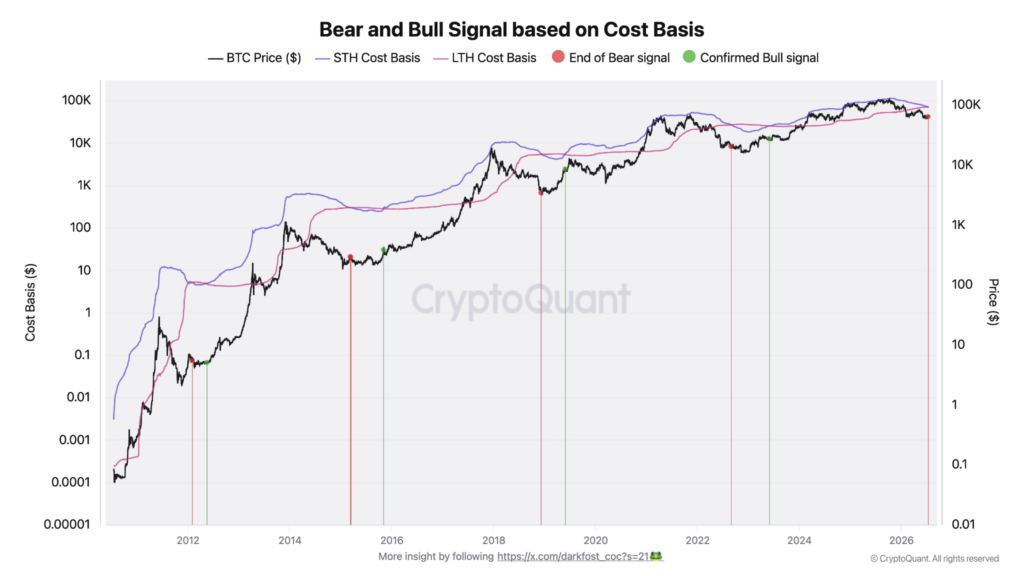
On-chain indicators are flashing signals that the prolonged nine-month bear market for Bitcoin may be approaching its final stages. A prominent crypto analyst, known as Darkfost, recently detailed this development, highlighting a significant downward crossover of the cost basis between Short-Term Holders (STH) and Long-Term Holders (LTH). This crucial signal, confirmed over a three-day period, suggests a potential turning point for the cryptocurrency’s price trajectory.
Darkfost elaborated on this pivotal moment in a recent analysis, stating, "The end-of-bear-market signal has just flashed. This signal is defined by the downward crossover of the STH/LTH cost basis (with a 3-day confirmation window to validate the signal)." This observation, backed by historical data, has historically preceded periods of market recovery and the commencement of new bull cycles.
Understanding the Short-Term Holder (STH) and Long-Term Holder (LTH) Cost Basis
To fully grasp the significance of this indicator, it’s essential to understand what STH and LTH cost bases represent.
- Short-Term Holders (STH): These are investors who have held their Bitcoin for less than 155 days. Their buying and selling behavior is often more sensitive to market fluctuations and can contribute to short-term price volatility. The STH cost basis represents the average price at which these short-term investors acquired their holdings.
- Long-Term Holders (LTH): Conversely, LTHs are investors who have held their Bitcoin for longer than 155 days. These investors are generally considered to be more conviction-driven and less likely to panic sell during market downturns. The LTH cost basis reflects the average acquisition price of these more patient investors.
The crossover of these two metrics is a powerful on-chain metric because it indicates a shift in the market’s overall sentiment and holder behavior. When the STH cost basis drops below the LTH cost basis, it signifies that new market participants are entering at lower price points, effectively dragging down the average cost of recent acquisitions. This can create a more favorable environment for future price appreciation.
Historical Context of the Bear Market
Bitcoin has been navigating a challenging bear market for approximately nine months. This period has been characterized by significant price declines from its all-time highs, driven by a confluence of macroeconomic factors, regulatory uncertainty, and the collapse of several prominent crypto entities. The market experienced a sharp downturn following the peak reached in late 2021, with prices struggling to regain upward momentum.
The current bear market has tested the resilience of both retail and institutional investors. Many have been forced to re-evaluate their strategies, with some exiting the market altogether, while others have adopted a more patient approach, waiting for clearer signs of a bottom. The prolonged nature of this downturn has led to widespread discussion about whether traditional market cycles are still applicable to Bitcoin.

The Significance of the $69K Cost Basis
The recent analysis by Darkfost points to a dramatic fall in the STH cost basis, plummeting from an estimated $112,500 to $69,000. This substantial decrease indicates that recent buyers have been acquiring Bitcoin at significantly lower prices. The fact that this STH cost basis has now overlapped with, and potentially is beginning to dip below, the LTH cost basis is a crucial development.
This overlap suggests that the market may be reaching a point where the cost of entry for newer investors is becoming more aligned with, or even lower than, that of long-held positions. This can create a more attractive environment for Dollar Cost Averaging (DCA) strategies, where investors systematically invest a fixed amount of money at regular intervals, regardless of price. A lower average buying price can enhance the potential returns of such strategies as the market eventually recovers.
Analysis of the Crossover and its Implications
The downward crossover of the STH and LTH cost bases is a strong, albeit not infallible, indicator of a market bottom. Historically, this pattern has preceded the commencement of bull markets. The logic behind this is that when short-term holders are consistently buying at lower prices than long-term holders, it signifies capitulation from those who bought at higher prices, and accumulation by those who believe the asset is undervalued.
However, it is crucial to note that this signal indicates the beginning of the end of the bear market, not its immediate conclusion. The market conditions are becoming ripe for a potential recovery, but a definitive end to the bear market and the onset of a sustained bull run will likely require further confirmation.
Future Outlook and Potential Scenarios
As the bear market nears its terminal phase, the cryptocurrency market is likely to witness Bitcoin establishing a bottom in the near future and then consolidating around that level. There are differing opinions among market participants regarding the potential for further downside. Some proponents believe that the current lows, around the $58.5k mark, represent a significant support level and that a further significant dip is unlikely. Others, however, argue that additional price pain might be necessary before a clear market bottom can be definitively called.
The divergence and subsequent re-convergence of the STH and LTH cost levels will be closely monitored. A subsequent upward crossover of these metrics would serve as a strong confirmation of the bull market’s onset. However, predicting the exact timing of this event is challenging, as it could take several months, or even over a year, to materialize.
Market Maturation and Cyclical Behavior
Despite the volatility and the cyclical nature of the cryptocurrency market, the current signals suggest a degree of maturation for Bitcoin. The observed patterns, while evolving, appear to be respecting some of the historical four-year cycle rhythms that have characterized Bitcoin’s price action. This suggests that investor behavior, a key driver of market cycles, continues to be a relevant factor.
While some critics have argued that the traditional four-year cycle may be obsolete and that the market is entering uncharted territory, the enduring cyclical investor behavior observed in Bitcoin suggests otherwise, at least for now. The ability of on-chain metrics like the STH/LTH cost basis crossover to provide insights into potential market turning points underscores the growing sophistication of market analysis in the digital asset space.
Broader Market Impact and Investor Strategies
The potential end of the bear market could have significant implications for the broader cryptocurrency ecosystem. A sustained recovery in Bitcoin’s price often has a positive ripple effect on altcoins, potentially leading to a resurgence in market sentiment and increased investment.
For investors, the current signals may present an opportune moment to review and potentially adjust their strategies. The concept of Dollar Cost Averaging (DCA) becomes particularly relevant during such periods, allowing investors to gradually build positions at favorable average prices. However, it is crucial for investors to conduct their own research, understand their risk tolerance, and avoid making decisions based solely on short-term market indicators. The cryptocurrency market remains inherently volatile, and careful planning and execution are paramount.
The confluence of on-chain data, historical patterns, and evolving market dynamics paints a cautiously optimistic picture for Bitcoin. While the path forward may still present challenges, the recent signals suggest that the prolonged period of bearish sentiment could be giving way to a new phase of market development, potentially ushering in a more favorable environment for investors in the coming months and years. The coming weeks and months will be critical in observing whether these on-chain indicators translate into a sustained recovery and the confirmation of a new bull cycle.