
Publicly listed companies have collectively amassed a significant Bitcoin treasury, now holding approximately 1.3 million BTC, representing a substantial 31% increase over the past 14 months. This milestone, highlighted by data recently shared by CryptoQuant, signals a notable shift in corporate digital asset strategy. However, a deeper examination of this accumulation reveals a complex and evolving landscape, suggesting that while institutional interest in Bitcoin remains, the nature of its adoption is undergoing a transformation. The prevailing sentiment in the market, buoyed by these accumulating holdings, hints at a potential end to Bitcoin’s protracted nine-month bear market, with a key indicator being the declining cost basis of short-term holders, which has reportedly fallen to around $69,000.
The surge in corporate Bitcoin holdings is undeniable. Since August 14, 2025, the total Bitcoin held by publicly traded companies has grown by an impressive 304,337 BTC. This consistent and rapid accumulation underscores a growing conviction among a segment of the corporate world regarding Bitcoin’s potential as a store of value and a strategic asset. This trend has been a significant driver of market sentiment, suggesting a new era of corporate Bitcoin adoption is dawning.
The Shifting Dynamics of Corporate Bitcoin Accumulation
Despite the headline-grabbing total, a closer look at the data shared by CryptoQuant reveals a more nuanced picture. While the aggregate number of Bitcoin held by public companies has reached a new high, the pace and distribution of this accumulation are not uniform. The data indicates a significant slowdown in treasury accumulation among the majority of Bitcoin-holding companies.
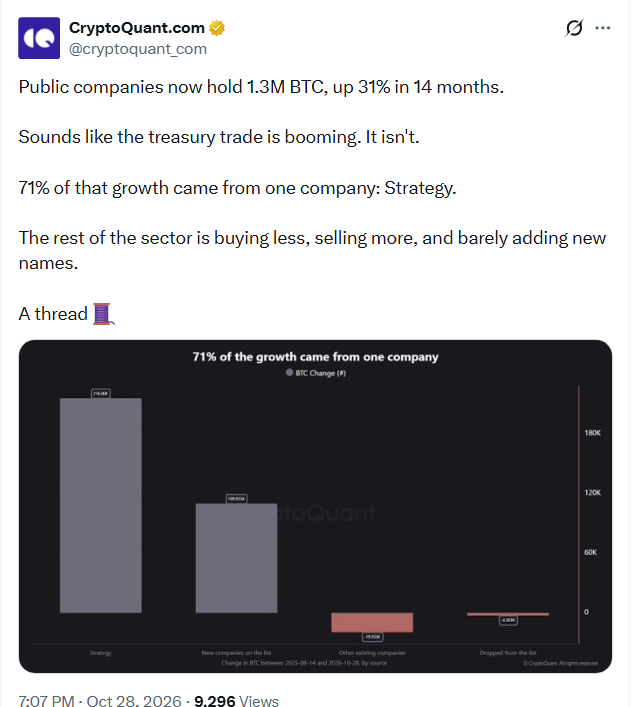
A critical insight from the report is that a staggering 71% of the 1.3 million BTC accumulated by public companies over the last 14 months originated from a single entity: Michael Saylor’s MicroStrategy. This revelation raises pertinent questions about the sustainability and breadth of Bitcoin treasury strategies across the broader corporate sector. While MicroStrategy has been a vocal and aggressive accumulator, the data suggests that the rest of the corporate landscape has been more reserved in its Bitcoin purchases.
The report breaks down the accumulation, showing that MicroStrategy, the largest corporate Bitcoin holder, quietly increased its holdings by a substantial 216,060 BTC during the period. In contrast, all other companies combined added a comparatively smaller 109,935 BTC to their reserves. This disparity strongly implies that the collective accumulation activity outside of MicroStrategy has markedly decreased.
A Slowdown in "Treasury" Purchases
This trend of slowing accumulation is further corroborated by the observation that most Bitcoin treasury companies have recently halted their BTC accumulation or significantly reduced their purchase volumes. Analysis of the data reveals that out of 205 firms with a history of Bitcoin holdings, only 50 have purchased any BTC in the past six months. This indicates a considerable cooling-off in the buying appetite of many corporations that had previously engaged in Bitcoin acquisition.

This phenomenon can be attributed to several factors. The prolonged bear market, characterized by significant price volatility, may have prompted a more cautious approach from many corporate treasuries. Furthermore, the initial wave of Bitcoin adoption by corporations might have been driven by a more speculative interest or a desire to be early adopters, whereas the current phase appears to be more about strategic asset management and risk assessment. The high cost of acquisition during peak market cycles may also be a deterrent for new entrants or for existing holders looking to expand their positions at current price levels.
The Emergence of a New Wave of Institutional Selling
Concurrently, a noteworthy shift has been observed in the selling behavior of these corporate Bitcoin holders. While the narrative has largely focused on accumulation, a significant number of companies have begun to liquidate portions of their Bitcoin holdings. The data indicates that 44 out of 100 newly formed Bitcoin treasury companies have sold some of their BTC.
This selling activity, while perhaps counterintuitive to the accumulation narrative, is being interpreted by market analysts as a sign of a new and maturing wave of institutional Bitcoin adoption. Instead of simply holding Bitcoin passively, these treasury firms are demonstrating a more active and sophisticated approach to managing their digital asset portfolios.
The fact that companies are beginning to sell, even if it represents a small fraction of their overall holdings, signifies a transition from a "buy and hold" strategy to one that actively manages price fluctuations, balances exposure, and treats Bitcoin as a more dynamic reserve asset. This is a crucial development, as it suggests that institutions are increasingly recognizing Bitcoin’s potential not just as a long-term store of value but also as an asset that can be strategically deployed and managed within a broader corporate finance framework.
Implications for Bitcoin’s Market Structure and Future
The divergence in accumulation and selling patterns between MicroStrategy and the broader corporate sector has significant implications for the future of Bitcoin adoption. It highlights the influence of key opinion leaders and early adopters like Michael Saylor in driving initial institutional interest. However, it also points to the need for a more diversified and sustainable adoption model that involves a wider range of corporate entities actively participating in the market.
The active management of Bitcoin holdings by institutions is a positive development for the cryptocurrency’s maturation. It suggests that Bitcoin is being integrated into traditional financial practices, where assets are regularly reviewed, rebalanced, and strategically utilized. This active participation can lead to increased liquidity and price discovery, making Bitcoin a more robust and reliable financial instrument.
Furthermore, the fact that companies are beginning to take profits and rebalance their portfolios indicates a growing understanding of Bitcoin’s risk-reward profile. This pragmatism is a hallmark of sophisticated financial management and suggests that institutional investors are moving beyond the initial excitement and developing more nuanced strategies for incorporating Bitcoin into their balance sheets.
The Broader Impact on Market Sentiment and Potential Price Action
The combined forces of continued, albeit concentrated, accumulation and the emergence of active selling strategies are creating a complex market dynamic. While the decline in the short-term holder cost basis to $69,000 is a significant technical indicator suggesting that recent buyers are underwater, this is often seen as a precursor to potential market bottoms. When short-term holders capitulate and sell at a loss, it can clear out weaker hands, paving the way for a more sustainable recovery.
The ongoing interest from institutions, even with the observed slowdown in broad-based accumulation, continues to provide a foundational support level for Bitcoin. The 1.3 million BTC held by public companies represents a substantial "whale" presence that is less likely to engage in panic selling compared to retail investors.
The shift towards active management by institutions means that future price movements may be influenced not only by macro-economic factors and retail sentiment but also by the strategic decisions of corporate treasuries. This could lead to a more stable and predictable price action over the long term, as institutional players are typically more disciplined in their investment approaches.
Looking Ahead: A Maturing Asset Class
The evolving landscape of corporate Bitcoin adoption, marked by concentrated accumulation and a new wave of active selling, paints a picture of a maturing asset class. While the initial surge in broad-based corporate buying may have tempered, the ongoing strategic engagement by institutions signifies a deeper integration of Bitcoin into the global financial system.
As more companies learn to effectively manage their Bitcoin positions, balancing risk and reward, the perception of Bitcoin as a volatile speculative asset is likely to diminish, replaced by its recognition as a legitimate and strategic financial instrument. This transition is crucial for Bitcoin’s long-term success and its potential to become a significant component of institutional portfolios worldwide. The coming months will be critical in observing whether the current technical indicators, coupled with these evolving institutional strategies, will indeed mark the definitive end of Bitcoin’s nine-month bear market and usher in a new phase of growth and stability.