
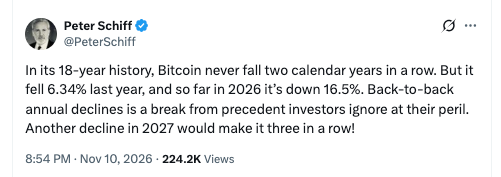
The cryptocurrency market is abuzz with speculation as prominent Bitcoin critic Peter Schiff has highlighted a potentially significant historical anomaly for the flagship digital asset. Schiff, a vocal proponent of gold and a staunch skeptic of cryptocurrencies, pointed out that Bitcoin is on the cusp of experiencing back-to-back calendar-year losses for the first time since its inception. This development, if it materializes, could signal a prolonged downturn and potentially reshape investor sentiment, even as some analysts suggest these periods of decline often precede significant recoveries.
Schiff’s recent commentary, disseminated across social media platforms, drew attention to Bitcoin’s performance over the past two years. He noted that in 2025, Bitcoin registered a price decrease of approximately 6.34%. As of the current reporting period in late 2026, the digital currency has already seen a decline of around 16.5%. Schiff warned investors to exercise caution, suggesting that this deviation from historical patterns could foreshadow further substantial price depreciation in 2027.
Historical Performance and Schiff’s Observations
Bitcoin, since its creation, has largely been characterized by periods of rapid growth followed by sharp corrections, but rarely by sustained, multi-year declines. Schiff’s assertion that Bitcoin has never posted consecutive calendar-year losses in its roughly 18-year history is a key point of his recent discourse.
Analyzing the data, Bitcoin’s performance in 2025 indeed saw a downturn. The digital asset began the year trading around the $93,400 to $93,500 mark. While it reached a new all-time high (ATH) of $127,500 in October 2025, it failed to sustain these gains, closing the year with a net loss of approximately 6.3% to 6.4%, ending near $87,500. This marks a notable instance where an asset reached new highs but couldn’t maintain its upward momentum through year-end.

The trend appears to have continued into 2026. Starting the year around the $86,000 price level, Bitcoin has seen a significant decline, currently trading in the vicinity of $73,000. This represents a loss exceeding 16% for the current calendar year. Given the remaining weeks of 2026, the likelihood of a substantial rebound sufficient to negate this loss appears slim, thus setting the stage for the predicted consecutive annual declines.
The Significance of Consecutive Bear Years
The potential for two consecutive down years for Bitcoin is a significant departure from its historical trajectory. Typically, after a year of substantial losses – such as the 56%-58% decline in 2014, the 73%-74% drop in 2018, and the 64% fall in 2022 – Bitcoin has historically experienced strong recoveries in the subsequent year. For instance, 2015 saw significant gains following the 2014 downturn, 2019 rebounded after the 2018 bear market, and 2023 followed suit after the 2022 slump.
This pattern suggests a cyclical nature where significant price corrections have often served as catalysts for renewed bullish phases. The current scenario, characterized by a modest decline in 2025 followed by a more pronounced one in 2026, deviates from this established pattern. Schiff’s concern, therefore, is rooted in the potential breakdown of this historical trend.
Peter Schiff’s Long-Standing Stance
Peter Schiff’s skepticism towards Bitcoin is well-documented. He has consistently argued that digital currencies, including Bitcoin, lack intrinsic value and cannot function as a reliable store of value, contrasting them with his preferred asset, gold. His critiques often intensify during periods of market downturns, leading some observers to accuse him of selectively commenting on Bitcoin’s performance.
Indeed, Schiff has faced criticism for his tendency to highlight Bitcoin’s weaknesses when it is under pressure, while remaining conspicuously silent or downplaying its strengths during periods of robust recovery. For example, Bitcoin’s impressive rally from around $57,000 earlier in 2026 to $86,000 in a relatively short period did not elicit the same level of public commentary from Schiff as its subsequent declines. This selective engagement has led to accusations of bias and a focus on narrative rather than objective market analysis.
Critics have also unearthed past statements from Schiff where he expressed strong doubts about Bitcoin’s viability, even suggesting it was "not worth buying." These historical pronouncements are often juxtaposed with Bitcoin’s subsequent performance, highlighting how his bearish predictions have, at times, failed to materialize.
Market Analysis and Potential Implications
While Schiff’s pronouncements often carry a bearish tone, the data he presents regarding consecutive yearly losses is factually accurate based on the current market performance. The question remains whether this deviation from historical norms signifies a fundamental shift in Bitcoin’s market dynamics or a temporary anomaly.
Several factors contribute to the ongoing price action. The broader macroeconomic environment, including interest rate policies, inflation figures, and geopolitical events, continues to play a significant role in the risk appetite of investors, impacting assets like Bitcoin. Furthermore, regulatory developments in various jurisdictions, the evolution of institutional adoption, and technological advancements within the blockchain space all contribute to the complex interplay of forces influencing Bitcoin’s price.
If Bitcoin does indeed close 2026 with a second consecutive year of losses, the implications could be far-reaching:
- Investor Sentiment: A prolonged bear market could erode investor confidence, particularly among newer entrants who may have experienced significant paper losses. This could lead to reduced capital inflows and potentially a longer period of sideways or downward price movement.
- Institutional Adoption: While institutional interest in Bitcoin has grown, sustained price declines might temper the enthusiasm of some large investors who are sensitive to volatility and drawdown risks. However, it could also present attractive entry points for long-term investors.
- Market Structure: Consecutive losses could lead to further consolidation among mining operations and a potential shakeout of less resilient projects within the broader cryptocurrency ecosystem.
- Macroeconomic Correlation: A sustained downturn in Bitcoin, especially if it deviates from its traditional role as an inflation hedge or risk-on asset, could lead to a reassessment of its correlation with traditional markets.
The Counterpoint: Potential for Recovery
Despite Schiff’s bearish outlook, historical data also suggests that periods of sustained decline are often followed by significant upswings. The market for Bitcoin has demonstrated remarkable resilience in the past, bouncing back from major corrections with renewed vigor.

The concept of "short-term holder cost basis" is a crucial metric in this context. When the cost basis of short-term holders (those who have held Bitcoin for less than a year) falls below a certain threshold, it can indicate that these holders have capitulated, selling their assets at a loss. This capitulation can clear out weaker hands, potentially setting the stage for a recovery as more conviction-driven, long-term holders remain.
While the article does not explicitly detail the current short-term holder cost basis, if it has indeed fallen significantly, it could be interpreted as a bullish signal for the medium to long term, suggesting that the market has absorbed selling pressure and is poised for a turnaround. This is a common narrative in crypto cycles, where wash-out periods precede new bull runs.
Future Outlook and Expert Opinions
The cryptocurrency market is inherently dynamic, and predictions, especially those from vocal critics, should be viewed within the broader context of market cycles and diverse analytical perspectives. While Peter Schiff’s observations about consecutive yearly losses are noteworthy, they represent one viewpoint.
Other analysts and market participants may point to factors such as the upcoming halving events, the continued development of blockchain technology, increasing adoption of decentralized finance (DeFi) applications, and the potential for regulatory clarity as catalysts for future growth. The narrative of Bitcoin as a digital store of value, often compared to "digital gold," continues to resonate with a significant portion of investors, particularly in an environment of global economic uncertainty.
The coming months and years will be critical in determining whether Bitcoin’s current trajectory represents a temporary deviation or a fundamental shift in its market behavior. The resilience of its network, the adoption by institutions and individuals, and its ability to navigate evolving macroeconomic and regulatory landscapes will all play a pivotal role in shaping its future price performance and its place within the global financial system. Schiff’s predictions, while carrying weight due to his prominence, will ultimately be tested against the unfolding reality of the cryptocurrency market.