
On-chain data indicators are suggesting a potential turning point in the prolonged nine-month bear market for Bitcoin. A prominent cryptocurrency analyst, known by the pseudonym Darkfost, has highlighted a significant technical development: a downward crossover of the cost basis between Short-Term Holders (STHs) and Long-Term Holders (LTHs). This signal, confirmed over a three-day period, is traditionally interpreted as a strong indicator of an impending bear market bottom.
Darkfost, a recognized voice in the crypto analytics community, shared his findings on social media platform X (formerly Twitter), accompanied by a detailed graph illustrating the convergence of these critical holder metrics. The analyst stated, "The end-of-bear-market signal has just flashed. This signal is defined by the downward crossover of the STH/LTH cost basis (with a 3-day confirmation window to validate the signal)." This pronouncement has generated considerable interest within the cryptocurrency ecosystem, as investors and traders eagerly seek signs of recovery after an extended period of price depreciation.
The concept of STH and LTH cost basis is a fundamental metric in on-chain analysis. The cost basis represents the average price at which a specific group of holders acquired their Bitcoin. Short-Term Holders are typically defined as those who have held their Bitcoin for less than 155 days, while Long-Term Holders have held for longer than 155 days. When the STH cost basis falls below the LTH cost basis, it implies that newer market participants are entering the market at lower average prices than the long-term investors. This can signal capitulation by recent buyers who bought at higher prices, thereby pushing down the average entry point for the short-term cohort.
According to Darkfost’s analysis and the accompanying visual data, the STH cost basis has experienced a substantial decline, reportedly falling from a peak of approximately $112,500 to around $69,000. This dramatic decrease suggests that a significant number of investors who acquired Bitcoin at higher valuations during the market’s peak are now selling at a loss. This selling pressure, while painful for those involved, can effectively "reset" the average cost for the remaining short-term holders, making the overall market sentiment more favorable for a potential rebound.
The crucial development, as highlighted by the analyst, is the recent overlap and subsequent downward crossover of the STH cost basis relative to the LTH cost basis. This signifies that the average purchase price of recent Bitcoin acquirers has fallen below that of the more established, long-term holders. Historically, such an event has preceded the end of bear markets and the commencement of new bull cycles. The 3-day confirmation adds a layer of robustness to this signal, reducing the likelihood of a false positive.
The Historical Context of Bear Market Signals
Understanding the significance of the STH/LTH cost basis crossover requires a look at Bitcoin’s cyclical market behavior. Bitcoin has historically operated on roughly four-year cycles, often influenced by its halving events – programmed reductions in the rate at which new bitcoins are created. These cycles typically involve a period of rapid price appreciation (bull market), followed by a prolonged downturn (bear market), and then a period of accumulation and eventual recovery.

The current bear market, which began after Bitcoin reached its all-time high in November 2021, has been one of the longest and most challenging in its history. The price has experienced significant drawdowns, exacerbated by macroeconomic headwinds, regulatory uncertainties, and the collapse of several prominent cryptocurrency entities, such as Terra (LUNA) and FTX. During these downturns, many short-term holders, often referred to as "newcomers" or "speculators," tend to exit their positions when faced with substantial losses. This capitulation is a key feature of bear market bottoms.
The STH/LTH cost basis crossover is a metric designed to capture this capitulation phase. When STHs are forced to sell at prices below their entry point, and their average cost basis drops below that of LTHs, it indicates that the market has absorbed a significant amount of selling pressure from less committed investors. The LTH cost basis, representing the average purchase price of those who have demonstrated conviction through long-term holding, typically acts as a more resilient support level. A crossover below this level suggests that even the more seasoned investors’ average entry price is being challenged, but more importantly, that the cost basis of new entrants is now lower, creating a more favorable entry environment for future buyers.
Supporting Data and Analysis
The current STH cost basis hovering around $69,000, as reported by Darkfost, is a notable figure. For context, the all-time high for Bitcoin was recorded at approximately $69,000 (and some exchanges showing slightly higher figures) in November 2021. The fact that the STH cost basis has now fallen to this level is particularly striking. It implies that many investors who bought near the previous market peak are now considered short-term holders and are selling at or below their purchase price.
The graph provided by Darkfost visually demonstrates this trend. It depicts the STH cost basis line dipping significantly and crossing below the LTH cost basis line. While the exact timing of the $112,500 peak for the STH cost basis is not precisely detailed, its subsequent sharp decline to $69,000 underscores the intensity of the bear market’s impact on recent entrants.
This dynamic has several implications for the cryptocurrency market:
- Lower Entry Points: The reduced average cost for short-term holders creates a more attractive entry point for new investors looking to accumulate Bitcoin. This can fuel demand as prices begin to stabilize and recover.
- Capitulation Confirmation: The crossover signals that a substantial portion of weaker hands has exited the market. This capitulation is a prerequisite for a sustainable market recovery, as it reduces the overhang of potential sellers.
- Psychological Shift: A falling STH cost basis can contribute to a psychological shift in the market. As the average purchase price for new investors decreases, the perceived risk of buying may also diminish, potentially encouraging more cautious accumulation.
The Path Forward: Accumulation and Potential Recovery
Darkfost’s analysis suggests that while the signal of an approaching end to the bear market has flashed, the market is not yet definitively out of the woods. The current overlap in cost bases indicates that the terminal phase of the bear market is underway, creating fertile ground for strategies like Dollar-Cost Averaging (DCA). DCA involves investing a fixed amount of money at regular intervals, regardless of the asset’s price. This strategy can be particularly effective in a bear market as it allows investors to accumulate more units of the asset when prices are low.
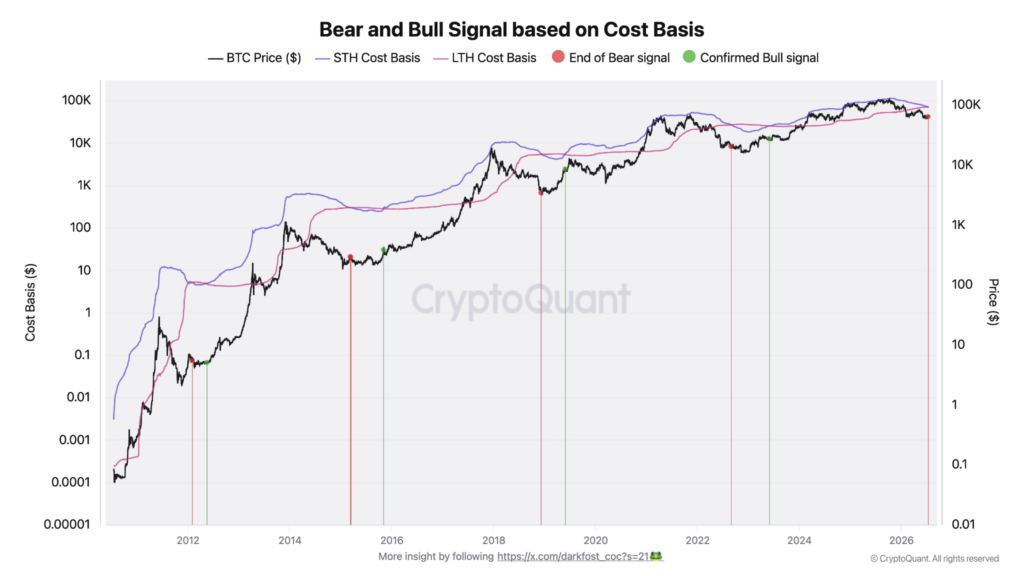
The analyst anticipates that the STH and LTH cost bases may diverge slightly in the near term, but a subsequent upward crossover of the STH cost basis above the LTH cost basis would serve as a confirmation of a new bull market’s onset. However, he cautions that there is no fixed timeline for this confirmation. It could take several months, or even over a year, for such a significant shift to occur and be reliably confirmed.
Broader Market Implications and Expert Perspectives
The current market conditions and the potential end of the bear market are being closely watched by various market participants. Some proponents of Bitcoin remain optimistic, believing that the current lows around $58,500 might represent a durable bottom. They point to the increasing adoption of Bitcoin as a store of value and a potential hedge against inflation.
Conversely, other analysts maintain that further price depreciation might be necessary before a clear market bottom can be established. These perspectives often hinge on different interpretations of market cycles, macroeconomic influences, and the potential for unforeseen "black swan" events within the crypto space.
The enduring relevance of Bitcoin’s four-year cycle is a subject of ongoing debate. Some critics argue that the cycle has been disrupted or even invalidated by the increasing institutionalization of the market, regulatory interventions, and the broader economic landscape. However, Darkfost’s analysis suggests that, at least from an on-chain holder behavior perspective, the cyclical investor behavior that has characterized Bitcoin’s history may still be holding true.
The maturation of Bitcoin as an asset class is evident in the sophistication of the on-chain metrics being used to analyze its market cycles. The STH/LTH cost basis crossover is just one of many indicators that analysts employ to gauge market sentiment and identify potential turning points. Other commonly used metrics include the Net Unrealized Profit/Loss (NUPL), the Mayer Multiple, and various exchange flow data.
The current juncture, with the STH cost basis converging with the LTH cost basis, represents a critical phase. It signifies a period of potential transition, where the forces driving the bear market may be losing momentum, and the conditions for a recovery are gradually being established. While the exact timing of the next bull run remains uncertain, on-chain data like the STH/LTH crossover provides valuable insights into the underlying market dynamics, offering a data-driven perspective on Bitcoin’s path forward. The next few months will be crucial in observing whether this signal translates into a sustained upward trend, confirming the end of the prolonged bear market and the dawn of a new cycle.