
On-chain indicators are pointing towards a potential inflection point in Bitcoin’s prolonged bear market, with several key metrics suggesting that the cryptocurrency may be entering its final stages. A prominent crypto analyst, known by the pseudonym Darkfost, recently highlighted a significant development: a downward crossover in the cost basis between Short-Term Holders (STH) and Long-Term Holders (LTH). This event, confirmed over a three-day period, is being interpreted by some as a historically reliable signal of an approaching market bottom.
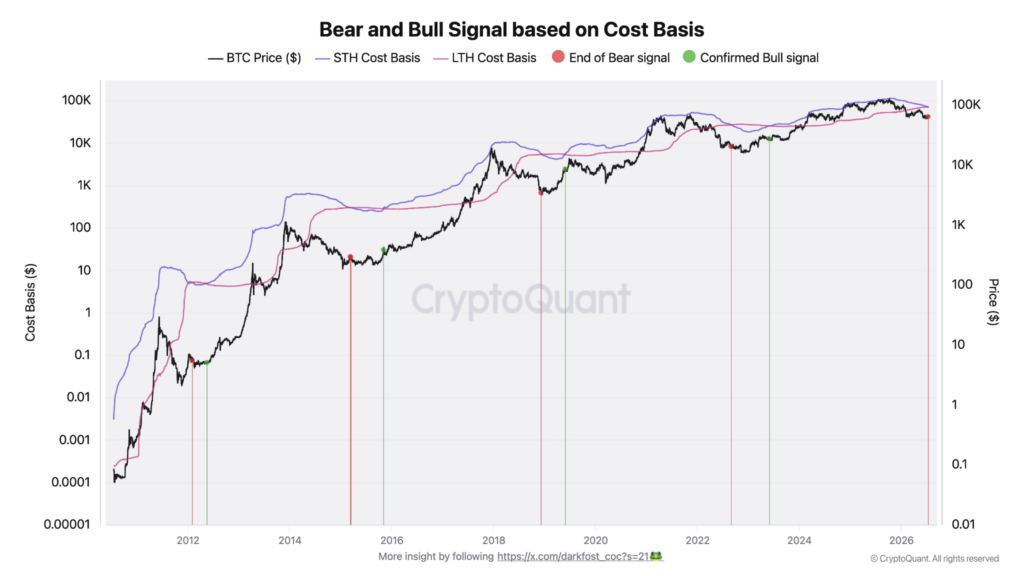
The persistent bear market, which has seen Bitcoin prices endure significant downturns for approximately nine months, has tested the resolve of many investors. However, the recent on-chain data, as detailed by Darkfost, offers a glimmer of optimism. The analyst shared a graph illustrating the divergence and subsequent convergence of the cost bases for these two distinct investor groups. The cost basis represents the average price at which holders acquired their Bitcoin. When the cost basis of short-term holders falls below that of long-term holders, it suggests that recent buyers have been acquiring Bitcoin at lower prices, potentially setting the stage for a recovery.
Understanding Short-Term vs. Long-Term Holders
To fully appreciate the significance of this development, it’s crucial to understand the distinction between Short-Term Holders (STH) and Long-Term Holders (LTH). In the context of cryptocurrency analysis, STHs are typically defined as investors who have held their Bitcoin for less than 155 days. These investors are often more sensitive to short-term price fluctuations and are more likely to sell during periods of volatility, contributing to downward price pressure. LTHs, on the other hand, are those who have held their Bitcoin for longer than 155 days. These investors are generally considered more conviction-driven and less prone to panic selling, often viewing market downturns as accumulation opportunities.
The cost basis of STHs represents the average price at which these more transient investors entered the market. A falling STH cost basis indicates that new entrants, or those who have recently reshuffled their holdings, are acquiring Bitcoin at progressively lower prices. When this STH cost basis drops below the LTH cost basis, it signifies that the recent wave of buying activity is occurring at levels significantly lower than the average acquisition price of long-term, more committed holders. This convergence or crossover is often seen as a sign that the market has absorbed much of the selling pressure from those looking to exit, and that new capital is entering at attractive valuations.
The Crossover Event: A Deeper Dive
Darkfost’s analysis, shared on social media, detailed the observation of a downward crossover of the STH/LTH cost basis, validated by a three-day confirmation window. This rigorous confirmation period is essential in on-chain analysis to filter out noise and ensure that the observed trend is not a temporary anomaly. The graph provided by the analyst depicted a dramatic shift. The STH cost basis, which had previously peaked at approximately $112,500, has seen a significant decline, reportedly falling to around $69,000. This substantial reduction in the average acquisition price for short-term holders suggests that a considerable amount of Bitcoin has been purchased at lower levels in recent times.

The visual representation clearly shows the STH cost basis not only falling but also approaching and eventually overlapping with the LTH cost basis. The analyst’s commentary suggests that the STH cost basis could even dip below the LTH cost basis in the coming months. This scenario would further reinforce the notion that the market is in a capitulation phase, where weaker hands have sold off their holdings, and a new cohort of buyers is establishing positions at attractive prices.
Historical Context and Market Cycles
The concept of market cycles is central to understanding Bitcoin’s price action. Historically, Bitcoin has exhibited a roughly four-year cycle, often correlated with the halving events, which reduce the rate at which new Bitcoins are created. These cycles typically involve a period of significant price appreciation (bull market), followed by a prolonged period of decline and consolidation (bear market), before eventually embarking on a new upward trend.
The current bear market, which has lasted for approximately nine months, is consistent with the historical patterns of price corrections following major rallies. The halving event that occurred in April 2024 reduced the block reward for miners from 6.25 BTC to 3.125 BTC. While halvings are generally viewed as bullish catalysts in the long term by increasing scarcity, they can also be followed by periods of price consolidation as the market digests the change.
The observed crossover in STH and LTH cost bases has historically been a reliable indicator of the latter stages of a bear market. During previous bear cycles, when this metric has signaled a bottoming out, it has often preceded a sustained recovery. For instance, following the 2017 bull run and the subsequent bear market of 2018, similar on-chain signals emerged before Bitcoin began its ascent in 2020. The current situation, with the STH cost basis plummeting and converging with the LTH cost basis, suggests that Bitcoin may be nearing a similar inflection point.
Implications for Investment Strategies
The current on-chain data provides a compelling case for the potential viability of Dollar Cost Averaging (DCA) strategies. DCA involves investing a fixed amount of money at regular intervals, regardless of the asset’s price. When the market is in a downturn and prices are low, DCA allows investors to acquire more units of the asset with each investment. The falling STH cost basis indicates that current market prices are favorable for new entrants to establish positions at lower average costs, making DCA a particularly attractive strategy in this environment.
As the bear market approaches its terminal phase, Bitcoin is likely to find a bottom and then stabilize. While there is no definitive consensus on the exact bottoming price, some proponents believe that the current lows, which have flirted with the $58,500 mark, may represent a significant support level. However, other analysts suggest that further downside might be necessary before a clear bottom can be declared, emphasizing the inherent volatility and unpredictability of cryptocurrency markets.
The Path Forward: Divergence and Confirmation
Looking ahead, the STH and LTH cost levels are expected to diverge slightly in the short term. This divergence is a natural part of market dynamics as new buyers enter and existing holders continue to manage their positions. However, the crucial development to watch for will be a subsequent upward crossover of the STH cost basis above the LTH cost basis. This would serve as a powerful confirmation of the onset of a new bull market.
The timeframe for this confirmation remains uncertain. On-chain analysis suggests that such a divergence and subsequent upward crossover could take several months, or potentially even over a year, to materialize. This highlights the importance of patience and a long-term perspective for investors participating in the cryptocurrency market.
Despite the cyclical nature of Bitcoin’s price movements, some market participants have questioned the continued relevance of the traditional four-year cycle. The narrative that the "4-year cycle is dead" has gained traction, with proponents suggesting that the market is entering uncharted territory due to evolving institutional adoption, regulatory landscapes, and technological advancements. However, the enduring cyclical investor behavior, as evidenced by the STH/LTH cost basis crossover, suggests that at least for Bitcoin, these historical patterns continue to hold sway.
Broader Market Impact and Expert Reactions
The potential end of Bitcoin’s bear market carries significant implications for the broader cryptocurrency ecosystem. A sustained recovery in Bitcoin’s price often has a ripple effect, boosting the performance of altcoins and increasing overall market sentiment. Institutional investors, who have been closely watching Bitcoin’s price action, may see a confirmed bottom as an opportune moment to increase their exposure.
While Darkfost’s analysis provides a compelling on-chain perspective, it’s important to note that on-chain data is just one piece of the puzzle. Macroeconomic factors, regulatory developments, and geopolitical events can all influence Bitcoin’s price trajectory. However, the convergence of STH and LTH cost bases offers a data-driven signal that is rooted in the actual behavior of market participants, making it a valuable indicator for assessing the health and potential future direction of the Bitcoin market.
The market will be closely watching for further confirmation of these trends. The sustained stability of Bitcoin above key support levels, coupled with positive developments in on-chain metrics, will be crucial in validating the theory that the nine-month bear market is indeed coming to a close. As always, investors are advised to conduct their own research and consider a diversified investment strategy, acknowledging the inherent risks associated with the cryptocurrency market. The current on-chain signals, however, suggest that a period of renewed optimism may be on the horizon for Bitcoin.