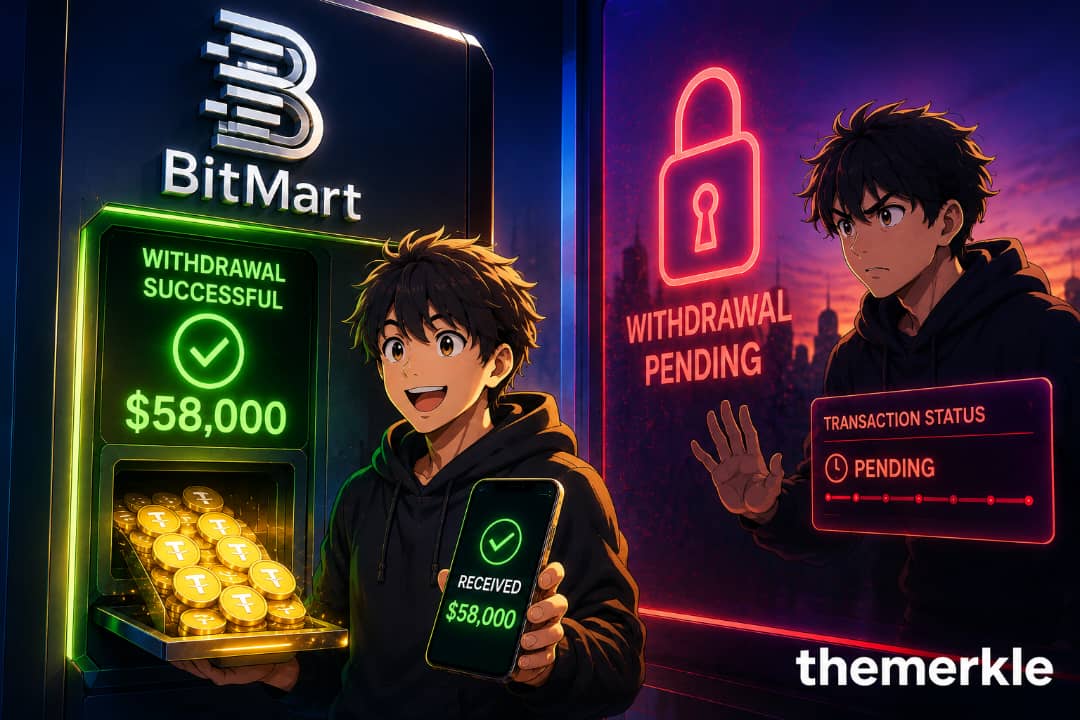
A BitMart user recently reported the successful processing of a $58,000 withdrawal after a two-week delay, a development that, while seemingly routine, has been met with a paradoxical sense of relief and celebration among the platform’s embattled user base. This singular success story emerges against a backdrop of widespread withdrawal issues and growing frustration following the cryptocurrency exchange’s announcement to cease operations. For many, the ability to retrieve funds from BitMart has become less of an expected service and more of a hard-won battle, with thousands of other users still struggling to access their assets. This situation underscores the precarious trust environment within the crypto industry, particularly concerning centralized exchanges navigating operational closures.
The relief expressed by the user whose funds finally cleared highlights the extraordinary circumstances surrounding BitMart’s wind-down. In a normal financial ecosystem, a two-week hold on personal funds would be cause for significant distress and immediate complaint. However, for current BitMart account holders, this outcome is being hailed as a "genuine win," indicating the severity of the challenges faced by others who remain unable to initiate or complete withdrawals. The user explicitly referred to BitMart as a "scammer exchange," a sentiment reflecting the deep-seated anger and distrust that has proliferated among its community in recent weeks. This perceived victory, while personal, serves as a crucial, albeit isolated, data point suggesting that the exchange’s systems are, at least intermittently, capable of processing transactions, offering a fragile glimmer of hope to those still waiting.
BitMart’s Tumultuous Journey: From Launch to Operational Halt
To fully comprehend the gravity of a single successful withdrawal being considered newsworthy, it is essential to trace BitMart’s operational history and the events leading up to its current predicament. BitMart, founded in 2017, quickly established itself as a global cryptocurrency exchange, offering a wide array of digital assets for trading, along with various financial services like staking and lending. It aimed to provide an accessible platform for both novice and experienced crypto traders, garnering a significant user base over its operational lifespan.
However, BitMart’s journey has not been without significant challenges. A pivotal event that severely tested user trust and the exchange’s resilience occurred in December 2021. BitMart suffered a major security breach, resulting in the theft of approximately $196 million in various cryptocurrencies, including Ethereum and Binance Smart Chain tokens. The hack, one of the largest in cryptocurrency history at the time, saw funds siphoned off from "hot wallets" – wallets connected to the internet for quick transactions. While BitMart’s CEO, Sheldon Xia, publicly acknowledged the breach and pledged to compensate affected users, the incident left a lasting scar on the exchange’s reputation and raised fundamental questions about its security protocols and liquidity management. The recovery process was arduous, involving complex negotiations and efforts to trace the stolen assets, further eroding user confidence in the platform’s long-term viability. This historical context is crucial, as it suggests a pre-existing fragility in the exchange’s operational and financial health long before the recent wind-down announcement.
The Wind-Down Announcement: A Discrepancy Between Narrative and Reality
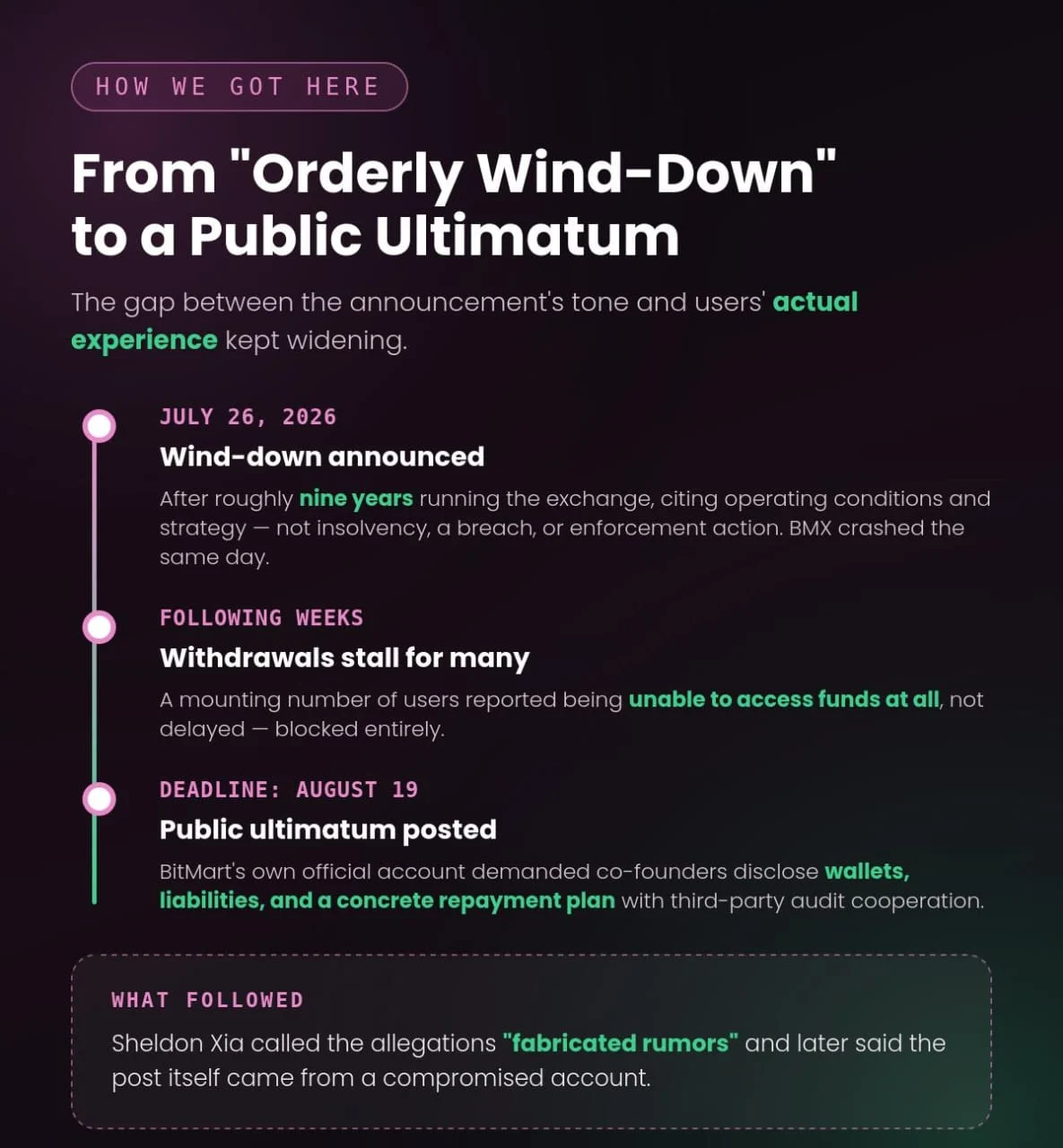
The immediate catalyst for the current crisis was BitMart’s official announcement on July 26, 2023, declaring an "orderly wind-down" of its operations. The company cited "operating conditions, market environment, and future strategic direction" as the primary reasons for its decision to cease exchange services after approximately nine years in business. Crucially, the announcement conspicuously avoided mentioning any specific insolvency event, security breach, or regulatory enforcement action as the impetus for the closure. This carefully worded statement projected an image of a strategic, controlled exit from the market, designed to minimize alarm and assure users of a smooth transition.
The market’s immediate reaction, however, betrayed a deeper unease. BitMart’s native token, BMX, experienced a sharp decline in value on the day of the announcement, reflecting investor apprehension and a lack of confidence in the exchange’s future. While the company presented its closure as a calm, business-as-usual strategic shift, the reality that unfolded in the subsequent weeks painted a starkly different picture. The expectation of an orderly process – one where users receive clear timelines, timely notifications, and unimpeded access to their funds – quickly dissolved as reports of withdrawal difficulties began to surface and multiply.
Mounting User Frustration and the Chinese Community’s Ultimatum
In the weeks following the July 26 announcement, the narrative shifted from an "orderly wind-down" to one of escalating user frustration and systemic failure. A significant and rapidly increasing number of BitMart users reported being completely unable to access their funds, far beyond a mere delay. These were not isolated incidents but a growing chorus of complaints across various social media platforms and crypto forums, painting a grim picture of blocked accounts, failed transactions, and unresponsive customer support. Users detailed experiences of withdrawal requests being perpetually "pending," or outright rejected without clear explanation, leading to immense anxiety and financial strain.
The boiling point was reached when BitMart’s own official Chinese-language account on a prominent social media platform posted an extraordinary and direct ultimatum. Addressed to the exchange’s co-founders, Sheldon Xia and Nancy Li, the post demanded a full accounting of user funds by August 19, 2023. The demands were specific and uncompromising:
- Full disclosure of all user fund wallets.
- Transparency regarding the exchange’s liabilities.
- A concrete repayment plan with specific dates for disbursements.
- Cooperation with an independent third-party audit to verify financial health.
The Chinese-language post did not mince words regarding the high stakes involved. It explicitly stated that for many everyday users, the funds locked within BitMart represented "a lifetime’s savings," highlighting the devastating potential impact of the ongoing withdrawal freeze. Furthermore, it revealed that BitMart employees were reportedly awaiting unpaid salaries and compensation, indicating a broader financial distress within the company beyond just user assets. This internal, public challenge from one of the exchange’s own official channels sent shockwaves through the crypto community, fundamentally undermining BitMart’s carefully constructed narrative of a controlled wind-down. It transformed individual complaints into a collective, public demand for accountability and transparency.
Contradictory Responses and Erosion of Trust
The leadership’s response to this unprecedented ultimatum was both swift and contradictory, further exacerbating the trust deficit. Sheldon Xia, BitMart’s CEO, initially dismissed the allegations contained in the ultimatum post as "fabricated rumors" and threatened legal action against those disseminating such claims. This strong denial aimed to reassert control over the narrative and quash dissent. However, this stance was almost immediately challenged by prominent crypto sleuth ZachXBT, who publicly questioned Xia’s claims, asking why, if BitMart genuinely possessed the necessary liquidity, the exchange simply didn’t return user funds instead of issuing vague denials. ZachXBT’s intervention, given his track record of exposing scams and irregularities in the crypto space, lent significant credibility to the user complaints and the ultimatum’s demands.
In a subsequent development that further complicated the situation, Sheldon Xia attributed the Chinese-language ultimatum post to a "hack," claiming that BitMart’s account had been compromised and the post was unauthorized. The post was subsequently removed. This explanation, however, was met with widespread skepticism. The specificity and internal details of the ultimatum’s demands made a simple "hack" explanation difficult to swallow for many, suggesting instead a possible internal revolt or a desperate attempt to distance leadership from inconvenient truths. The oscillating and inconsistent responses from BitMart’s leadership only served to deepen suspicions about the true state of the exchange’s finances and its commitment to user protection.
The $58,000 Withdrawal: A Double-Edged Revelation
It is within this volatile and uncertain environment that the successful $58,000 withdrawal gained prominence. This single transaction, after a two-week processing period, provides a nuanced and somewhat contradictory picture of BitMart’s current operational status. On one hand, it undeniably confirms that BitMart’s systems are still capable of processing legitimate withdrawal requests. It serves as concrete proof that funds can indeed move, at least in some instances, and that the exchange has not entirely ceased operations or gone "dark" on all users simultaneously. For those still anxiously waiting, this information is genuinely meaningful, offering a sliver of hope that their own funds might eventually be retrieved.
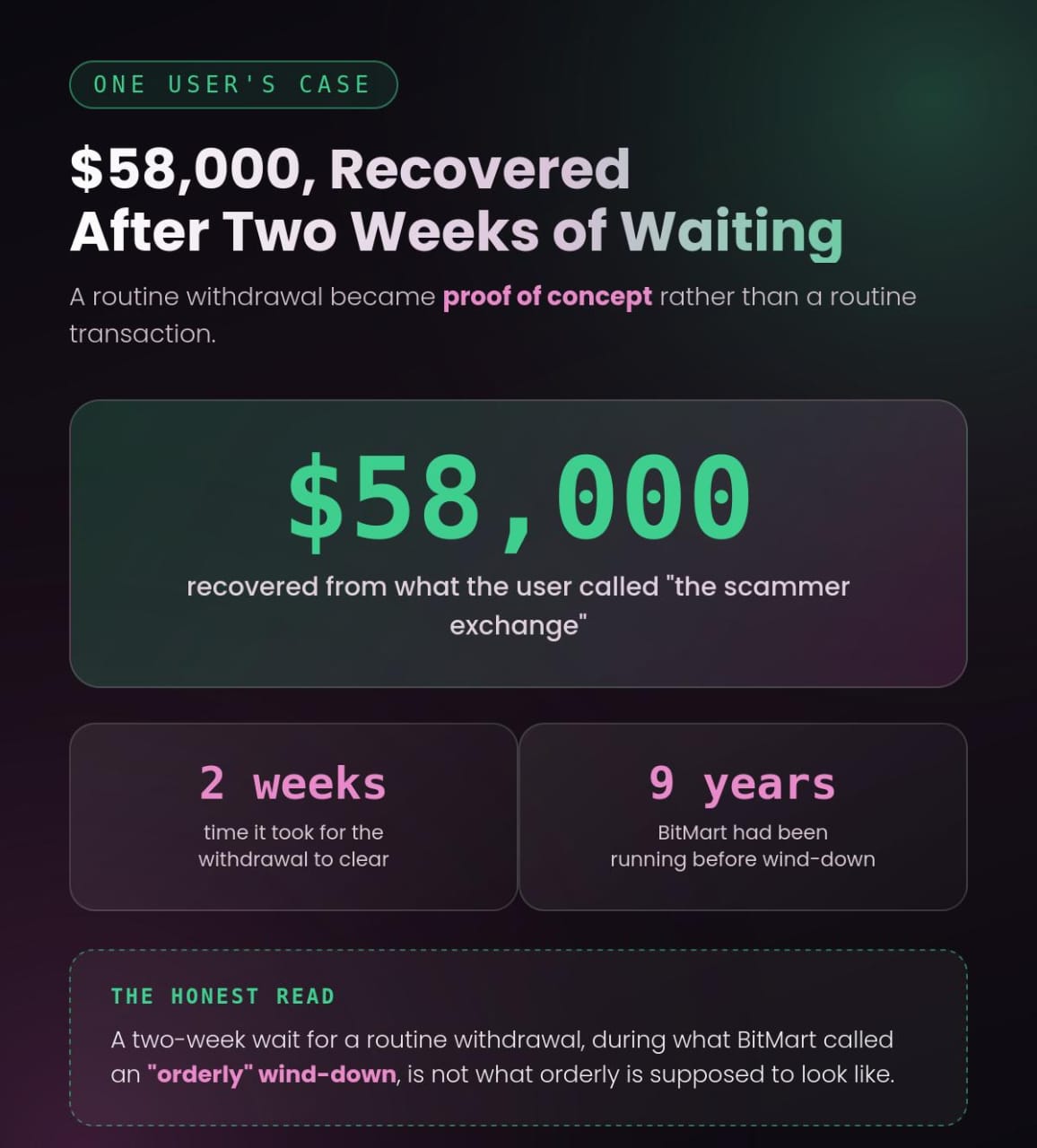
On the other hand, the very fact that a two-week processing time for a substantial withdrawal is considered a "victory" speaks volumes about the systemic dysfunction. During what BitMart itself described as an "orderly wind-down," such protracted delays are unequivocally not indicative of an efficient or well-managed closure process. An "orderly" wind-down implies a smooth, timely, and predictable return of assets to users, not a protracted battle requiring immense patience and public pressure. Therefore, while the successful withdrawal is a positive outcome for the individual user, it simultaneously exposes the underlying inefficiencies and the profound challenges that BitMart is facing in fulfilling its obligations. It represents the system working, eventually, but under conditions that should be entirely unacceptable for any financial institution.
Broader Implications: Eroding Trust in Centralized Exchanges
The saga of BitMart’s wind-down transcends the individual stories of users struggling to retrieve their funds; it serves as a stark case study in the broader implications for the cryptocurrency industry, particularly concerning centralized exchanges. The gaping chasm between BitMart’s official announcement of an "orderly wind-down" and the lived reality of weeks-long waits, mounting frustration, and an internal public ultimatum is precisely the kind of disparity that erodes trust in an entire industry, not just a single platform.
In an ecosystem still striving for mainstream acceptance and regulatory clarity, such incidents amplify skepticism among potential new entrants and reinforce the concerns of traditional financial institutions. They highlight the inherent risks associated with entrusting assets to third-party custodians in a largely unregulated or inconsistently regulated environment. The BitMart situation, following a string of high-profile failures and collapses within the crypto space (e.g., FTX, Terra/Luna, Celsius), contributes to a narrative of instability and unreliability that can impede the industry’s growth and innovation. It underscores the critical need for greater transparency, robust regulatory frameworks, and stringent accountability measures for all centralized crypto service providers. For users, it serves as a potent reminder of the "not your keys, not your coins" mantra, advocating for self-custody solutions where possible.
The Road Ahead: An Uncertain Future Awaits BitMart Users
The coming weeks are poised to be far more consequential than this single recovery story. The August 19 deadline, set by BitMart’s own Chinese account, for leadership to provide a comprehensive disclosure of user funds and a concrete repayment plan, remains a critical juncture. Whether this deadline culminates in genuine transparency and a viable path forward for users, or merely another round of vague reassurances and evasions, will significantly shape the future for those with locked assets.
Until such definitive answers emerge, stories like the $58,000 withdrawal will continue to circulate as the clearest, albeit piecemeal, real-time evidence of BitMart’s operational status. They offer a cautious encouragement, suggesting that some withdrawals are indeed processing, albeit slowly and inconsistently. However, the fundamental questions raised by the ultimatum – regarding the precise location and security of user funds, BitMart’s actual liability picture, and the feasibility of a transparent, equitable repayment plan – remain largely unanswered. The BitMart community, and indeed the broader crypto world, will be watching closely to see if the exchange can finally deliver on its promise of an "orderly wind-down" or if it will continue to leave a significant portion of its users stranded, waiting far longer than anyone should for access to their own financial assets. The resolution, or lack thereof, will undoubtedly contribute to the ongoing global discourse on cryptocurrency exchange regulation, user protection, and the imperative for true transparency in the digital asset landscape.