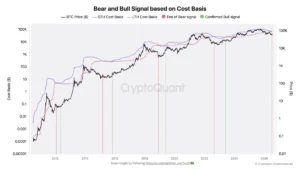
Mike McGlone, a senior commodity strategist at Bloomberg Intelligence, has presented a stark forecast for Bitcoin (BTC), predicting a potential descent to $10,000 by 2026. This projection is underpinned by a confluence of factors, including a significant shift in the digital asset landscape towards stablecoins and anticipated macroeconomic turbulence. McGlone’s analysis suggests a fundamental re-evaluation of Bitcoin’s value proposition is imminent, potentially leading to a dramatic "flippening" where stablecoins, particularly Tether, surpass established cryptocurrencies in dominance.
The Case for a Bitcoin Reversion to $10,000
McGlone’s central thesis revolves around the idea that Bitcoin may be reverting to a price point that reflects its historical trading activity and its foundational role in the cryptocurrency ecosystem. He posits that the cryptocurrency could revisit significantly lower levels, drawing a parallel to its pre-2020-21 "money pump" era when Bitcoin prices hovered around $10,000. This period, preceding a significant influx of capital into the market, is seen as a benchmark for a potential price recalibration.
"Potential $10,000 Bitcoin in 2026. Prove me wrong – stay above $75,000," McGlone stated in a recent commentary, challenging the prevailing bullish sentiment. He further elaborates that approximately $10,000 represents the most traded price for Bitcoin since 2017, the year cryptocurrency futures were launched. This price point, he argues, is significant because it reflects a more established and perhaps less speculative trading range for the "first-born crypto."
The Rise of Stablecoins and the "Flippening"
A key driver of McGlone’s bearish outlook for Bitcoin is the ascendant trajectory of stablecoins. He highlights that in an ecosystem now populated by "millions of cryptos," only a select few possess tangible value. Among these, dollar-backed tokens, with Tether (USDT) at the forefront, are identified as representing "a most enduring trend in the space." The continuous growth in assets under management (AUM) for these stablecoins signifies a fundamental shift in how capital is being allocated and utilized within the digital asset sphere.
McGlone predicts a "flippening" that will see Tether’s AUM surpass Ethereum’s by 2026, and ultimately, challenge Bitcoin’s market capitalization. This scenario suggests a potential migration of capital from riskier, more volatile assets like Bitcoin towards the perceived stability and utility of stablecoins. The rationale behind this shift, according to McGlone, is that "unlimited crypto supply and use-case rivals are Bitcoin headwinds." While Bitcoin’s supply is capped at 21 million coins, the proliferation of new digital assets and the increasing utility of stablecoins for transactions and value storage are creating competitive pressures.
Macroeconomic Pressures and Market Volatility
Beyond the internal dynamics of the crypto market, McGlone emphasizes the impact of broader macroeconomic conditions. He points to the potential for a stock market rollover and a subsequent recovery in volatility as significant catalysts that could weigh on cryptocurrency prices, including Bitcoin. A downturn in traditional financial markets often leads to a flight to safety, which could see investors divest from riskier assets across the board.
The analyst’s prediction of Bitcoin experiencing "first-ever consecutive down years in 2026" suggests a prolonged period of price decline, potentially exacerbated by these external economic shocks. The historical correlation between Bitcoin and the broader stock market, particularly during periods of heightened uncertainty, supports this view. As institutional investors increasingly allocate capital to digital assets, Bitcoin’s performance becomes more susceptible to systemic market risks.
Historical Context and Data
To understand McGlone’s forecast, it’s crucial to examine Bitcoin’s historical price movements and the evolution of the cryptocurrency market.
- Early Days and the $10,000 Benchmark: In the years leading up to 2020, Bitcoin experienced significant price fluctuations. However, periods where it traded around the $10,000 mark were often characterized by either consolidation or the early stages of bull runs. For instance, in late 2019 and early 2020, Bitcoin was trading in the low $10,000s before the massive rally that began in late 2020.
- The 2020-2021 Bull Run: This period saw Bitcoin surge to all-time highs, driven by institutional adoption, retail interest, and accommodative monetary policies. The narrative shifted towards Bitcoin as a potential hedge against inflation and a store of value.
- The Emergence of Stablecoins: While stablecoins have existed for years, their adoption has accelerated rapidly. Tether, launched in 2014, has consistently been the largest stablecoin by market capitalization. Its utility in facilitating trading on exchanges, providing a bridge between fiat and crypto, and serving as a refuge during volatile periods has cemented its position. The total market cap of stablecoins has grown from tens of billions to over $150 billion in recent years, according to various market data providers.
- Ethereum’s Market Dominance: Ethereum, the second-largest cryptocurrency by market cap, has seen its utility expand significantly with the growth of decentralized finance (DeFi) and non-fungible tokens (NFTs). However, its market capitalization, while substantial, has historically been outpaced by Bitcoin. McGlone’s prediction of Tether’s AUM surpassing Ethereum’s by 2026 implies a substantial shift in market sentiment and capital flows.
Analysis of Implications
McGlone’s outlook, if realized, would have profound implications for the cryptocurrency market:
- Re-evaluation of Bitcoin’s Role: A significant price drop to $10,000 would challenge the narrative of Bitcoin as an inevitable digital gold or a primary inflation hedge. It could signal a period of fundamental reassessment of its long-term value proposition, potentially leading to a more cautious approach from investors.
- Dominance of Stable Value: The ascendancy of stablecoins would underscore their growing importance as a foundational element of the digital asset ecosystem. They would function not just as trading tools but as reliable stores of value within the crypto space, potentially attracting a broader range of users and capital seeking stability.
- Impact on Altcoins: A sharp decline in Bitcoin’s price often has a cascading effect on altcoins, which tend to be more volatile. If Bitcoin falters, many smaller cryptocurrencies could face severe price corrections or even disappear.
- Regulatory Scrutiny: The increasing prominence of stablecoins, particularly large ones like Tether, is already attracting regulatory attention globally. A further surge in their market share could intensify calls for stricter oversight, focusing on reserves, transparency, and systemic risk.
- Shift in Investment Strategies: Investors might pivot from speculative bets on volatile cryptocurrencies to a more conservative strategy focused on stablecoins and perhaps Bitcoin only if it demonstrates resilience at lower price points or if macroeconomic conditions drastically change.
Broader Market Context and Expert Opinions
The cryptocurrency market is notoriously cyclical, characterized by periods of rapid growth followed by sharp corrections. McGlone’s view, while bearish, aligns with concerns expressed by some market analysts regarding the sustainability of current valuations in the face of potential economic headwinds.
Other market participants, however, maintain a more optimistic long-term outlook for Bitcoin, citing its inherent scarcity, growing adoption by institutional players, and its potential as a decentralized alternative to traditional financial systems. The development of Bitcoin’s Layer 2 solutions, such as the Lightning Network, aims to enhance its scalability and utility for everyday transactions, which could provide long-term support for its value.
The narrative surrounding digital assets is continually evolving. While McGlone’s forecast presents a challenging scenario for Bitcoin, the broader crypto market is a complex interplay of technological innovation, investor sentiment, regulatory developments, and macroeconomic forces. The coming years will likely be crucial in determining whether Bitcoin consolidates its position as a primary digital asset or faces a significant paradigm shift driven by the rise of more stable and utility-focused digital currencies.
The Bloomberg Intelligence strategist’s analysis serves as a potent reminder of the inherent volatility and the multifaceted risks associated with the cryptocurrency market. Investors are advised to conduct thorough due diligence and consider their risk tolerance before making any investment decisions in this dynamic and rapidly changing asset class. The potential for a significant price correction, as outlined by McGlone, underscores the importance of a cautious and well-informed approach to navigating the future of digital finance.