The native token of the Binance ecosystem, BNB, has successfully reasserted its dominance in the cryptocurrency market rankings, reclaiming its position as the fourth-largest digital asset by market capitalization after a decisive move past XRP in mid-May. While the immediate battle for the third-runner-up spot appears settled for the time being, a new wave of technical and fundamental analysis is shifting the focus toward much more ambitious milestones. Recent projections from market analysts suggest that while a return to previous all-time highs and a push toward the $2,000 mark remains a grounded possibility, the prospect of BNB reaching a valuation of $10,000 or $20,000 per token would require a fundamental restructuring of the global digital asset economy.
As of late May 2024, BNB maintains a robust market capitalization of approximately $80.6 billion. This valuation places it behind only Bitcoin (BTC), Ethereum (ETH), and the leading stablecoin, Tether (USDT). The asset’s recent price action has been characterized by a steady recovery following a period of intense regulatory scrutiny and leadership transition within its parent exchange, Binance. However, the discourse surrounding the token has shifted from mere survival to aggressive expansion, with popular analysts now debating the upper limits of its price discovery phase.
The Mathematical Framework of the 10,000 Dollar Target
A comprehensive breakdown published by the prominent crypto analyst known as Crypto Patel has brought a sense of mathematical realism to the often-hyperbolic world of price predictions. To understand the feasibility of a $10,000 BNB, one must look past the price per unit and examine the implied market capitalization. Currently, BNB’s circulating supply is subject to a programmatic "Auto-Burn" mechanism designed to eventually reduce the total supply to 100 million tokens.
Under the assumption that this 100-million-token target is eventually reached, a price of $10,000 per BNB would result in a total market capitalization of $1 trillion. To put this figure into perspective, a $1 trillion valuation is roughly equivalent to the entire market capitalization of Bitcoin during its major bull cycles. For a single utility token—even one as deeply integrated as BNB—to command a trillion-dollar valuation, the broader crypto market would likely need to expand to a total valuation exceeding $10 trillion or $15 trillion.

The analysis becomes even more staggering when considering a $20,000 price target. At that level, BNB would represent a $2 trillion asset. This figure currently exceeds the combined value of the entire cryptocurrency market as it stands today. Crypto Patel noted that any near-term projections of $20,000 are likely based on marketing hype rather than sound financial analysis. Such a valuation would place BNB in the same league as global tech giants like Apple, Microsoft, or Nvidia, requiring an unprecedented level of institutional adoption and utility that spans far beyond the current scope of the Binance ecosystem.
The Path to Overtaking Ethereum
While the $10,000 mark remains a long-term theoretical goal, the more immediate objective for many BNB bulls is the "flippening" of Ethereum. Having already distanced itself from XRP, the next logical milestone in the hierarchy is the number two spot currently held by ETH.
The gap between BNB and Ethereum remains significant but is not insurmountable under specific market conditions. At current supply levels, BNB would need to reach a price point of approximately $1,500 to match Ethereum’s current market capitalization of roughly $203 billion—assuming Ethereum’s price remains static. Historically, BNB has shown a tendency to outperform Ethereum during periods of high retail activity, primarily due to the lower transaction costs on the BNB Chain compared to Ethereum’s Mainnet.
However, a "static" comparison is rarely reflective of reality. In a typical bull market, Ethereum is expected to rise alongside the rest of the sector. For BNB to actually overtake Ethereum, it would need to see a massive influx of Total Value Locked (TVL) in its decentralized finance (DeFi) protocols and a significant increase in its Real World Asset (RWA) tokenization projects. Recent data suggests that the BNB Chain is already making strides in this area, with the total value of RWAs on the network recently hitting the $3 billion mark.
Chronology of Recent Developments and Market Recovery
The journey of BNB over the last 18 months has been one of the most volatile and scrutinized in the industry. To understand where the price is going, it is essential to look at the timeline of events that have shaped its current standing:

- November 2023: Binance reaches a historic $4.3 billion settlement with the U.S. Department of Justice (DOJ) and the Commodity Futures Trading Commission (CFTC). Changpeng Zhao (CZ) steps down as CEO, and Richard Teng takes the helm. BNB experiences a sharp but brief decline.
- Q1 2024: Under the leadership of Richard Teng, Binance shifts its focus toward "compliance-first" growth. The BNB Chain introduces several technical upgrades to improve scalability and reduce gas fees further.
- March – April 2024: BNB begins a steady climb, buoyed by the general market optimism surrounding the Bitcoin Spot ETFs. The token reclaims the $600 level, signaling a return of investor confidence.
- May 2024: BNB successfully overtakes XRP in market cap rankings. The "burn" mechanism continues to remove millions of dollars worth of BNB from circulation, increasing the scarcity of the remaining tokens.
- June 2024 (Projected/Current Analysis): Discussions regarding a potential BNB Spot ETF emerge following the surprising approval of Ethereum Spot ETFs by the SEC. Analysts begin projecting targets between $2,000 and $3,000 for the 2025 cycle.
The "Binance Concentration" Risk
Despite the bullish sentiment, the analysis by Crypto Patel and other industry experts highlights a critical structural vulnerability: the "Binance concentration" risk. Unlike Bitcoin, which is decentralized and has no single point of failure, or Ethereum, which has a diverse array of developers and stakeholders, the value of BNB is inextricably linked to the health and success of the Binance exchange.
Every major value driver for BNB—the burn mechanism, its utility for trading fee discounts, its role in Launchpad events, and its use as gas on the BNB Chain—is either directly controlled by or adjacent to Binance. This creates a "key man" or "key institution" risk. Any regulatory action, legal setback, or operational failure at Binance would immediately and severely impact the price of BNB.
While the 2023 settlement with U.S. authorities removed a significant cloud of uncertainty, the exchange remains under a five-year monitorship. Any breach of the settlement terms could lead to renewed volatility. For BNB to reach the $10,000 level, it would likely need to evolve into a more "exchange-agnostic" asset, where the BNB Chain’s independent ecosystem becomes a larger driver of value than the exchange itself.
Institutional Adoption and the ETF Prospect
A major catalyst that could bridge the gap between the current $600 range and the $2,000+ target is the introduction of institutional investment vehicles. Following the success of Bitcoin ETFs and the preliminary approval of Ethereum ETFs, the market has begun to speculate on which altcoin is next in line.
BNB is a primary candidate due to its high liquidity and significant market cap. However, its classification remains a point of contention. While the SEC has not officially designated BNB as a security in the same way it has other tokens, the historical link between the token’s sale and the exchange’s growth remains a point of regulatory focus. If a BNB ETF were to be approved in the United States or other major financial hubs like Hong Kong, it would provide the "wall of money" necessary to push the market cap toward the $300 billion to $500 billion range.
Future Outlook: 2025 to 2029
The "believable bull case" for the upcoming 12 to 18 months involves BNB reclaiming its previous all-time high and pushing toward the $3,000 level. This would represent a roughly 5x return from current levels and would likely occur in the context of a broader market peak.
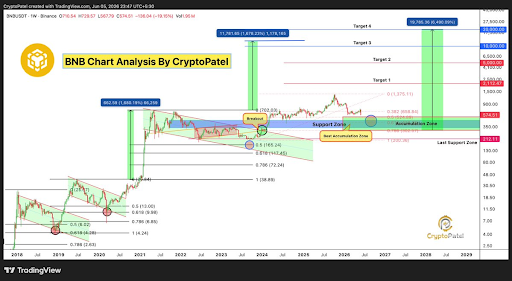
For the $10,000 and $20,000 scenarios, analysts point toward a much longer horizon. Crypto Patel’s chart projections suggest that a trajectory toward the $20,000 range would not be mathematically or economically feasible until at least 2029. This timeline accounts for multiple "halving cycles" in the broader crypto market and assumes a consistent reduction in BNB supply through the burn mechanism.
In conclusion, while the $10,000 target for BNB makes for compelling headlines, it remains a mathematical "moonshot" that requires the entire cryptocurrency industry to grow by an order of magnitude. In the interim, the focus for investors remains on BNB’s ability to maintain its lead over XRP and its potential to challenge Ethereum for the silver medal of the crypto world. The asset’s success will ultimately depend on its ability to transition from an exchange-centric utility token to a foundational pillar of decentralized finance and global digital infrastructure.