
The digital asset landscape has witnessed a significant shift in recent weeks as BNB, the native utility token of the BNB Chain ecosystem, has successfully reclaimed its position among the top tier of the cryptocurrency market. After a period of intense competition and market volatility, BNB managed to surpass XRP in total market capitalization during May, solidifying its status as the fourth-largest cryptocurrency by market value, excluding stablecoins. However, as the asset stabilizes in this higher echelon, the focus of analysts and investors has shifted from immediate competitive skirmishes to long-term valuation ceilings. New technical and fundamental analyses are now grappling with the feasibility of BNB reaching unprecedented price levels, ranging from $2,000 to as high as $20,000, and the macroeconomic conditions required to sustain such growth.
The primary catalyst for this renewed discussion is the evolving market structure and the aggressive deflationary mechanisms built into the BNB ecosystem. While a move toward previous all-time highs is viewed by many as a logical progression in a bullish market cycle, the prospect of a five-figure BNB price tag introduces a complex set of mathematical and economic hurdles. To understand the trajectory of BNB, one must look beyond simple price charts and examine the underlying market capitalization requirements, the competitive landscape against Ethereum, and the systemic risks associated with the asset’s close ties to the Binance exchange.
The Mathematical Reality of a Ten Thousand Dollar Valuation
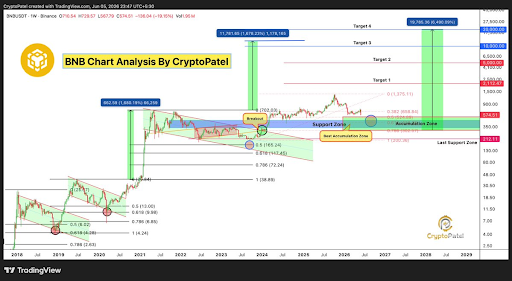
The discourse surrounding BNB’s potential peak often involves astronomical figures that challenge current market logic. Crypto Patel, a prominent market analyst, recently provided a comprehensive breakdown of what these price targets would mean in terms of global market share. At its current valuation, BNB holds a market capitalization of approximately $80.6 billion. For the asset to reach the $10,000 mark, the math requires a fundamental shift in the entire crypto industry’s scale.
BNB operates on a long-term "burn" trajectory, with a stated goal of reducing the total supply from its original 200 million tokens to a final target of 100 million. Assuming this 100 million supply target is eventually reached, a $10,000 price per token would imply a total market capitalization of $1 trillion. To put this in perspective, $1 trillion is roughly equivalent to the current market capitalization of Bitcoin, the world’s first and largest cryptocurrency. For BNB to achieve this, it would essentially need to occupy the same space in the financial ecosystem that Bitcoin holds today, or the entire cryptocurrency market would need to expand by a factor of five to ten.

The projections become even more speculative when discussing a $20,000 price target. At such a level, BNB would command a $2 trillion valuation. This figure exceeds the combined value of the entire cryptocurrency market as it exists in the current environment. As noted by analysts, any suggestion that BNB could reach $20,000 in the near term likely ignores the constraints of global liquidity and capital allocation. Such a valuation would place BNB in the same league as the world’s largest tech conglomerates, such as Apple or Microsoft, necessitating a level of institutional adoption and utility that has yet to be realized in the blockchain sector.
The Competitive Struggle with Ethereum and the Flippening Narrative
While the $10,000 target remains a long-term "moonshot," the more immediate challenge for BNB is its positioning relative to Ethereum. Having already displaced XRP, BNB’s next major milestone is narrowing the gap with the second-largest cryptocurrency. This "flippening" narrative—where a smaller asset overtakes a larger one—is a recurring theme in crypto circles, but the data suggests that BNB has a significant climb ahead.
Currently, for BNB to match Ethereum’s market capitalization of approximately $203 billion (using current static figures), the price of BNB would need to rise to roughly $1,500. This level is slightly above its previous all-time high of approximately $1,370, which was reportedly reached in late 2025 according to some projected market cycles. However, this comparison assumes that Ethereum remains stagnant while BNB rallies. In a typical bull market, assets tend to move in correlation; if BNB rises to record levels, Ethereum is likely to experience a concurrent surge, effectively moving the goalposts for any potential takeover.
The rivalry between the two networks is not merely a matter of price but of ecosystem health. Ethereum remains the dominant force in decentralized finance (DeFi) and non-fungible tokens (NFTs) in terms of total value locked (TVL) and developer activity. However, BNB Chain has carved out a massive niche by offering lower transaction fees and faster confirmation times, making it a preferred hub for retail-focused applications and stablecoin transactions. For BNB to truly challenge Ethereum’s market cap, it must continue to attract high-value projects and institutional interest, particularly in the realm of Real World Assets (RWAs) and enterprise-grade blockchain solutions.
The Binance Concentration Risk and Structural Vulnerabilities
A critical factor in BNB’s valuation that cannot be overlooked is the "Binance concentration risk." Unlike Bitcoin or Ethereum, which are highly decentralized in their governance and development, BNB is intrinsically linked to the fortunes of the Binance exchange. The token’s primary utility—ranging from trading fee discounts to participation in the Binance Launchpad—is centered on the exchange’s platform.

This centralization creates a unique risk profile. Almost every driver of BNB’s value, including the quarterly burn mechanism, on-chain activity on the BNB Chain, and institutional custody services, runs through or is adjacent to Binance. Consequently, any regulatory pressure, legal challenges, or operational setbacks faced by the exchange have a direct and often magnified impact on the price of BNB. Recent years have seen Binance navigate a complex global regulatory landscape, including settlements with United States authorities and shifts in leadership. While the exchange has shown resilience, the "Key Man Risk" and the "Platform Risk" remain significant hurdles for investors who might otherwise view BNB as a purely decentralized utility token.
Historical Chronology and the Evolution of BNB
To understand where BNB is going, one must look at where it has been. Launched in 2017 through an Initial Coin Offering (ICO), BNB was originally an ERC-20 token on the Ethereum network. Its primary purpose was to provide a discount to traders on the then-new Binance exchange. However, the asset’s evolution has been rapid:
- 2019: The Launch of Binance Chain. BNB migrated to its own native blockchain, focusing on high-speed decentralized trading via the Binance DEX.
- 2020: The Introduction of Binance Smart Chain (BSC). This was a pivotal moment, as BSC introduced smart contract functionality and Ethereum Virtual Machine (EVM) compatibility, allowing developers to port Ethereum dApps to a more affordable environment.
- 2022: Rebranding to BNB Chain. The network sought to distance itself from the exchange’s name to emphasize its growing decentralization and community-driven nature.
- 2023-2024: Regulatory Navigation. Following the departure of founder Changpeng "CZ" Zhao and a massive settlement with the DOJ, the ecosystem focused on compliance and institutional-grade infrastructure.
This timeline demonstrates that BNB is no longer just a "discount coupon" for an exchange; it has become the gas for a massive, multi-chain ecosystem. This fundamental shift is what fuels the "believable bull case" of $3,000, as the token captures value from every transaction occurring on its underlying network.
Institutional Interest and the Road Ahead
The prospect of a BNB Exchange-Traded Fund (ETF) has also entered the conversation, following the approval of Bitcoin and Ethereum ETFs in the United States. Recent amendments by major asset managers like Grayscale and VanEck have sparked rumors that a BNB-based institutional product could be on the horizon. If an ETF were to be approved, it would provide a massive influx of "sticky" institutional capital, potentially providing the liquidity needed to push the asset toward the $2,000–$3,000 range.
However, the path to $10,000 or $20,000 remains a marathon, not a sprint. Analysts like Crypto Patel suggest that while these targets are mathematically possible in a world where crypto becomes a multi-trillion-dollar asset class, the timeline for such a move likely extends into 2029 and beyond. This trajectory would require the BNB Chain to become the backbone of global digital finance, processing millions of transactions daily across DeFi, gaming, and traditional finance integrations.
Implications for the Broader Market
The rise of BNB serves as a barometer for the health of the broader "Exchange Token" and "Layer 1" sectors. If BNB can maintain its growth and successfully decouple its price action from the immediate news cycles of the Binance exchange, it could pave the way for other ecosystem tokens to achieve similar institutional status. Conversely, if BNB struggles to overcome its concentration risks, it may serve as a cautionary tale about the limits of exchange-backed digital assets.
In conclusion, the analysis of BNB’s future price points reveals a dichotomy between realistic growth and speculative ambition. A return to all-time highs and a push toward $3,000 appears fundamentally supported by the network’s burn mechanism and growing utility. However, the journey to $10,000 and beyond is contingent upon a global expansion of the cryptocurrency market that has yet to occur. For now, BNB remains a dominant force, but its ultimate ceiling will be determined as much by global regulatory clarity and market expansion as by its own internal technological milestones.