


The global cryptocurrency ecosystem has undergone a profound transformation between July 2025 and June 2026, navigating a period characterized by unprecedented price volatility and a significant shift in user behavior. According to the latest comprehensive analysis of on-chain data, the world’s crypto economy—a metric combining service inflows, domestic peer-to-peer (P2P) activity, and cross-border transfers—demonstrated remarkable resilience, shrinking by a mere 1.6% to $9.4 trillion despite a massive 50% contraction in total market capitalization. This stability in the face of a $2.1 trillion market drawdown suggests that the industry is successfully transitioning from a purely speculative phase to one defined by diverse, real-world utility. While Western capital allocators increasingly view digital assets as a necessary technological upgrade for asset tokenization, users in the Global South have embraced stablecoins and P2P networks as essential financial lifelines against economic instability and political uncertainty.
A Year of Extreme Market Turbulence
The reporting period from July 1, 2025, to June 30, 2026, recorded some of the most dramatic price movements in the history of digital assets. At the start of the cycle, Bitcoin surged to a new all-time high, buoyed by institutional adoption and favorable regulatory signals in major economies. However, this peak was followed by the largest dollar-value retreat ever recorded for the asset, with Bitcoin losing $67,000 from its high to its eventual trough. This downward pressure triggered a broader market correction that erased $2.1 trillion in total value, marking the most severe bear market since the high-profile collapses and scandals of late 2022.

Despite this "crypto winter," the underlying economic activity remained robust. In previous bear markets, such as the 2023 period, a much smaller contraction in market capitalization (-$0.3 trillion) resulted in a significantly larger drop in global value flows, which fell by 23% or $1.2 trillion. In contrast, the 2026 drawdown saw value flows dip by only $0.1 trillion. This divergence indicates that the crypto economy is no longer solely tethered to price speculation; rather, it is being sustained by a growing variety of use cases that remain active regardless of asset valuations.
The Surge of Retail Participation and P2P Activity
One of the most surprising findings of the 2026 period was the sharp growth in retail-sized transfers. While large-scale institutional activity often dominates headlines, small-dollar inflows into cryptocurrency services surged. Transfers valued at under $100 grew by 78.4%, while those between $100 and $1,000 rose by 58.6%. Although these retail transactions represent a relatively small portion of the total $9.4 trillion in activity—approximately $273 billion—the growth rate suggests that everyday users are increasingly integrating cryptocurrency into their financial habits, even during periods of declining prices.
Simultaneously, the world witnessed a massive rally in peer-to-peer activity. As centralized services and decentralized finance (DeFi) protocols saw a slight decline in value inflows (falling 4.3% from $9.30 trillion to $8.90 trillion), the value moving directly between personal wallets within countries skyrocketed. P2P activity rose by 302.9%, jumping from $56.8 billion to $228.7 billion. This shift was most pronounced in regions where traditional financial infrastructure is either expensive or inaccessible. P2P transactions now account for 2.5% of the total crypto economy, up from just 0.6% in the previous year, with stablecoins making up a staggering 96% of this direct wallet-to-wallet volume.

Stablecoins: The New Anchor of Global Commerce
Stablecoins have emerged as the primary driver of market resilience, acting as a stable "anchor" amidst the volatility of unpegged assets like Bitcoin and Ethereum. As of June 2026, stablecoin balances on-chain held steady between $98 billion and $109 billion throughout the nine-month drawdown, even as other assets lost more than 55% of their value. By the end of the reporting period, stablecoins accounted for 22.5% of all global on-chain balances.
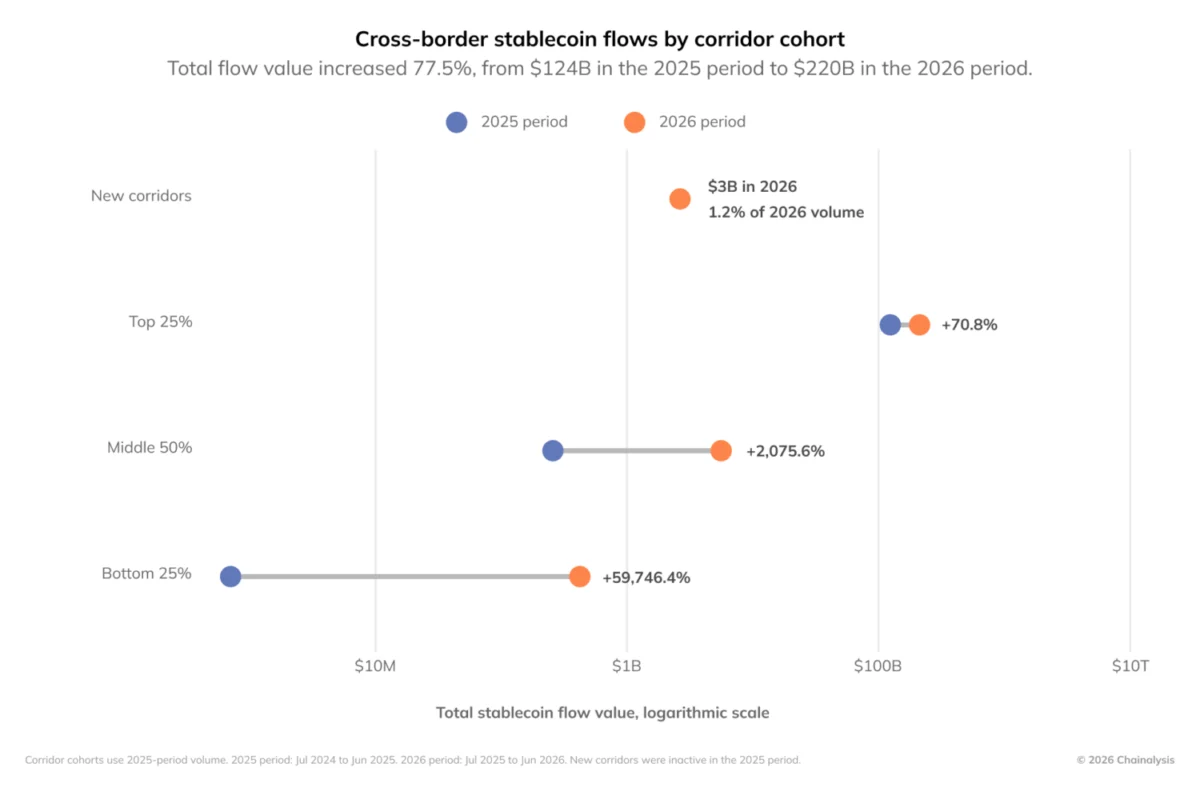
The growth in cross-border stablecoin transfers has been particularly impactful. Monthly cross-border value more than doubled, rising from $11 billion in January 2025 to $24 billion by June 2026. Total stablecoin value moving across borders for the year reached $220.3 billion, a 77.5% increase. Analysis of transaction sizes suggests that this growth is not driven by institutional speculation but by business and personal needs. The average transaction size of approximately $3,000 aligns with small-business payments to suppliers, remittances to family members, and individuals moving savings out of volatile local currencies.
Philip Gradwell, Vice President of Economics at Tether, noted that the rhythm of this activity has become consistent and steady, rather than occurring in speculative bursts. Gradwell emphasized that the "long tail" of the economy—segments previously excluded from traditional finance due to high costs—is now being served by assets like USDT, which offer near-instant settlement for a fraction of the cost of legacy wire transfers.

Regulatory Frameworks and Regional Leaders
The adoption of stablecoins has been further accelerated by the emergence of clear regulatory frameworks in key jurisdictions. The implementation of the GENIUS Act in the United States, along with the continued maturation of the Markets in Crypto-Assets (MiCA) regulation in the European Union, has provided a level of legal certainty that was previously lacking. Similar legislative actions in Japan, Hong Kong, Singapore, and the United Kingdom have encouraged both businesses and retail users to adopt dollar-pegged assets for trade and settlement.
On a regional level, Latin America and Sub-Saharan Africa led the world in growth. Latin America’s crypto economy grew by 9.8%, defying the global downward trend. This growth was driven by a collective pivot toward stablecoins as a hedge against local currency volatility. Sub-Saharan Africa, meanwhile, led the world in P2P growth, reinforcing the region’s reputation as a pioneer in grassroots digital asset adoption.
Brazil: The Global Leader in Grassroots Adoption
For the first time, Brazil has claimed the top spot in the global grassroots adoption index. Brazil’s success is attributed to its consistent performance across multiple metrics rather than dominance in a single category. The country’s $252.5 billion crypto economy has proven to be exceptionally resilient, outperforming more established markets like the United States in terms of relative growth and participation.

The top five countries for grassroots adoption in 2026 are:
- Brazil: High scores across P2P activity and cross-border flows.
- United States: Ranked first in total flows and balances but lower in P2P usage.
- Nigeria: The global leader in P2P economy and cross-border stablecoin flows.
- Japan: Strong institutional flows and a robust regulatory environment.
- Republic of Korea: Second globally in total on-chain balances.
Other notable performers include India, which remains a powerhouse for total flows, and Ukraine, which continues to use cryptocurrency as a vital tool for economic survival amidst ongoing conflict.
Methodology and Data Integrity
The 2026 Geographies of Cryptocurrency report utilizes a refined methodology to track adoption across 117 countries. The index is a geometric mean of four sub-indexes: total flows, on-chain balances, P2P economy, and cross-border flows. To ensure a fair comparison between nations of different economic sizes, raw values are weighted by purchasing power parity (PPP) and GDP per capita.

Assigning activity to specific countries remains a complex task. While personal wallets are geolocated through behavioral indicators and interactions with domestic exchanges, service-level data (such as large exchange pools) is allocated based on web traffic. Chainalysis researchers adjusted these traffic shares by the square root of a country’s GDP per capita to account for the fact that users in wealthier nations typically engage in larger transactions. This conservative approach aims for precision, filtering out internal service movements and "wash trading" to provide a lower-bound estimate of the true on-chain economy.
Broader Implications and Future Outlook
The data from the 2025-2026 period marks a significant milestone in the evolution of the cryptocurrency market. The relative stability of the $9.4 trillion crypto economy during a massive price correction suggests that the industry has reached a level of maturity where utility outweighs speculation. The boom in P2P activity and stablecoin usage indicates that for millions of people, particularly in emerging markets, cryptocurrency is no longer a "get rich quick" scheme but a functional component of their financial lives.
As regulatory clarity continues to improve globally, the integration of stablecoins into mainstream commerce is expected to accelerate. The opening of over 4,700 new cross-border payment corridors during this period highlights the expanding reach of digital assets. While the "identity" of cryptocurrency varies by region—from a high-tech asset class in the West to a survival tool in the Global South—the overarching trend is clear: the crypto economy is becoming a permanent and resilient fixture of the global financial landscape. Moving forward, the focus is likely to shift further toward enhancing the scalability and accessibility of these payment rails, ensuring that the "long tail" of the global economy can continue to benefit from instant, low-cost digital value transfer.














