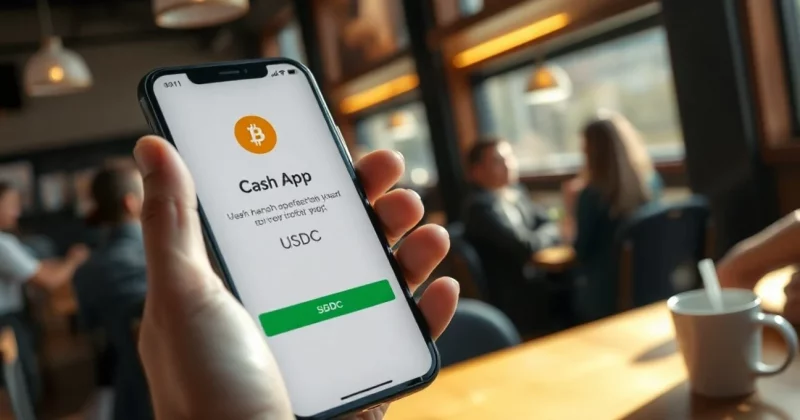
Cash App, a dominant force in the peer-to-peer payment landscape, has officially stepped into the realm of stablecoin transactions, marking a significant pivot for Jack Dorsey’s fintech giant, Block. Beginning May 27th, the company initiated a phased rollout of USDC (USD Coin) send-and-receive functionality to approximately 15 million users, representing a substantial quarter of its nearly 60 million monthly active users. This integration, which leverages the high-speed, low-cost infrastructure of the Solana blockchain, promises to streamline digital payments and offers users an instant conversion of USDC into their existing U.S. dollar Cash balance.
The move signifies a maturation of Cash App’s digital asset strategy, evolving from its long-standing support for Bitcoin to a more comprehensive digital asset suite. While Bitcoin has cemented its position as a store of value and a speculative asset, its volatility can pose challenges for everyday transactions where price stability is paramount. USDC, on the other hand, is pegged 1:1 to the U.S. dollar and is backed by a combination of cash and short-dated U.S. Treasuries held in reserve by its issuer, Circle. This inherent stability makes it an ideal medium for seamless consumer-level payments, bridging the gap between traditional fiat currency and the burgeoning digital asset ecosystem.
The Mechanics of Seamless Stablecoin Transactions
At the core of this integration lies a user-friendly experience designed to abstract away the complexities often associated with blockchain technology. Each Cash App user is assigned a unique blockchain deposit address for USDC transactions. This innovative approach extends the functionality beyond the Cash App ecosystem, enabling anyone, regardless of whether they are a Cash App user, to send USDC directly to a Cash App account using a standard Solana wallet address.
The true magic of the integration unfolds within the app itself, where the conversion between USDC and the user’s USD Cash balance occurs automatically and instantaneously. This eliminates the need for users to manage separate cryptocurrency wallets, navigate complex bridging mechanisms between different blockchain networks, or fret over the unpredictable and often prohibitive gas fees associated with more congested blockchains. Block’s strategic decision to utilize Solana as its settlement layer is a testament to the network’s compelling attributes: exceptional speed and remarkably low transaction costs. In stark contrast to the exorbitant fees that can plague Ethereum’s mainnet during periods of high demand, making even small transactions economically unfeasible, Solana’s sub-cent transaction costs render micropayments a practical reality.
The initial rollout, commencing this week, is slated for full availability to all Cash App users by the end of the current week. This rapid expansion from the initial 25% cohort to the broader user base underscores Block’s commitment to quickly scaling this new payment capability.
A Strategic Evolution: From Bitcoin Pioneer to Digital Asset Innovator
Cash App’s relationship with digital assets is not new. For years, it has been a frontrunner in democratizing Bitcoin ownership and transactions, allowing users to buy, sell, and conduct payments utilizing the Lightning Network, a second-layer solution designed to enhance Bitcoin’s transaction speed and scalability. However, the addition of USDC represents a significant strategic reorientation.
Bitcoin, while revolutionary, presents inherent challenges for users seeking to send a precise amount, say $50, without the anxiety of price fluctuations between the moment of initiation and the recipient’s receipt. The value of Bitcoin can shift considerably in short periods, making it less suitable for transactional purposes where value stability is crucial. USDC, by its very design, mitigates this concern. Its 1:1 peg to the U.S. dollar, backed by robust reserves, ensures that $1 worth of USDC remains equivalent to $1, regardless of market volatility. This stability is a critical enabler for widespread adoption in everyday commerce and peer-to-peer transfers.
Block’s initial announcement of its stablecoin integration plans dates back to November 2025. At that time, the company outlined its vision to incorporate USDC support on Solana, alongside enhancements to its existing Bitcoin payment functionalities. The current May rollout effectively delivers on that roadmap, aligning closely with the timeline Block originally projected for an early 2026 launch. This sustained commitment to their strategic objectives highlights a deliberate and measured approach to expanding their digital asset offerings.
Implications for Investors and the Wider Ecosystem
The ramifications of a platform with nearly 60 million monthly active users integrating stablecoin payments are far-reaching and significant. For Solana, the potential increase in transaction volume as Cash App scales this functionality across its entire user base could be transformative. This influx of activity could further solidify Solana’s position as a leading blockchain for decentralized applications and payment solutions, potentially attracting more developers and users to its network.
The impact on USDC issuer Circle is equally consequential. Cash App’s endorsement and integration represent a substantial endorsement for USDC, with the potential to significantly boost its circulation and daily transaction volume. This could fortify USDC’s competitive standing against its primary rival, Tether’s USDT, in the increasingly dynamic stablecoin market. A larger user base and higher transaction throughput for USDC could lead to greater network effects and further entrench its utility.
For Block itself, the introduction of stablecoin payments unlocks a new spectrum of revenue generation possibilities. The company could capitalize on conversion spreads between USDC and USD, earn revenue from transaction fees, or even generate yield from the USDC reserves held on behalf of its users. This diversification of revenue streams is crucial for continued growth, especially as Cash App’s Bitcoin trading already contributes meaningfully to Block’s financial performance.
This strategic move by Cash App places it in esteemed company. PayPal, another payments behemoth, has launched its own stablecoin, demonstrating a similar recognition of the potential within this market. Stripe, a leading payment infrastructure provider, has actively pursued stablecoin solutions, notably acquiring Bridge for this purpose. Cash App’s routing of consumer transactions through Solana now adds another prominent player to the growing list of traditional financial technology companies embracing blockchain and stablecoins for mainstream payment applications.
However, the landscape of stablecoin adoption is not without its challenges, chief among them being regulatory uncertainty. The legislative framework surrounding stablecoins in the United States remains in flux. Any future regulatory developments could impose new requirements that fundamentally alter the economic calculus of offering these services. In the broader context of remittances, where legacy services often charge fees in the range of 5-10%, stablecoins present a compelling competitive threat to established players like Western Union, offering the potential for significantly lower transaction costs and faster cross-border transfers. This competitive pressure could drive further innovation and cost reductions across the entire remittance market.
The integration of USDC on Solana by Cash App represents a pivotal moment, not only for the company and its users but also for the broader digital asset ecosystem. It signals a tangible step towards mainstream adoption of stablecoins as a viable and user-friendly payment method, driven by the technological advantages of blockchains like Solana and the strategic vision of fintech leaders like Block. As this rollout progresses, the financial industry will be closely watching to see how this innovation reshapes consumer behavior and competitive dynamics in the payment space.