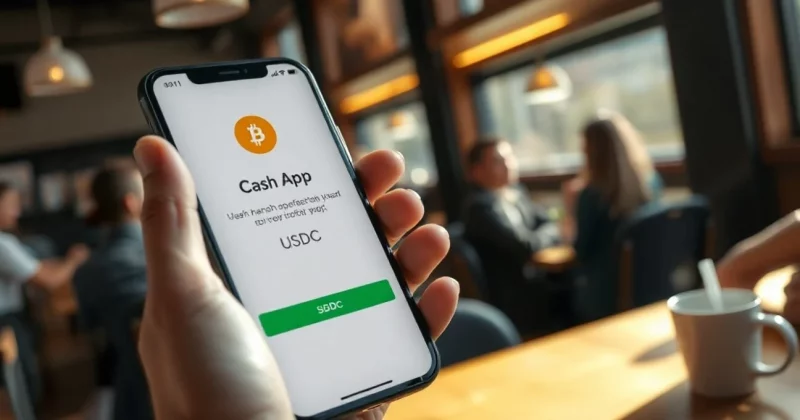
Cash App, the immensely popular peer-to-peer payment application operated by Jack Dorsey’s fintech giant Block, has officially begun integrating United States Dollar Coin (USDC) payment functionality for its users. This significant development marks a pivotal moment for mainstream cryptocurrency adoption, positioning Cash App as one of the largest consumer platforms to offer stablecoin transactions. The rollout, which commenced on May 27th, initially encompasses approximately 15 million users, representing a substantial 25% of its nearly 60 million monthly active users. This strategic move not only expands Cash App’s digital asset offerings beyond Bitcoin but also leverages the speed and cost-efficiency of the Solana blockchain for seamless, low-fee transactions.
The new feature allows users to send and receive USDC directly within the Cash App ecosystem. Crucially, transactions are settled on the Solana blockchain, renowned for its high throughput and minimal transaction costs. Upon receiving USDC, users have the immediate ability to convert it into their existing USD Cash balance within the app, eliminating the need for complex external wallet management or manual conversion processes. This integration is designed to abstract away much of the technical complexity typically associated with cryptocurrency, aiming to provide a user experience akin to traditional digital payments.
The Mechanics of Seamless Stablecoin Integration
The technical architecture underpinning Cash App’s USDC integration is designed for user simplicity and operational efficiency. Each Cash App user is provisioned with a unique blockchain deposit address specifically for USDC transactions. This means that individuals do not need to be existing Cash App users to send USDC to a Cash App account. Anyone equipped with a standard Solana wallet can initiate a USDC transfer to a Cash App user by utilizing this dedicated address.
The core innovation lies in the automatic and instantaneous conversion between USDC and USD that occurs within the app. This process eliminates the need for users to manage separate cryptocurrency wallets, engage in cross-chain bridging, or worry about unpredictable and potentially prohibitive "gas fees" that have historically been a significant barrier to entry for many on other blockchains. The absence of these complexities is a deliberate design choice aimed at fostering broader adoption among a user base accustomed to the ease of traditional financial applications.
Block’s decision to select Solana as the settlement layer for these stablecoin transactions is a testament to the blockchain’s capabilities. Solana has garnered attention for its impressive transaction speeds, often processing thousands of transactions per second, and its remarkably low transaction costs, which typically hover at fractions of a cent. This is a stark contrast to the Ethereum mainnet, where transaction fees can escalate dramatically during periods of network congestion, rendering small-value payments economically unviable. For instance, sending a mere $20 to a friend on a congested Ethereum network could incur fees that far exceed the transfer amount, making such transactions impractical. Solana’s sub-cent transaction costs, however, effectively democratize micropayments, making them a feasible option for everyday consumer use.
The phased rollout, which began this week, is on track for full availability across the entire user base by the end of the current week. This rapid deployment from an initial 25% cohort to the broader user base underscores Block’s commitment to quickly scaling this new functionality.
Evolution from Bitcoin Focus to a Comprehensive Digital Asset Ecosystem
Cash App’s journey into the stablecoin realm signifies a significant strategic pivot from its long-standing focus on Bitcoin. For years, Cash App has been a prominent platform for Bitcoin enthusiasts, enabling users to buy, sell, and make payments using the cryptocurrency, often leveraging the Lightning Network for faster and cheaper Bitcoin transactions. While Bitcoin remains a cornerstone of digital finance, particularly as a store of value and a speculative asset, its volatility presents challenges for everyday transactional use. Sending a fixed amount, say $50, can be problematic if the price of Bitcoin fluctuates significantly between the moment the transaction is initiated and when it is received and checked by the recipient.
USDC, on the other hand, offers a stable alternative. It is designed to maintain a 1:1 peg with the U.S. dollar, backed by reserves of cash and short-dated U.S. Treasury bonds held by regulated financial institutions. This inherent stability makes it an ideal medium for everyday payments, remittances, and other transactional use cases where price predictability is paramount.
Block first signaled its intentions to integrate stablecoin support in November 2025, at which time it announced plans to introduce USDC functionality on the Solana blockchain. These plans were concurrent with announcements regarding enhancements to its existing Bitcoin payment features. The current rollout in May aligns with the timeline Block originally projected, with the feature slated for launch in early 2026. This delivery on its roadmap demonstrates a consistent strategic vision for expanding its digital asset capabilities.
Investor Implications and Market Dynamics
The integration of USDC payments by a platform with nearly 60 million monthly active users carries significant downstream implications for the broader cryptocurrency ecosystem. Solana, in particular, stands to benefit from a potentially exponential increase in transaction volume as Cash App progressively rolls out USDC payments to its entire user base. This influx of activity could further solidify Solana’s position as a leading blockchain for consumer-facing applications.
For Circle, the issuer of USDC, this partnership represents a monumental opportunity. Cash App’s extensive reach and user engagement could lead to a substantial boost in USDC’s circulation and daily transaction volume. Such a development would undoubtedly strengthen USDC’s competitive standing against Tether’s USDT, its primary rival in the global stablecoin market. A more widespread adoption through a platform like Cash App could also lend further legitimacy to stablecoins as a mainstream financial instrument.
From Block’s perspective, the introduction of stablecoin payments opens up new avenues for revenue generation. The company could potentially earn revenue through various mechanisms, including conversion spreads when users exchange between USDC and their USD Cash balance, nominal transaction fees, or by earning yield on the USDC reserves held on behalf of its users. This diversification of revenue streams complements the already significant contributions from Cash App’s Bitcoin trading services, further enhancing Block’s financial performance.
This move by Cash App follows a trend of major financial technology companies embracing stablecoins. PayPal, another payments giant, launched its own stablecoin, and Stripe, a leading online payment processor, acquired Bridge to facilitate stablecoin payments. Cash App’s integration of consumer transactions via Solana places it firmly within this evolving landscape, signaling a broader industry shift towards leveraging blockchain technology for more efficient and accessible financial services.
Regulatory Landscape and Future Outlook
The inherent risks associated with stablecoin operations, particularly in the United States, remain a critical consideration. The regulatory framework surrounding stablecoins is still in a state of flux, with ongoing legislative discussions and potential future regulations that could significantly impact the economics of offering these services. Any new legislation could impose requirements related to reserves, oversight, and consumer protection, which might necessitate adjustments to how Cash App and other platforms operate their stablecoin services.
Despite these regulatory uncertainties, the potential for stablecoins to disrupt traditional remittance services is substantial. Legacy remittance providers typically charge fees ranging from 5% to 10% for international money transfers. Stablecoins, with their significantly lower transaction costs and faster transfer times, present a compelling alternative that could capture a significant share of this lucrative market, challenging incumbents like Western Union. Cash App’s foray into stablecoin payments, therefore, is not just about expanding its digital asset portfolio but also about strategically positioning itself to capitalize on the disruptive potential of blockchain technology in the global payments landscape. The success of this integration could serve as a blueprint for further innovation and adoption of digital assets within mainstream financial services.