


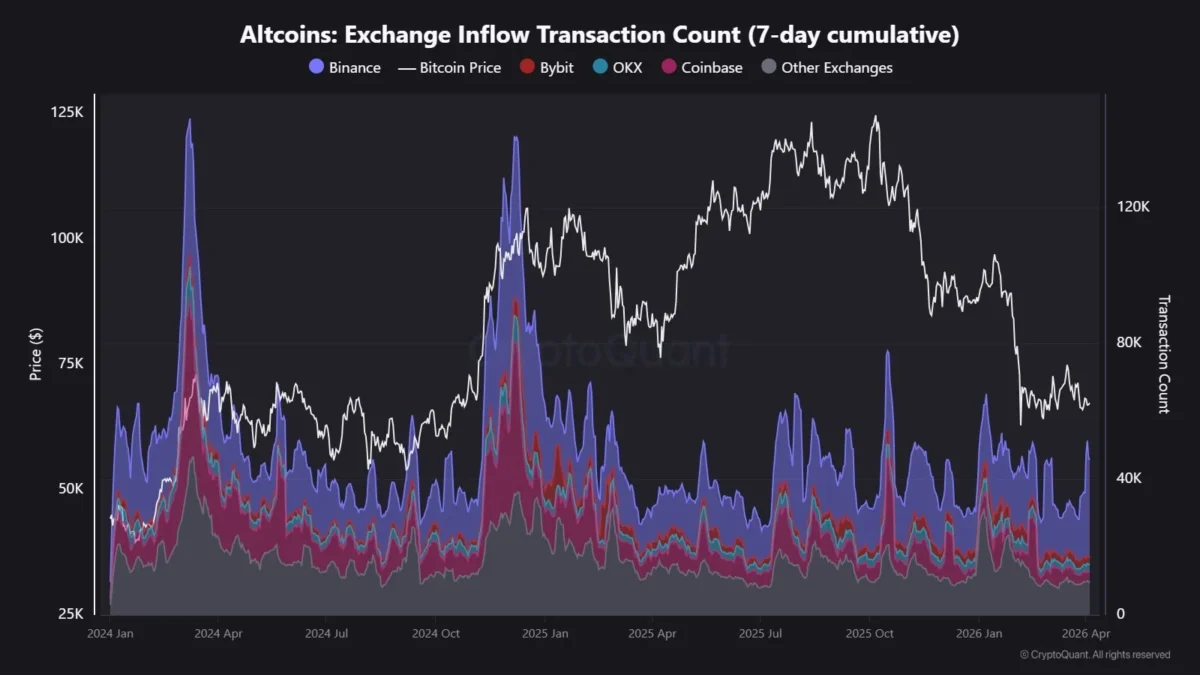
The global cryptocurrency landscape is currently navigating a period of profound structural transformation, characterized by heightened volatility and a shifting appetite for risk among retail and institutional participants alike. On April 2, a significant data anomaly emerged on Binance, the world’s largest cryptocurrency exchange by trading volume, that has captured the attention of market analysts and liquidity providers. While the broader altcoin market has been characterized by stagnant price action and diminishing retail engagement, a sudden and massive spike in altcoin inflow transactions occurred exclusively on the Binance platform. This event, which saw inflows reach a multi-month high of approximately 34,000 transactions, stands in stark contrast to the activity levels recorded on competing exchanges such as Coinbase, Bybit, and OKX, suggesting a localized catalyst rather than a generalized resurgence of interest in digital assets.
Detailed analysis from Maartunn, a prominent analyst at the blockchain analytics firm CryptoQuant, indicates that this transaction spike represents the highest level of inflow activity seen in nearly three months. In a typical market environment, a surge of this magnitude would be interpreted as a precursor to a broad-based altcoin rally or a significant increase in speculative derivatives trading across the entire industry. However, the isolation of this data to a single venue indicates that the driver was not a macro shift in crypto sentiment, but rather a strategic internal development within the Binance ecosystem. The timing of this anomaly coincides precisely with the platform’s expansion into traditional finance (TradFi) instruments, specifically the introduction of commodity-linked futures contracts.
The Catalyst: Integration of Traditional Commodities
The primary driver behind the April 2 inflow spike appears to be the rollout of new futures contracts on Binance. Just twenty-four hours prior to the surge in transactions, the exchange expanded its suite of tradable instruments to include West Texas Intermediate (WTI) Crude Oil and Natural Gas futures. These commodities joined an existing array of traditional finance tickers on the platform, including gold and silver. By integrating these assets, Binance has effectively bridged the gap between the volatile world of cryptocurrencies and the globally significant commodities market, which is currently reacting to intense geopolitical and macroeconomic pressures.

The availability of these instruments on a familiar crypto-native interface has created a unique "migration" effect. Traders who previously focused on altcoin volatility are now utilizing their existing capital—often held in various altcoins or stablecoins—to participate in the fluctuations of the energy and metals markets. The 34,000 inflow transactions recorded on April 2 represent the movement of capital into Binance’s ecosystem specifically to collateralize or fund positions in these newly launched commodity pairs. This explains why the spike did not appear on Coinbase or OKX; those platforms have not yet moved as aggressively into the cross-asset integration that Binance is currently pioneering.
A Structural Shift in Speculative Capital
The implications of this migration are significant for the long-term health of the altcoin market. Historically, the "altcoin season" phenomenon relied on a rotation of capital from Bitcoin into high-beta digital assets. However, the data from early April suggests that a new rotation is taking place. Instead of capital moving from Bitcoin to Ethereum or mid-cap tokens, speculative liquidity is moving from the crypto sector entirely into traditional commodities while remaining within the same exchange infrastructure.
This internal shift poses a challenge for altcoin valuations. For a digital asset to maintain or increase its price, it requires consistent bid-side liquidity. When thousands of active traders divert their attention and their capital toward WTI Crude Oil or Natural Gas futures, they are effectively withdrawing the liquidity that previously supported altcoin price floors. This trend reflects a broader maturation of the crypto investor base, which is increasingly focused on global macroeconomic drivers—such as inflation data, central bank policies, and supply chain disruptions in the energy sector—rather than the idiosyncratic developments of individual blockchain projects.
Chronology of the Market Anomaly
To understand the scale of this event, it is necessary to examine the timeline leading up to the April 2 spike:

- Late Q1 2024: The altcoin market begins to show signs of exhaustion. The "TOTAL3" index (the total market cap of all cryptocurrencies excluding Bitcoin and Ethereum) begins to face rejection at key resistance levels.
- March 2024: Binance continues to expand its "TradFi" offerings, noticing a high correlation between crypto trading activity and major macroeconomic announcements.
- April 1, 2024: Binance officially launches futures trading for WTI Crude Oil and Natural Gas. These instruments allow for high leverage and are settled in stablecoins or other supported assets.
- April 2, 2024: Transaction data shows a vertical spike in altcoin inflows to Binance. While other exchanges remain flat, Binance records 34,000 transactions, the highest in nearly 90 days.
- April 3–7, 2024: Analysis confirms that these commodity pairs have quickly risen to the top of Binance’s volume charts, occasionally rivaling major altcoins in terms of daily turnover.
Technical Analysis: Altcoin Market Cap Under Pressure
While the inflow spike on Binance highlights a shift in trader behavior, the broader technical structure of the altcoin market reinforces a bearish or neutral outlook. The total cryptocurrency market capitalization, excluding the top 10 assets, is currently hovering near the $172 billion mark. This sector of the market, often referred to as the "Others" chart, is displaying a classic "lower high" structure on the weekly timeframe.
The rejection from the mid-2023 and early 2024 highs suggests that the market has transitioned from an expansionary phase into a distribution phase. Several key technical indicators support this view:
- Moving Average Alignment: The altcoin market cap is currently trading beneath its 50-week and 100-week moving averages. These levels, which previously acted as support during bullish cycles, have now flipped to become formidable resistance. The 200-week moving average remains a critical "line in the sand" near the $150 billion zone, which was recently tested but held.
- Volume Asymmetry: During recent downward moves, selling volume has been significantly higher than the buying volume observed during recovery attempts. This indicates that "smart money" may be exiting positions during relief rallies, while retail participation remains tepid.
- The $200 Billion Hurdle: For the altcoin market to reclaim its bullish momentum, a sustained weekly close above the $200 billion threshold is required. Until this occurs, the path of least resistance appears to be sideways or downward, with a potential retest of the $130 billion level if current support fails.
Broader Implications for the Crypto Exchange Industry
The success of Binance’s commodity futures launch is likely to trigger a defensive response from other major exchanges. If the "TradFi-fication" of crypto exchanges continues, we may see a convergence where platforms like Bybit, Kraken, and OKX also begin offering traditional assets to retain their user bases. This trend transforms crypto exchanges into multi-asset brokerage firms, putting them in direct competition with legacy giants like the CME Group or Interactive Brokers.
For the user, this provides unprecedented convenience, allowing them to hedge crypto exposure with gold or bet on energy prices using their crypto wallet balances. However, for the cryptocurrency ecosystem, it may lead to a "liquidity drain." If the most profitable and volatile trades are found in oil or gas rather than in decentralized finance (DeFi) tokens or "meme coins," the capital that once fueled the explosive growth of the crypto industry may remain parked in traditional instruments.

Expert Reactions and Market Sentiment
Market analysts have noted that the isolation of the Binance inflow spike serves as a warning to those looking for a broad "altcoin season." The consensus among data-driven observers is that the "signal" provided by exchange inflows must always be cross-referenced with external catalysts. In this instance, the catalyst was a product launch, not a change in fundamental demand for blockchain technology.
"The concentration of flows on a single exchange is a classic tell," noted one industry researcher. "If the world were suddenly bullish on altcoins, we would see a tide that lifts all boats. Instead, we saw a crowd rushing toward a specific door on Binance. That door led to the oil and gas pits, not to the next big crypto project."
As the market moves deeper into the second quarter, the focus remains on whether the altcoin market can find a new narrative to attract capital back from traditional commodities. With macroeconomic uncertainty persisting and geopolitical tensions remaining high, the allure of "hard assets" like oil and gold may continue to overshadow the speculative appeal of the broader digital asset market. For now, the data suggests that while the liquidity remains within the crypto infrastructure, its heart is beating for traditional finance.














