The Cronos blockchain, an EVM-compatible network built on the Cosmos SDK, officially rolled out its v1.8 mainnet upgrade on October 22. This significant update introduces Block-STM, Cronos’s parallel execution engine, directly into the Cosmos SDK layer, a move touted to enhance the network’s processing capabilities. However, the launch has been accompanied by a notable disparity between prior performance claims—circulated via social media in September—and the current availability of official, verifiable benchmarks. While earlier simulations suggested potential improvements of approximately 20% faster median block times and up to 66% higher sustained throughput, these figures are conspicuously absent from the official v1.8 blog post and release notes. Furthermore, an examination of the Cronos explorer on the day of the upgrade reveals that about three out of four blocks contain no transactions, rendering the more ambitious throughput claims presently untestable due to low network utilization.
Deep Dive: Cronos v1.8 and the Evolution of Parallel Execution
The core of the Cronos EVM v1.8 mainnet upgrade is the full integration of Block-STM, Cronos’s proprietary parallel execution engine, directly into the Cosmos SDK. This architectural shift marks a maturation of a technology first introduced in Cronos v1.4, where parallel execution was present but not as deeply embedded. In v1.8, Block-STM operates at a foundational level, allowing the network to process multiple transactions concurrently rather than sequentially. The underlying principle is to execute transactions simultaneously, assuming they do not conflict by touching the same state variables. Should a conflict arise, the engine intelligently re-runs the conflicting transactions one after another, ensuring data integrity while still maximizing parallel processing where possible.
Parallel execution is a critical advancement for blockchain scalability, addressing the "bottleneck" problem inherent in traditional sequential execution models. By moving Block-STM into the Cosmos SDK layer, Cronos aims to leverage the benefits of parallel processing more efficiently, potentially unlocking greater transaction capacity and reducing latency. This approach is increasingly adopted by various Layer-1 blockchains seeking to overcome the limitations of their predecessors, allowing them to handle a higher volume of transactions per second (TPS) without compromising decentralization or security. For Cronos, which operates within the competitive landscape of EVM-compatible chains, enhancing its core execution engine is a strategic imperative to attract developers and users.
Beyond Block-STM, the v1.8 upgrade also brings a comprehensive update to the underlying technology stack. Cronos has transitioned to Cosmos SDK v0.54.3, CometBFT v0.39, and IBC-Go v11, alongside an upgrade to RocksDB v10.9.1. These updates reflect a commitment to integrating the latest advancements within the broader Cosmos ecosystem, improving network stability, security, and interoperability. The Cosmos SDK provides a robust framework for building application-specific blockchains, and keeping pace with its developments ensures Cronos remains at the forefront of this modular blockchain paradigm. CometBFT, the consensus engine formerly known as Tendermint Core, is crucial for block finality and network security. IBC-Go, the implementation of the Inter-Blockchain Communication protocol, is vital for seamless asset and data transfer across interconnected Cosmos chains, enhancing Cronos’s role in the multi-chain future.
The Origins of Performance Claims and the Absence of Official Benchmarks
The anticipation surrounding Cronos v1.8 was significantly fueled by performance metrics shared in late September. A social media post from Cronos Network claimed the upgrade would deliver "~20% faster median block times" and "up to 66%" higher sustained throughput. These figures, as indicated at the time, were derived from mainnet simulations. When the testnet upgrade subsequently went live on September 30, Cronos reiterated the 20% block-time claim, although the throughput figure was notably absent from that specific announcement.
However, a crucial point of contention arises from the official mainnet release documentation. Neither the Cronos EVM v1.8 mainnet announcement blog post nor the v1.8.0 release notes on GitHub contain any benchmark numbers to substantiate these earlier claims. The blog post’s only performance assertion is a general statement that Block-STM "delivers the best block-execution performance available on Cronos." The GitHub release mentions "lower peer-to-peer latency and faster block turnaround from the mempool change" but provides no quantitative measurements. This lack of concrete data—such as baselines, test conditions, or the specific transaction mix used in simulations—raises questions about the verifiability and transparency of the initial performance projections. In a domain where empirical evidence is paramount, the absence of detailed benchmarks in official release documents can foster skepticism within the developer and user communities.
Adding to the ambiguity, a minor conflict exists between the two official documents regarding networking improvements. The GitHub release states that v1.8 "replaced the legacy networking stack with libp2p," claiming this "greatly reduces latency." Conversely, the blog post clarifies that libp2p is currently experimental and "not enabled on mainnet." This discrepancy implies that any potential latency gains attributed to the new networking layer do not apply to the mainnet upgrade deployed on October 22, further complicating the assessment of the upgrade’s immediate performance impact.
Scrutinizing Block Time Claims: A Testable Metric
While the throughput claims face immediate verification hurdles, the assertion of a 20% faster median block time is, in principle, testable. The context for this claim is Cronos’s prior efforts to significantly reduce block times. In a previous upgrade (likely mid-2022 or mid-2023, given the context of already achieving sub-second blocks), Cronos successfully cut its block time from approximately 5.6 seconds to under one second, aiming for a tenfold reduction. This historical achievement demonstrates the network’s capacity for substantial performance enhancements.
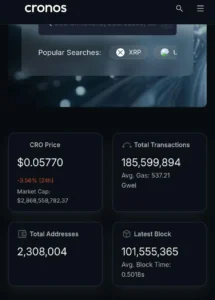
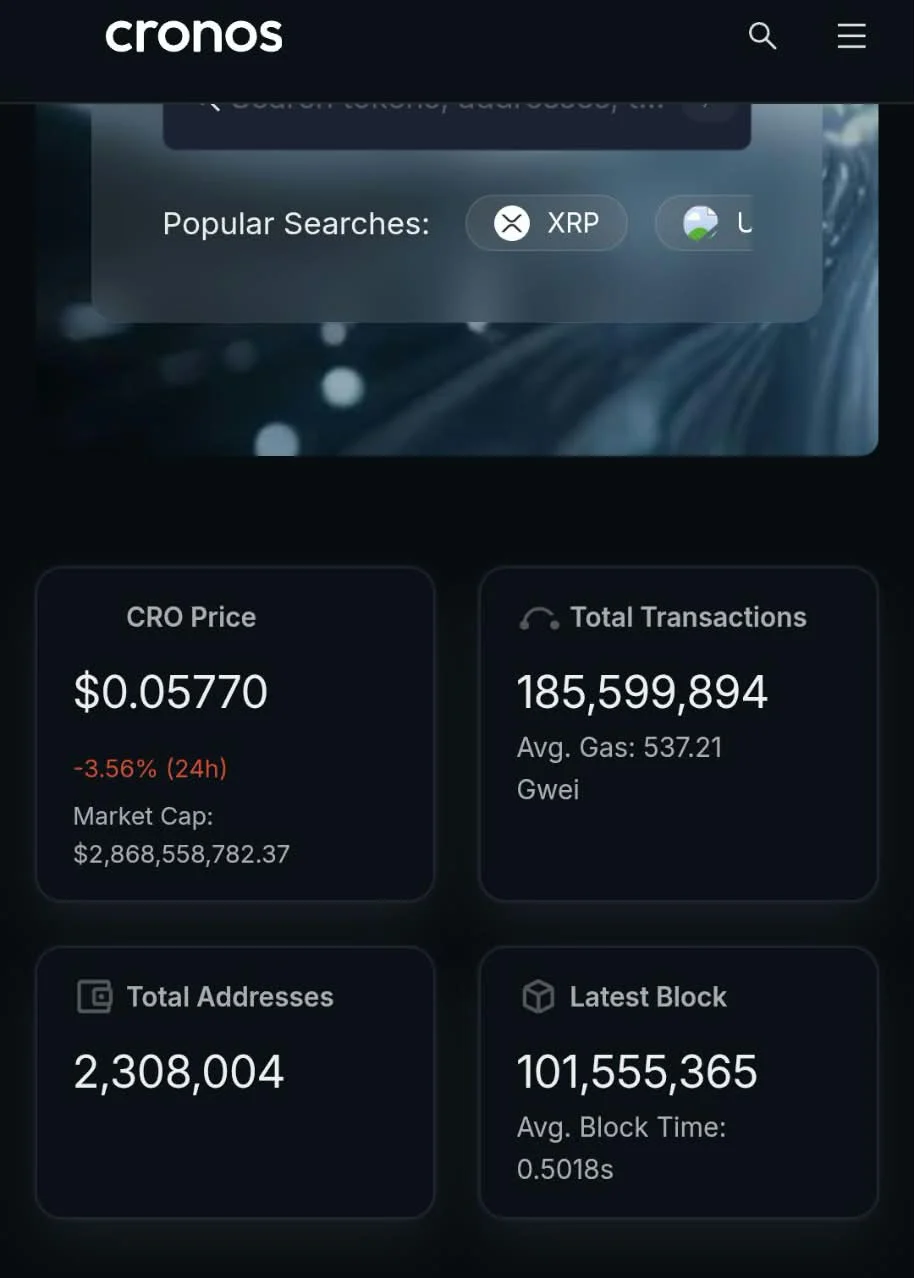
As of the evening of October 22, the Cronos explorer displayed an average block time of approximately 0.5018 seconds at block 101,555,365. For the v1.8 upgrade to deliver on its promise of a 20% reduction, the average block time prior to the upgrade would need to have been around 0.63 seconds. This provides a clear target for post-upgrade analysis. If the network was already operating close to half a second per block before the upgrade, then the 20% gain would not be immediately evident in the reported average.
It is important to acknowledge two caveats when interpreting these figures. Firstly, the explorer’s average block time might not specify the exact period it covers, which could influence the ‘before’ comparison. Secondly, Cronos’s original claim referred to median block time, which represents the typical block time, as opposed to the average, which can be skewed by a few exceptionally slow blocks. Despite these nuances, the average block time reported by the explorer serves as the initial public metric and provides a tangible figure against which the 20% claim can be assessed in the coming days.

To accurately verify the block time claim, a reliable method involves counting blocks over a fixed time window. Given that EVM block timestamps are recorded in whole seconds, comparing timestamps block-by-block can be misleading, especially at speeds of two blocks per second where multiple blocks might share the same timestamp. A more robust approach, as suggested, is to leverage the Cronos explorer’s daily block count data. By dividing 86,400 seconds (the total seconds in a day) by the total number of blocks produced in a day, one can derive the average daily block time. A clean comparison would involve taking a full day’s data before the upgrade and contrasting it with a full day’s data after the upgrade. If v1.8 indeed delivers a 20% faster block time, a post-upgrade day should exhibit approximately 25% more blocks. For instance, if the pre-upgrade pace was around 0.63 seconds per block, yielding about 137,000 blocks daily, a 20% improvement would lead to roughly 172,000 blocks per day. This direct comparison will be the definitive test for the block time claim in the immediate aftermath of the upgrade.
The Throughput Conundrum: Awaiting Network Demand
In stark contrast to block time, the claim of up to 66% higher sustained throughput faces an immediate and significant obstacle to verification: extremely low network utilization. Throughput, which measures the number of transactions a network can process per unit of time, only becomes a limiting factor when there is sufficient demand to fill blocks. On the day of the v1.8 mainnet upgrade, the Cronos explorer painted a clear picture of this challenge.
As of the time of checking on October 22, the chain had processed 137,087 blocks but only 33,253 transactions. This translates to an average of approximately 0.24 transactions per block, meaning roughly three out of every four blocks produced on the Cronos network contained no transactions at all. The average block size was a mere 2,221 bytes, indicative of minimal data being processed.
Looking at the broader trend over the past month, the explorer’s transaction chart shows daily activity fluctuating between roughly 30,000 and 93,000 transactions. Even on the busiest days within this period, the network was processing only about one transaction per second, while simultaneously producing around two blocks per second. This substantial disparity between block production rate and transaction volume underscores the current lack of demand.
Under these conditions, a claim of a 66% increase in throughput cannot be observed or validated. Whether the network’s capacity has risen to handle 35 transactions per second or 350 transactions per second, the on-chain data appears identical when blocks are predominantly empty. The true limit of throughput can only be revealed under conditions of high network stress, such as during a targeted stress test designed to flood the network with transactions, or through a sustained surge in organic user demand. Ironically, these are precisely the conditions under which Cronos previously conducted its simulations to arrive at the 66% figure.
This situation is not a critique of Block-STM’s underlying technology. Parallel execution mechanisms like Block-STM are designed to deliver their maximum benefits when blocks are densely packed with transactions, particularly those that do not conflict with each other. When blocks are largely empty, as they currently are on Cronos, there is simply no workload for the parallel execution engine to optimize. The potential for higher throughput remains latent, awaiting an increase in network activity to demonstrate its capabilities.
Broader Context: The Cronos Ecosystem and Scalability Challenge
Cronos is a significant player in the blockchain space, closely associated with Crypto.com, one of the world’s largest cryptocurrency exchanges. Launched with the vision of providing a highly scalable and cost-effective platform for DeFi, NFTs, and GameFi applications, Cronos has aimed to bridge the gap between the Cosmos and Ethereum ecosystems through its EVM compatibility. Its strategic position leverages the robust security and interoperability of the Cosmos SDK while offering familiarity to developers accustomed to the Ethereum Virtual Machine.
The pursuit of scalability, as exemplified by the v1.8 upgrade, is a universal challenge for all Layer-1 blockchains. Networks like Ethereum, Solana, Polygon, and Avalanche are constantly iterating to improve their transaction processing capabilities, reduce fees, and enhance user experience. While Cronos’s current average block time of ~0.5 seconds is remarkably fast compared to Ethereum’s ~12-13 seconds, and even competitive with high-performance chains like Solana (~0.4 seconds), its transaction volume lags significantly behind. For context, Ethereum processes millions of transactions daily, and even sidechains/L2s like Polygon handle hundreds of thousands to millions. Cronos’s daily transaction count of 30,000-93,000 suggests that despite its technical advancements, attracting substantial user and developer activity remains a key hurdle.
The broader implication of this low utilization is that while the infrastructure for high performance is being built, the demand to truly test and utilize that infrastructure is not yet present. This is a common challenge for many newer blockchains that launch with ambitious technical roadmaps but struggle to gain critical mass in terms of adoption. For Cronos, the v1.8 upgrade is a foundational step, but its true impact will only be realized when the network can demonstrate its enhanced capabilities under sustained load.
Technical Underpinnings and Breaking Changes
The v1.8 upgrade is not merely about parallel execution; it’s a comprehensive overhaul that touches multiple layers of the Cronos stack. The migration to Cosmos SDK v0.54.3, CometBFT v0.39, IBC-Go v11, and RocksDB v10.9.1 represents a significant commitment to adopting the latest versions of core blockchain components. These updates often bring performance improvements, security patches, and new features from the broader Cosmos ecosystem.
However, such significant upgrades typically involve "breaking changes" that require attention from node operators and developers. Cronos v1.8 is no exception. Key breaking changes include:

- SendCroToIbc limited to authorized contracts: This likely enhances security and control over IBC transfers involving the native CRO token.
- Interchain Accounts removed: This is a notable change, as Interchain Accounts (ICA) are a powerful feature within the Cosmos ecosystem, enabling one blockchain to securely control an account on another. Its removal might indicate a strategic shift or a temporary measure for stability, potentially to be reintroduced in a different form.
- MsgTurnBridge no longer supported: This implies a change in how bridging operations are handled or a deprecation of an older bridging mechanism.
- Tighter governance parameter bounds: This suggests a move towards more conservative or controlled network parameters, potentially affecting future governance proposals and network configurations.
These breaking changes necessitate careful review and adaptation by all participants in the Cronos ecosystem, from validators running full nodes to decentralized application (dApp) developers. Failure to adapt to these changes could lead to compatibility issues or service disruptions.
Furthermore, the activation of Block-STM’s full potential is contingent on proper node configuration. The parallel execution engine relies on specific node settings such as block-executor, block-stm-workers, and block-stm-pre-estimate. Nodes that continue to operate with older [evm] settings might default to sequential transaction processing, thereby missing out on the performance gains offered by Block-STM. Cronos’s official blog post recommends Block-STM "for all node types" and urges operators to follow the v1.8 migration guide. A new requirement for operators to review json-rpc.txfee-cap, now enforced on eth_sendRawTransaction, also highlights the need for diligent updates. The actual real-world performance results on the mainnet will, therefore, depend significantly on the proportion of validators and nodes that successfully configure and activate the new parallel execution engine.
Verifying Performance: A Path Forward
The Cronos v1.8 mainnet upgrade presents a dichotomy in its immediate verifiability. The claim of a 20% faster median block time is within reach of empirical validation. Community members, researchers, and analytics platforms can leverage the public data available on the Cronos explorer to perform day-over-day comparisons of block counts and average block times, providing an objective assessment of this specific performance enhancement. This transparency in data availability allows for accountability and fosters trust in the network’s reported capabilities.
However, the more ambitious claim of up to 66% higher sustained throughput remains in a state of limbo. Until the Cronos network experiences a substantial and sustained increase in transaction volume—either through organic user growth and dApp adoption or via controlled stress tests—the full impact of Block-STM on throughput cannot be accurately measured or confirmed. The current state of largely empty blocks means that the network’s theoretical capacity remains untested.
For Cronos to fully substantiate its throughput claims, several paths could be considered:
- Orchestrated Stress Tests: The Cronos team or independent researchers could conduct public stress tests, simulating high transaction loads to push the network to its limits and demonstrate its maximum TPS under realistic conditions.
- Incentivized Usage Campaigns: Introducing programs or incentives to drive dApp deployment and user activity could naturally increase network traffic, providing real-world data on throughput.
- Enhanced Reporting: Official dashboards or reports detailing network capacity, current utilization, and Block-STM’s performance metrics under varying loads would offer greater transparency.
Implications for Cronos and the Blockchain Landscape
The Cronos v1.8 mainnet upgrade is a testament to the continuous innovation in the blockchain space, particularly the drive towards solving the scalability trilemma. By deeply embedding parallel execution, Cronos is positioning itself with advanced infrastructure capable of handling future demand. However, the current situation underscores a critical challenge faced by many emerging blockchains: building advanced infrastructure does not automatically guarantee demand.
The implications for Cronos are multifaceted. On one hand, the upgrade solidifies its technical foundation, demonstrating a commitment to leading-edge blockchain technology. This can attract sophisticated developers looking for high-performance environments. On the other hand, the discrepancy between pre-launch performance claims and the lack of immediate verifiable benchmarks in official documentation, coupled with low network utilization, could impact community perception and trust. Transparency in performance reporting is crucial for maintaining credibility, especially in a market where technical claims are often scrutinized.
For the broader blockchain landscape, Cronos v1.8 serves as a case study in the ongoing evolution of Layer-1 chains. It highlights the importance of parallel execution as a key scaling solution and the continuous effort to integrate robust components from ecosystems like Cosmos. However, it also emphasizes that technological prowess alone is insufficient for success; fostering a vibrant ecosystem with genuine user demand is equally, if not more, critical. As Cronos moves forward, the focus will undoubtedly shift from the successful deployment of the v1.8 upgrade to demonstrating its tangible benefits through increased network activity and verifiable performance metrics.
Disclosure: This is not trading or investment advice. Always do your research before buying any cryptocurrency or investing in any services.
Follow us on Twitter @themerklehash to stay updated with the latest Crypto, NFT, AI, Cybersecurity, and Metaverse news!