The V24 upgrade, a culmination of extensive development efforts, is designed to bolster Dash’s foundational capabilities, particularly concerning masternode management and network efficiency. As per the release schedule, two distinct deployments, v24 and evo_shares, are part of this release. However, a key detail from the commit message indicates that only v24 can activate with this current release, as v24 nodes do not sign the evo_shares signal. This distinction is vital for understanding the phased rollout of new functionalities within the Dash ecosystem.
Understanding Dash and Its Masternode Network
To fully appreciate the significance of the V24 upgrade, it’s essential to understand Dash’s unique architecture. Launched in 2014, Dash (short for "Digital Cash") was conceived as a privacy-centric cryptocurrency with a focus on speed, user-friendliness, and decentralized governance. Unlike Bitcoin’s purely proof-of-work (PoW) consensus mechanism, Dash employs a two-tier network. The first tier consists of traditional miners who secure the blockchain and validate transactions, similar to Bitcoin. The second tier, however, is unique to Dash and comprises "masternodes."
Masternodes are specialized servers running on the Dash network that provide advanced services and play a critical role in the project’s governance. To operate a masternode, an operator must collateralize 1,000 Dash. In return, masternodes receive a portion of the block reward and have the right to vote on proposals submitted to Dash’s decentralized autonomous organization (DAO), known as the Treasury. This system, often referred to as Proof of Service (PoSe), ensures network stability, incentivizes good behavior, and funds ongoing development. Masternodes are instrumental in facilitating Dash’s InstantSend (near-instant transaction confirmation) and PrivateSend (enhanced transaction privacy) features. The V24 upgrade directly impacts this critical masternode tier, making its smooth implementation paramount.
The V24 Network Upgrade: Key Features and Benefits
The V24 hard fork introduces a suite of features primarily aimed at optimizing masternode ownership, rewards, and network communication. These enhancements represent a significant step towards a more flexible and robust Dash network, paving the way for future innovations like Dash Platform.
-
Shared Masternode Collateral: This is arguably one of the most anticipated features. Currently, a single masternode requires 1,000 DASH from a single owner. V24 enables a version 3 ProRegTx (Masternode Registration Transaction) to carry a collateral share table. This means multiple parties can contribute to the 1,000 DASH collateral, effectively allowing for shared ownership of a single masternode. This lowers the barrier to entry for individuals wishing to participate in the masternode network, potentially increasing decentralization and resilience. It also introduces new transaction types (ProUpRegTx for registration updates, ProUpServTx for service updates, ProUpRevTx for revocation) to manage these shared nodes.
-
Split Payouts (Multi-party Payouts): Complementing shared collateral, V24 allows a masternode to split its owner reward among several addresses. This can be configured in basis points, offering granular control over reward distribution. For shared masternodes, this means each contributor can directly receive their proportional share of the rewards, simplifying accounting and distribution.
-
Extended Network Addresses: Masternodes will now be able to explicitly list their core P2P, Platform P2P, and Platform HTTPS endpoints using version 3 provider transactions. This standardization and extension of address information are crucial for improved network discovery and communication, especially as Dash Platform development progresses. This applies to both regular masternodes and EvoNodes (masternodes running Dash Platform services). Post-activation, EvoNode service updates must be version 3; older version 2 updates will be rejected.
-
Platform Changes: The upgrade also brings changes to how Dash Platform withdrawals work. While the specifics are complex, these adjustments are critical for ensuring seamless interaction between the core Dash blockchain and the emerging Dash Platform, which is designed to enable decentralized applications. Notably, the introduction of a new ChainLock type (
CLSIG_DKG) and a new signature type (BLS) are foundational for these platform-related improvements.
Hard Fork Mechanism: DIP-0023 Explained
The activation of V24 relies on Dash’s Enhanced Hard Fork mechanism, defined in DIP-0023 (Dash Improvement Proposal 23). This mechanism distinguishes Dash’s upgrade process from Bitcoin’s, which typically relies on miner signaling. In Dash, the process is initiated and driven by masternodes.
Here’s a breakdown of how DIP-0023 facilitates the V24 activation:
- Signaling: Unlike Bitcoin, where miners signal their readiness for an upgrade by including specific bits in the blocks they mine, Dash’s masternodes vote on the upgrade. Once the new software is released, masternodes that have upgraded begin signaling their support.
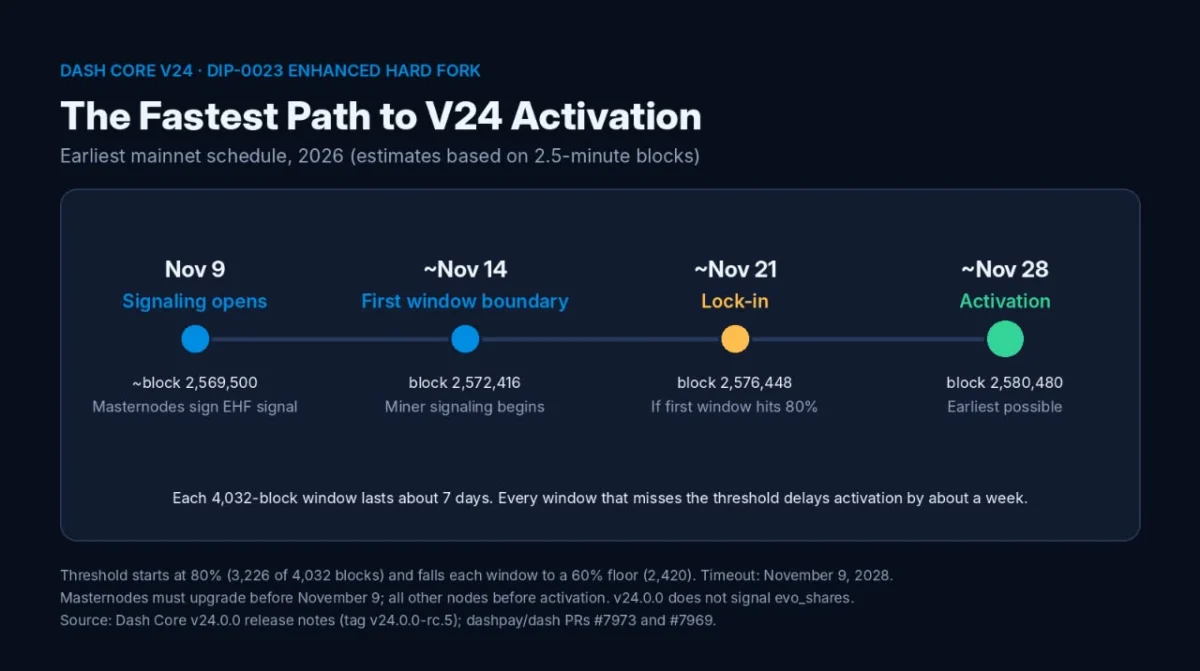
- Activation Thresholds: The hard fork mechanism operates within defined "window boundaries" (typically 4,032 blocks, or about seven days). Within each window, a certain percentage of masternode signals must be achieved for the upgrade to "lock in." The threshold starts at 80% (3,226 out of 4,032 blocks) and gradually steps down to 60% (2,420 blocks) after 10 windows if adoption is slow. This adaptive threshold ensures that upgrades can still proceed even with slower adoption, preventing perpetual delays.
- Lock-in and Activation: Once the required signaling threshold is met within a window, the upgrade "locks in." After a subsequent waiting period (typically another window’s duration), the new rules officially "activate." At this point, all nodes on the network must conform to the new protocol version. Nodes that have not upgraded will be considered to be following an invalid chain and will be disconnected from the network.
This masternode-centric signaling mechanism reflects Dash’s commitment to decentralized governance and ensures that critical network upgrades are decided and implemented by a broad consensus of its key stakeholders.

Crucial Timeline for Activation
The schedule for the V24 upgrade is precise, underscoring the urgency for masternode operators and other network participants. The mainnet schedule was officially merged into the Dash Core codebase on October 29 by developer ‘pasta,’ giving the network a clear directive.
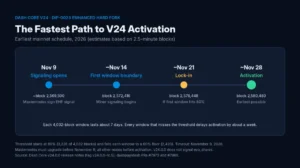
- November 9, 2023, 00:00 UTC: Signaling officially opens for the V24 upgrade. This marks the start of the period where upgraded masternodes begin to cast their votes.
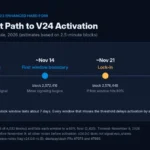
- November 14, 2023 (approximate): The first window boundary is expected around block 2,572,416. If the necessary 80% masternode signaling threshold is met within this initial window, the upgrade will lock in.
- November 28, 2023 (approximate): If signaling proceeds optimally, V24 could activate around block 2,580,480. This date represents the earliest possible activation scenario, assuming continuous 2.5-minute blocks.
- Flexibility in Activation: The system is designed with flexibility. If a window misses the signaling threshold, activation is delayed by approximately one week. The decreasing threshold over time (from 80% to 60%) is a safety mechanism to ensure eventual activation even if initial adoption is slow.
It is important to note that while the V24 network upgrade is slated for immediate activation, the deployment parameters for the specific v24 and evo_shares components within the code have a future start date. The change sets the start time for these deployments to November 9, 2026, at 00:00 UTC, with a timeout of November 9, 2028. This implies that while the V24 mandatory upgrade enables the overall functionality for regular masternodes (like shared collateral and split payouts), the internal parameters for these specific deployments are set for a later signaling window, potentially allowing for future activation without another hard fork, or serving as a fallback. The current focus remains on the immediate mandatory upgrade of the V24 software to enable the core features for regular masternodes around November 28, 2023.
Mandatory Upgrades and Potential Penalties
The V24 release is explicitly described as mandatory for all nodes on the Dash network. The deadlines differ based on node type, but the urgency for masternode operators is particularly acute.
- Masternode Operators: Masternodes must upgrade their software before November 9, 2023. The fork cannot commence until a sufficient number of masternodes have upgraded and signaled their support. Failure to upgrade promptly carries significant risks. V24 raises the minimum masternode protocol version from 70240 to 70242. Masternodes running older protocol versions during distributed key generation (DKG) — a process essential for ChainLocks and InstantSend — will be considered to have a "bad connection" and will be voted "bad." This can lead to Proof of Service (PoSe) penalties, potentially resulting in temporary deactivation or even removal from the masternode list, causing a loss of block rewards.
- All Other Nodes (Regular Nodes, Exchanges, Wallets): These nodes must upgrade before activation, which is expected around November 28, 2023. As the release notes starkly warn, failing to upgrade means these nodes "will follow an invalid chain" once the hard fork activates, leading to disconnection and inability to process or validate transactions correctly.
The upgrade process itself for non-masternode operators might involve a longer initial start-up time (20-40 minutes or more) for nodes with address, spent, or timestamp indexes, as these indexes are migrating to their own dedicated databases. This architectural change aims to improve performance and scalability in the long run.
Strategic Implications and Future Outlook
The V24 upgrade is one of Dash’s most substantial consensus upgrades in recent years, carrying significant strategic implications for the project’s long-term vision.
- Enhanced Decentralization and Accessibility: By enabling shared masternode collateral, V24 democratizes participation in Dash’s second-tier network. This could lead to a more diverse and robust masternode ecosystem, as smaller investors can now collectively run a masternode, increasing network decentralization and resilience against potential attacks or centralized control.
- Improved Masternode Economics: Split payouts offer greater flexibility for masternode owners, particularly for shared setups or those wishing to diversify their reward recipients. This financial flexibility can make masternode operation more attractive and efficient.
- Foundation for Dash Platform: The extended network addresses and platform-specific changes are critical preparatory steps for the full rollout and integration of Dash Platform (formerly Evolution). Dash Platform aims to provide a decentralized application (dApp) ecosystem built on Dash, offering features like decentralized usernames, document storage, and identity management. The V24 upgrade ensures the underlying network infrastructure is robust enough to support these advanced functionalities.
- Continued Evolution and Competitiveness: In a rapidly evolving cryptocurrency landscape, continuous innovation is crucial. Upgrades like V24 demonstrate Dash’s commitment to improving its core technology, enhancing user experience, and maintaining its competitive edge, particularly in areas like transaction speed and governance. While the original article’s header mentions "privacy coins explode," V24’s primary focus is on infrastructure and masternode mechanics rather than new privacy features. However, a robust and decentralized masternode network indirectly supports the integrity of features like PrivateSend.
Looking Ahead: The evo_shares Deployment
While the V24 upgrade brings significant changes, the evo_shares deployment, which covers the EvoNode-specific versions of shared collateral and multi-party payouts, will not activate with this release. V24.0.0 nodes do not sign the evo_shares signal, meaning EvoNodes cannot currently register with shared collateral or utilize more than one owner payout. Attempts to do so will be rejected.
According to the release notes, a later release, expected to be V24.1, will sign the evo_shares signal once Dash Platform fully supports EvoNode shares and payouts. The parameters for evo_shares are already set with the same future start and timeout dates (November 9, 2026, and November 9, 2028, respectively) as v24. This strategic pre-setting allows for evo_shares to activate with a future release without requiring another mainnet parameter change, streamlining the development process. This means shared ownership will first arrive for regular masternodes with the V24 fork, with EvoNode-specific shared ownership and payouts following in a subsequent update.
Recommendations for Stakeholders
The V24 upgrade demands immediate attention from various participants within the Dash ecosystem:
- For Masternode Operators: It is imperative to upgrade to the latest V24.0.0-rc.5 (or newer stable release if available) software immediately. The deadline of November 9 is critical to avoid PoSe penalties and ensure continued participation in the network. Familiarization with the new version 3 ProRegTx format is also essential for managing masternode registrations, especially for those planning to utilize shared collateral.
- For Regular Node Operators, Exchanges, and Wallets: A mandatory upgrade is required before activation, projected around November 28. It is advisable to plan for potential extended start-up times for nodes with indexing services. Timely upgrades are crucial to prevent following an invalid chain and ensure uninterrupted service.
- For Developers: Any applications or tools that interact with provider transactions, such as blockchain explorers, SPV libraries, and external wallets, must be updated to handle the new version 3 format before the activation date. This ensures compatibility and proper functioning within the upgraded network.
The V24 upgrade marks a pivotal moment for Dash, solidifying its infrastructure and paving the way for advanced functionalities. The success of this upgrade hinges on the proactive participation of all network stakeholders, particularly masternode operators, in adhering to the established timeline for software updates. The coming weeks will be critical as the Dash network collectively transitions to this enhanced era of digital cash.