Ethereum (ETH) is currently navigating a period of price consolidation, exhibiting limited movement on Friday after a week of modest gains. This period of relative calm is occurring concurrently with a notable withdrawal of over 116,000 ETH from cryptocurrency exchanges in just 48 hours, a move valued at approximately $300 million at current market prices. This significant outflow, highlighted by crypto analyst Ali Martinez, suggests a potential shift in investor sentiment and could influence Ethereum’s future price trajectory.
The observed reduction in ETH held on exchanges is a development that typically garners attention within the cryptocurrency market. A decrease in readily available supply on trading platforms can, in theory, diminish the immediate selling pressure on an asset. While such outflows do not unilaterally guarantee a price surge, their occurrence within Ethereum’s current trading pattern is particularly noteworthy.
Current Market Dynamics and Analyst Outlook
Ethereum has been trading within a relatively tight range, primarily fluctuating between approximately $2,370 and $2,530 since August 26th, according to Martinez. This consolidation phase indicates a period of indecision among market participants, where neither buyers nor sellers have established decisive control. Analysts are closely monitoring this range, anticipating that a clear hourly close outside these boundaries will signal the direction of Ethereum’s next significant price movement.

Martinez suggests that a decisive break above the $2,530 mark could serve as a bullish catalyst, potentially propelling Ethereum towards the $2,700 level. The combination of this compressed price action and the ongoing decline in exchange balances could indeed provide the impetus for a substantial upward move, contingent on increased buying pressure.
Technical Analysis and Key Support/Resistance Zones
Further technical analysis from other market observers corroborates the significance of Ethereum’s current price action. Analyst Daan Crypto Trades pointed out that ETH has been hovering just above its breakout point for approximately three weeks, a prolonged period of consolidation that could precede a larger price swing, mirroring previous patterns that led to significant upward movements.
Daan Crypto Trades identified the $2,350 area as a critical support level for Ethereum bulls. Maintaining prices above this zone is deemed essential for preserving the current bullish structure. Conversely, a sustained drop below $2,350 could trigger a "liquidity sweep," where stop-loss orders are activated, potentially leading to a temporary price dip before a potential recovery back into the broader consolidation range.
Another crucial level identified by Daan Crypto Trades is the $2,550 mark. This area has consistently acted as a ceiling, limiting Ethereum’s upward advances. A decisive and sustained move above $2,550 would be a significant indicator for the establishment of a stronger uptrend.

Broader Market Perspectives and Long-Term Outlook
Beyond short-to-medium term technical analysis, some analysts hold a more optimistic long-term view for Ethereum. Michaël van de Poppe, another prominent analyst, expressed the possibility of a substantial upside move if Ethereum successfully defends its current support levels. He specifically highlighted the $2,520 area, suggesting that a successful breach of this resistance could pave the way for Ethereum to target the $3,000 mark.
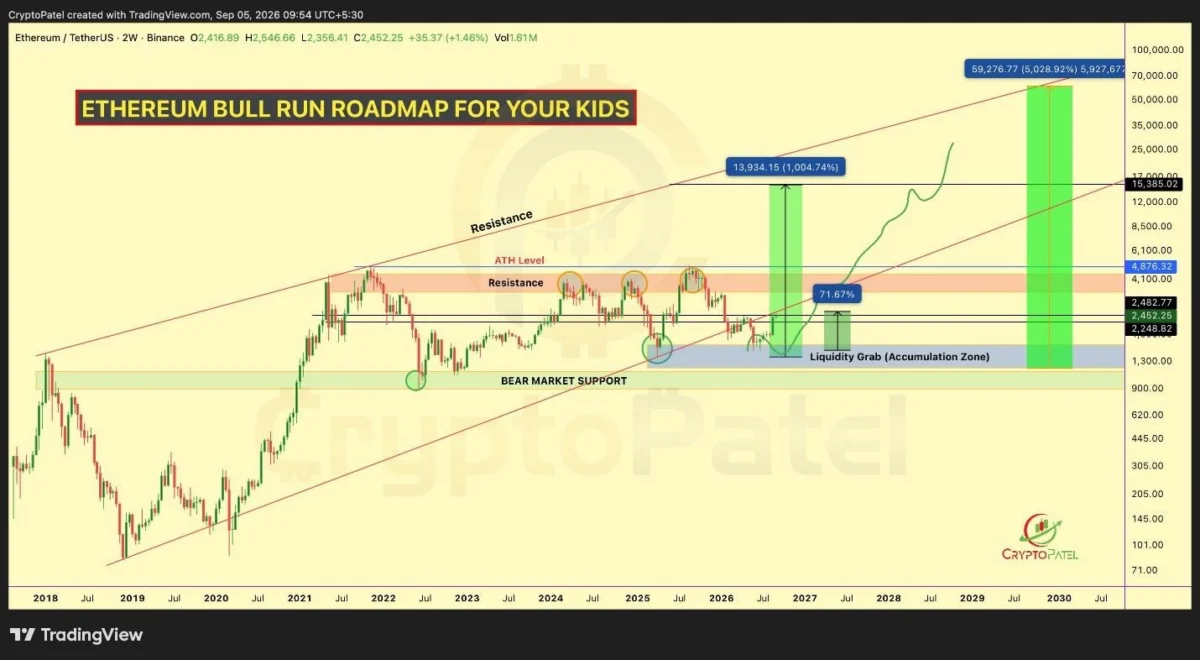
In a more ambitious projection, Crypto Patel maintains a bullish long-term outlook, forecasting that Ethereum’s trajectory could eventually extend well beyond $15,000. Patel views significant price dips not as reasons for long-term holders to lose conviction, but rather as valuable accumulation opportunities. This perspective suggests a belief in Ethereum’s fundamental value and its potential for sustained growth over an extended period.
Implications of Exchange Outflows
The significant outflow of ETH from exchanges, amounting to nearly $300 million, carries several potential implications for the market. Firstly, it directly reduces the readily available supply on centralized trading platforms, which can influence price dynamics by decreasing immediate selling pressure. This is particularly relevant in a consolidation phase, as it could amplify the impact of any incoming buying demand.
Secondly, large outflows can be interpreted as a sign of increased investor confidence and a preference for self-custody. Many investors choose to withdraw their assets from exchanges to hold them in personal wallets, often indicating a long-term holding strategy or a belief in the asset’s future appreciation. This "hodling" behavior can further tighten the circulating supply available for short-term trading.

Historical Context and Market Sentiment
The current market scenario for Ethereum can be viewed within the broader context of its performance following significant network upgrades and market events. Ethereum has demonstrated resilience and recovery in the past, with its price often reacting to developments such as the successful implementation of the Merge (transition to Proof-of-Stake) and subsequent protocol enhancements.
The ongoing debate about potential Ethereum ETF approvals in major financial markets also continues to be a background factor influencing investor sentiment. While recent news has focused on specific exchange outflows, the underlying anticipation of broader institutional adoption remains a significant influence on long-term price expectations.
Navigating the Resistance Zone
As of the latest reporting, Ethereum was trading at $2,436, marking a 2.89% decrease over the preceding 24 hours. Despite this minor dip, the overarching trend of significant exchange outflows adds a layer of bullish intrigue to the current consolidation. The critical factor moving forward will be how buyers respond to the key resistance zone between $2,520 and $2,550. A decisive upward breach of this area, supported by continued demand and potentially sustained exchange outflows, could signal the beginning of a new upward trend. Conversely, a failure to overcome this resistance could lead to a retest of lower support levels, potentially within the $2,350 to $2,370 range.
The market is keenly observing whether the reduced exchange supply will translate into tangible price appreciation, making the upcoming price action around these resistance levels a pivotal moment for Ethereum’s short-term trajectory. The interplay between technical indicators, on-chain data, and broader market sentiment will ultimately determine Ethereum’s next significant move.