Ethereum has entered a consolidation phase, trading just below the $2.5K mark, following a robust recovery from its previous lows around the $1.5K level. This period of price stabilization occurs amidst persistent tests of the upper boundary of its recent trading range and a notable decline in exchange reserves, suggesting a potentially constructive supply-side environment for the leading altcoin. The technical landscape, coupled with on-chain metrics, indicates a market at a critical juncture, with key levels poised to dictate its next significant price movement.
Ethereum’s Technical Trajectory: A Shift from Recovery to Consolidation
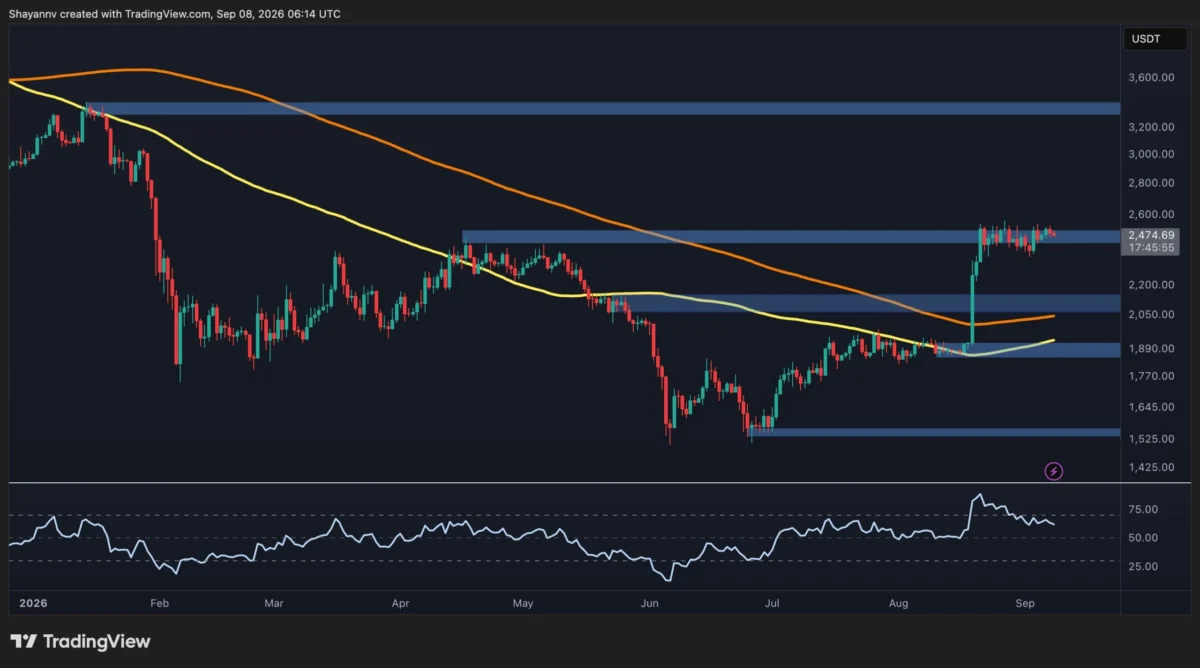
The daily chart for Ethereum (ETH) reveals a significant improvement in its structural integrity over recent weeks. The cryptocurrency successfully broke through a prolonged base around the $1.9K zone, subsequently reclaiming the $2.1K area, which had previously acted as a formidable resistance barrier. This breakout was characterized by a sharp, near-vertical ascent from approximately $1.9K to the $2.5K vicinity.
Currently, ETH has established itself above its 100-day and 200-day moving averages, both of which are exhibiting an upward trend. This technical development is a strong indicator that the broader market trend is transitioning from a recovery phase toward a potentially bullish structure. However, the cryptocurrency is now navigating a significant resistance zone, roughly between $2.4K and $2.5K, with its current trading price hovering near $2.47K. Multiple attempts to decisively breach this ceiling on a daily basis have been met with resistance, marking it as a crucial level to monitor. A sustained move above $2.5K could pave the way for further upward momentum, potentially targeting the next significant resistance at approximately $3.3K.
On the downside, the former breakout area around $2.1K now serves as the first key support level. As long as ETH maintains its position above this threshold, the recent positive structural improvements are likely to remain intact. The daily Relative Strength Index (RSI) also warrants attention. While it has significantly recovered from the deeply oversold conditions observed during the June lows, it has recently retreated below the traditional overbought threshold. This suggests that the market may be entering a period of consolidation or a minor correction as it seeks to cool off and allow for the emergence of fresh buying pressure.
The 4-Hour Chart: A Defined Trading Range
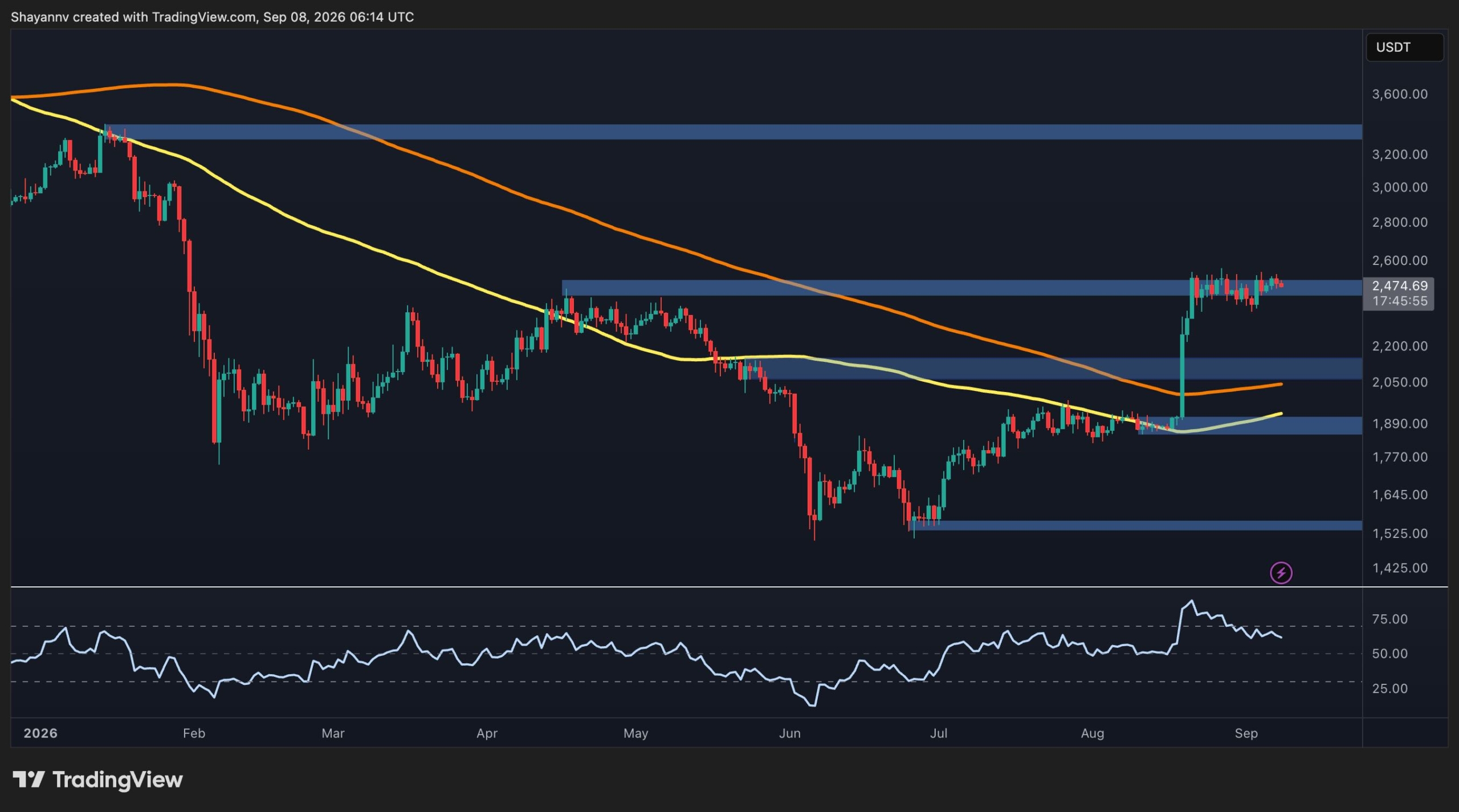
Examining the 4-hour chart provides a more granular view of Ethereum’s current consolidation pattern. Following its rapid ascent from the $1.9K area, ETH has been trading sideways within a defined range, approximately between $2.35K and $2.55K. The repeated rejections from the upper boundary of this range, specifically around $2.45K-$2.5K, indicate that sellers remain active in this price zone. Conversely, buyers have demonstrated consistent defense of the lower boundary, situated near $2.35K-$2.4K.
At present, ETH is positioned near the midpoint of this range, reflecting a degree of indecision within the market. This sentiment is also mirrored in the 4-hour RSI, which is hovering around the 50 mark, a neutral indicator. A confirmed breakout above the $2.5K resistance level would significantly strengthen the case for a continuation of the bullish trend, potentially unlocking higher resistance levels. Conversely, a decisive break below the $2.4K support level could signal that the current consolidation is evolving into a deeper correction, with the $2.25K demand zone emerging as the next critical area of interest for traders and investors.
On-Chain Dynamics: Declining Exchange Reserves as a Bullish Undercurrent
Complementing the technical analysis, the on-chain data, particularly regarding Ethereum’s exchange reserves, presents an intriguing backdrop. Ethereum’s total exchange reserves have experienced a steady decline, falling from over 21 million ETH during 2025 to approximately 14.9 million ETH as of recent data, even as the price has recovered towards the $2.4K level.
Exchange reserves represent the total amount of ETH held on centralized cryptocurrency exchanges. A consistent decrease in this metric is generally interpreted as a sign that fewer ETH are readily available on exchanges for immediate selling. While this metric alone does not definitively prove that investors are accumulating ETH, a sustained decline typically indicates a tightening supply environment.
The divergence between the price recovery and the declining exchange reserves is particularly noteworthy in the recent market data. As ETH has mounted a significant recovery from its earlier lows, exchange reserves have continued their downward trend. This suggests that the supply available for sale on exchanges has not kept pace with the upward price movement.
From a market structure perspective, this scenario can be supportive for further price appreciation if demand continues to grow. With a reduced supply of ETH accessible on exchanges, any sustained increase in spot demand could potentially exert upward pressure on the price. However, it is crucial to view the declining reserve trend as a supportive factor rather than an isolated bullish signal. It suggests a potentially favorable supply-demand dynamic, but it must be considered in conjunction with other market indicators and broader macroeconomic factors.
Broader Context and Historical Precedents
Ethereum’s journey to its current consolidation phase is part of a larger narrative within the cryptocurrency market. Following a significant market downturn in late 2025 and early 2026, which saw ETH dip to around $1.5K, the asset has been in a recovery mode. This recovery has been driven by a confluence of factors, including broader market sentiment shifts, anticipation surrounding upcoming network upgrades (such as further developments post-Merge), and increased institutional interest in the digital asset space.
The $1.9K to $2.1K range previously acted as a psychological and technical barrier, its reclamation marking a significant turning point in sentiment. The subsequent sharp ascent towards $2.5K demonstrated strong buying conviction, but the inability to decisively break this resistance highlights the presence of profit-taking or cautious selling pressure from investors who may have entered at higher price points.
The decline in exchange reserves is not an unprecedented phenomenon during periods of sustained price recovery in cryptocurrencies. Historically, when investors are confident in the future appreciation of an asset, they tend to withdraw their holdings from exchanges and move them to cold storage or self-custody wallets, reducing the readily available supply. This was observed during previous bull cycles for Bitcoin and Ethereum. The current trend in ETH reserves aligns with this historical pattern, suggesting a degree of long-term confidence from a segment of the holder base.
Implications and Future Outlook
The current consolidation phase for Ethereum presents both opportunities and challenges for market participants. The key resistance at $2.5K remains the immediate hurdle. A successful breach and sustained hold above this level could trigger a cascade of buying orders, potentially accelerating the price towards the $3.3K target. This scenario would likely be reinforced by continued positive developments in the broader crypto market, favorable regulatory news, and sustained inflows into ETH-based investment products.
Conversely, failure to break above $2.5K and a subsequent breakdown below the $2.4K support could signal a retracement. In such a case, the $2.25K demand zone would become a critical area to watch. A dip to this level might offer a new accumulation opportunity for investors who believe in Ethereum’s long-term potential, provided that the underlying fundamentals remain strong.
The ongoing decline in exchange reserves, while a supportive factor, needs to be monitored closely. If this trend reverses significantly or if selling pressure on exchanges intensifies without a corresponding increase in demand, it could negate the positive supply-side narrative.
The Relative Strength Index (RSI) hovering below overbought territory on the daily chart suggests that there is still room for price appreciation without the immediate risk of overheating. However, the indecision on the 4-hour chart indicates that short-term price action could be volatile as the market digests the current price levels and awaits a clearer directional signal.
In conclusion, Ethereum is in a delicate balance, poised between continued ascent and potential correction. The $2.4K-$2.5K resistance zone is the critical battleground. The confluence of improving technical structure, a defined trading range, and a tightening supply indicated by declining exchange reserves paints a nuanced picture. Investors and traders will be closely watching for a decisive breakout above $2.5K to confirm further bullish momentum, or a breakdown below $2.4K to signal a potential shift towards a more significant correction. The coming days and weeks will be crucial in determining Ethereum’s next significant price trajectory.